Translating Answer Engine Impressions Into the Financial Language CFOs Already Trust
AI search visibility directly shapes pipeline and revenue that finance already values today.

Board-ready ROI reporting for AI search optimization translates visibility metrics into three financial measures, namely pipeline contribution, revenue-at-risk, and cost-per-acquisition. Answer engine impressions support an investment case only when they connect to CRM outcomes, existing revenue exposure, and acquisition costs that finance can compare with other channels. The task is not to persuade CFOs to value a new marketing metric, but to show what that metric means for an existing financial decision.
Why CFOs reject AEO metrics — and what it costs when they do
A marketing leader puts an improving citation rate on a budget-meeting slide, but the CFO remains unmoved. The slide shows visibility without showing what it is worth to the business. Finance evaluates spending against pipeline contribution, acquisition efficiency, and revenue exposure, whether the request concerns paid search, events, or headcount. An answer engine optimization pitch expressed only in impressions or share of model leaves that comparison unfinished.
The consequences extend beyond an unsuccessful presentation. Programs stall at pilot budgets, teams lose headcount, and competitors that secure investment can compound their visibility advantage. Writer’s 2026 enterprise guide describes buyers forming “silent shortlists” in AI conversations before visiting a website. The budget conversation needs to show what this channel, which buyers already use, means for the business in financial terms.
The three financial constructs that belong in every AEO conversation with finance
Pipeline contribution connects channel activity to deals in the CRM. It answers whether an investment is worth starting by showing the revenue opportunities it generates or touches. The distinction between generated and influenced pipeline is important because the two claims describe different contributions. Finance needs to know which claim the evidence supports.
Revenue-at-risk quantifies existing business exposed to a change in buyer behavior or competitive position. It makes the cost of inaction explicit. Rather than asking only what new revenue an investment might create, this construct asks what revenue could erode without it. That helps finance decide how much to spend to protect revenue and whether to keep funding an existing program.
Cost-per-acquisition measures the expense of bringing in a customer through a channel. It answers whether the investment is efficient relative to alternatives such as paid search and events. The comparison needs a common outcome, namely an acquired customer. These are familiar financial tests.
What AEO metrics actually measure, before any translation happens
Brand mention rate measures how often a brand appears in AI responses across a tracked prompt set. Recommendation rate measures how often the answer positions it as the preferred choice. Those are not interchangeable signals of buyer consideration. A brand can appear often without earning a recommendation, so more mentions alone cannot show that buyers are more likely to buy. Writer’s guide describes share of model, coined by Jack Smyth and Tom Roach, as a measure of how often a brand appears in AI answers compared with competitors.
Prompt coverage measures the share of high-intent buyer queries for which the brand appears at all. It identifies where the brand participates in buyer research. An uncovered prompt marks a conversation from which it is absent, making coverage useful for understanding pipeline exposure. Visibility volatility adds a different dimension by measuring stability across model updates and query variations. A volatile citation profile represents fragile visibility.
These measurements also need an engine-specific view. Citation rates can differ across ChatGPT, Perplexity, Gemini, and Claude, so an aggregate can hide a weak position on one platform. The guide explains that AI synthesizes a brand’s reputation across third-party sources as well as its website. Different mixes of signals can thus change how visible a brand is. The raw measurements already exist, and the remaining work is to connect them to financial outcomes without treating visibility itself as revenue.
Translating mention rate and share of model into pipeline contribution
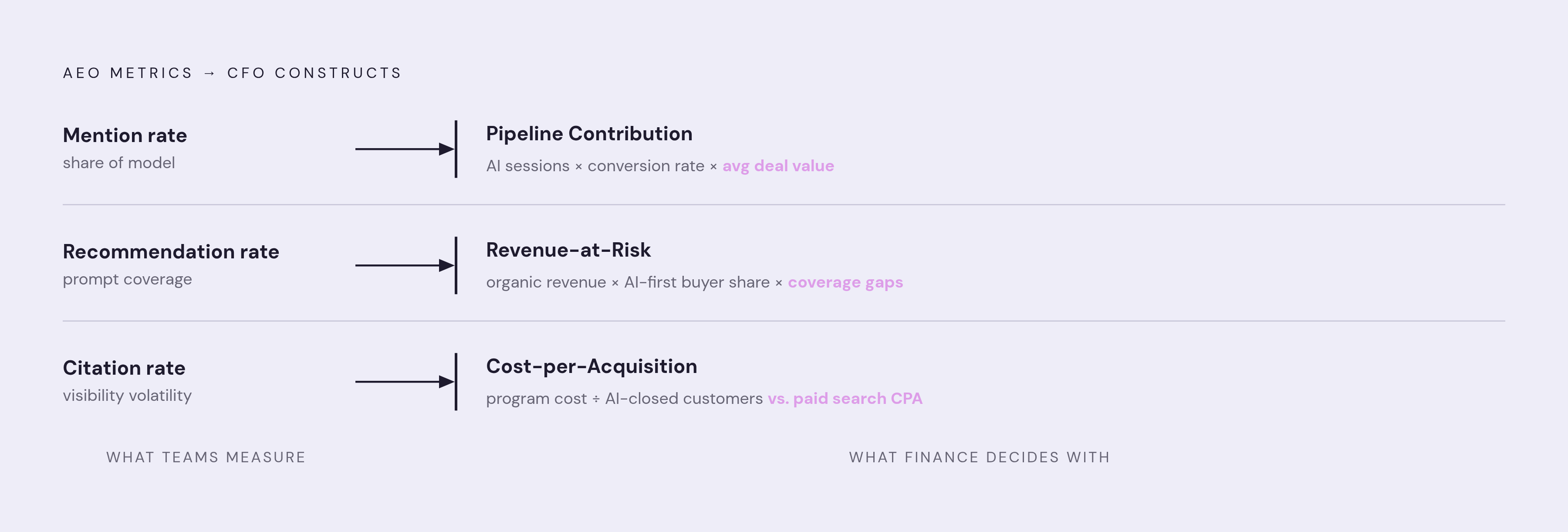
The practical translation starts with measured referral activity. Mention rate, recommendation rate, and share of model describe presence in answers, but they do not convert directly into dollars. To estimate pipeline, multiply AI-referred sessions by the observed AI conversion rate and then by average deal value. This is the same formula structure used to evaluate other acquisition channels. Its credibility depends on defining the conversion event precisely.
For a pipeline estimate, the conversion rate must connect sessions to the opportunities being valued. A trial conversion is not a closed customer. If the conversion measure stops at trial signup, the CRM must show how those signups lead to opportunities before they count toward pipeline. Average deal value then puts a financial value on those opportunities.
Discovered, also known as Discovered Labs, provides a concrete example of traceable activity. Its 2026 AEO case study describes growing a B2B SaaS client from 575 to more than 3,500 trials per month in seven weeks through AEO-optimized content targeting buyer-intent queries on ChatGPT, Claude, and Perplexity. UTM-tagged referral sessions and CRM attribution made the downstream pipeline impact traceable. The trial increase establishes acquisition activity, while the attribution trail connects that activity to the financial calculation.
Combine UTM-tagged AI referrals with self-reported attribution in lead forms and closed-loop CRM reporting. These records link AI-sourced leads to opportunities and won deals through audit trails that finance already accepts. If AI-referred leads demonstrably close at a meaningfully higher rate, modest traffic can generate a substantial pipeline contribution.
Framing AI invisibility as revenue-at-risk, not just a visibility gap
The defensive case begins with revenue already associated with organic search. It asks what share of that business is exposed as buyers move their initial research into AI assistants. MAXAEO’s CFO template frames this migration as a threat to existing organic revenue, rather than simply an opportunity to acquire additional traffic. That changes the starting point for the calculation.
To quantify the exposure, take a defined organic revenue or pipeline figure and estimate the fraction associated with buyers who now begin research in AI. The resulting amount represents exposure to displacement. Revenue and pipeline must remain distinct throughout the calculation. A pipeline-based estimate describes pipeline at risk, while a revenue-based estimate describes revenue at risk. The exposed share depends on how far the relevant buyer personas have moved toward AI-first research.
An AI answer names a small number of brands, creating a more concentrated, winner-take-most dynamic than traditional search. When a competitor receives the recommendation and the brand does not appear, the brand is absent from that conversation.
For finance, the implication is a measurable defensive investment case. Existing organic attribution shows how much business is at stake, while evidence of how buyers research shows the share that is exposed. Coverage and recommendation gaps then show where the brand lacks a position in those conversations. The estimate should distinguish exposure from realized loss and make its assumptions visible.
Building the AEO cost-per-acquisition comparison that finance will actually use
The AEO acquisition calculation divides monthly program cost by AI-attributed closed customers in the period. Program cost includes platform and content spending. The customer denominator gives finance an acquisition comparison, with trials, MQLs, and opportunities representing different conversion events. Paid search provides an existing benchmark with the same basic structure. Using the same outcome and period helps finance compare where to put the budget.
The case for lower costs depends on how the program performs. If AI-referred leads close at a materially higher rate than paid search leads, AEO can produce a lower acquisition cost even after platform and content costs are included. MAXAEO’s template shows how that outcome can lower blended customer acquisition cost even as top-line traffic falls. Traffic growth is therefore not a prerequisite for efficiency.
The same variables also establish a break-even point. Dividing the monthly AEO program cost by the known paid search CPA gives the customer volume needed for acquisition-cost parity. The observed AI-referral-to-customer conversion rate then connects that customer requirement to referral volume. No universal traffic target is necessary for this calculation. The marketing team can use its own costs, conversion performance, and paid search benchmark.
A phased program makes that comparison easier to evaluate over time. The template proposes an AI readiness audit in months 1–2, targeted content optimization in months 3–6, and continuous monitoring as the third phase. Each phase has a defined cost and expected output. Finance can therefore assess progress quarter by quarter. The structure ties spending to evidence as the program develops.
What metrics should go in a board-ready AEO measurement stack?
A CFO-ready report brings the three financial translations into one view. It shows AI-referred pipeline contribution, estimates of how much revenue exposure has been reduced or revenue protected, and how AEO acquisition cost compares with paid alternatives. These outputs belong at the same cadence and in the same format as other channel reports. That makes it easier to compare this investment with others in the portfolio. Any estimate of protected revenue must remain distinguishable from observed closed revenue.
The supporting measurements form a separate explanatory layer. Citation rate, share of model, and prompt coverage by engine help explain changes in AI-attributed MQLs, MQL-to-opportunity rate, closed-won outcomes from AI referrals, and AEO customer acquisition cost. The financial layer states the business result. The marketing layer helps account for it, without substituting improving visibility for proof of pipeline or acquisition efficiency.
Platform-level reporting preserves information that a blended visibility score can erase. Writer’s guide notes that only a small minority of domains are cited by both ChatGPT and Perplexity and recommends tracking each platform separately. A strong overall score can otherwise conceal limited coverage in an engine buyers use. Attribution then connects the platform view to outcomes through UTM-tagged sessions, self-reported lead-form responses, and CRM tags extending to closed revenue.
How to present the AEO business case in a capital-allocation meeting
For the presentation itself, the recommended order is risk, pipeline contribution, and acquisition efficiency. The presentation should open with the defined organic revenue exposure and the assumptions used to estimate it. Then show the AI-attributed pipeline evidence that supports an investment response. Close the financial argument with CPA against paid search.
The investment request should follow the same discipline. MAXAEO’s template frames AEO as a strategic pivot to mitigate revenue risk. A small initial audit can produce the quantified risk and opportunity baseline needed for a larger request. Subsequent spending then rests on inputs finance has evaluated.
The Discovered case demonstrates that buyer-intent content can generate attributable trial growth where a mature SEO program had stopped delivering that growth. Another company’s conversion rate and acquisition cost must come from what the proposed program itself tracks. The blended CAC comparison belongs on the penultimate slide, where it can answer the expected paid search benchmark objection directly.
The competitive clock is already running during this budgeting work. Buyers keep using AI answers to decide which brands they prefer, while competitors with funded programs can become more visible. The early-mover advantage most teams have not yet claimed is the ability to translate AI visibility into finance’s language soon enough to secure investment while those preferences are still being formed.


