Integrating AEO Into an Existing SEO Editorial Calendar
Adapt your SEO calendar with decision rules, not new stages, to win AI visibility.

You don't need to tear down your existing SEO editorial calendar to integrate AEO into it. The calendar already performs the hardest parts of the work: topic research, publishing cadence, content review cycles, and cross-functional sign-off between writers, editors, and subject-matter experts. It does not need new stages bolted onto that process. It needs decision rules added to the stages already running.
This matters because SEO, AEO, and Generative Engine Optimization (GEO) are converging, so a team's existing SEO investment has direct upstream value for AI visibility. When a large language model picks pages to cite in an answer, quality backlinks, established site authority, and a deep bench of indexed content all feed into that choice. Teams that have spent years building that foundation are not starting from zero on AI visibility. They are starting with a structural advantage they simply haven't activated yet.
The three-layer visibility model, SEO for rankings and clicks, AEO for direct answers in featured snippets and AI Overviews, GEO for citations inside tools like ChatGPT, Perplexity, Claude, and Gemini, describes three compounding effects. One editorial calendar can serve all three at once, if it carries the right modifications. The calendar most teams run today was built for a click-through world. It doesn't yet encode answer-intent targeting, AI-citation formatting, or recency signals as explicit production requirements. Those gaps, not the calendar itself, are what the rest of this piece closes.
What AI search has changed about content discovery
AI search has become the front door to buyer research, and that shift changes what an editorial calendar has to account for before a single topic gets greenlit. By mid-2026, buyers routinely form what practitioners call "silent shortlists," preferences built inside AI conversations before the buyer ever visits a brand's website. Content that doesn't surface in an AI-generated answer is invisible at precisely the moment a buyer's decision is taking shape, no matter how well that content ranks on a traditional search results page.
The surfaces a brand now needs to win have multiplied. AEO targets featured snippets, knowledge panels, and AI Overviews. GEO, meanwhile, targets the citations and recommendations that show up inside conversational AI platforms. Each surface carries its own content requirements, and both can be planned for inside a single calendar.
GEO in particular is a game of scarcity. Large language models cite a limited, selective set of domains in any single response, and that number varies by engine, running as low as two to four sources for engines like ChatGPT and Claude and climbing to five, twelve, or more for Perplexity. When an AI engine names a brand inside its answer, it delivers an implicit endorsement that no organic search listing can replicate. That scarcity is also why cross-platform planning matters: ChatGPT, Perplexity, Claude, and Gemini behave as distinct surfaces with distinct citation logic, and a brand earning citations on one does not automatically earn them on another. Share of model, the measure of how often a brand appears in AI-generated answers relative to its competitors, has become the AI-era successor to share of voice. Unlike paid share of voice, share of model is earned through content quality and authority signals, not bought.
A more fundamental change in what counts as a successful piece of content drives all of this. Traditional SEO was built to deliver a click. GEO operates on a different premise: the goal is to be named, cited, or synthesized inside an AI-generated response, often with no click involved. An editorial calendar now has to plan for both outcomes at once, not choose between them.
What AEO requires at the content level
AEO optimization lives primarily at the structural and formatting level of an individual piece of content, not at the level of topic selection. That makes it fundamentally a production-stage discipline, one that slots into an editorial workflow a team already runs.
The foundational requirement is answer-first structure. AEO content is built to be extracted and presented without forcing a reader, or an AI system, to click through to get the point. In practice, that means every major section of an article needs to open with a direct, self-contained answer, then expand into supporting detail and nuance. It should not build toward a conclusion the way a feature story or a traditional SEO piece often does.
Authority signals matter just as much as formatting, and they extend well beyond what happens on the page. Brand-owned blogs, press releases published on a company's own domain, and sponsored placements are largely invisible to AI citation engines. These systems were trained to recognize the same credibility signals editors have always relied on: coverage from a respected third-party publication, earned without a financial relationship, functions as a genuine endorsement, and AI engines weigh it accordingly. The underlying data reinforces this pattern. Earned media works as a primary upstream supply chain for AI citations, but brand-owned content published in isolation does not, so PR coordination needs to sit inside the content calendar as a requirement, not run as a separate initiative by a different team. Princeton research found that if you add citations, statistics, and expert quotes to a piece of content, its visibility in AI search meaningfully improves compared with unoptimized content covering the same topic.
Technical access is a precondition that has to be confirmed before any of this production work pays off. Structured data and schema markup help AI models generate more accurate results from a brand's content, and that access has to be verified during an audit, before editorial teams invest in production changes that an inaccessible site will never surface. None of this demands an unfamiliar skill set. The content characteristics AI systems favor, clear, factual, well-sourced, logically structured writing, are the same characteristics strong editorial judgment has always produced. That overlap is why integration is possible without a teardown.
The pre-publication audit: where to add AEO criteria before a new topic enters the calendar
Answer-intent targeting belongs at the topic-selection stage, not after a draft has already been written. Adding it here, before a topic formally enters the calendar, prevents the kind of structural rework that happens when a finished piece has to be retrofitted for AI visibility after the fact.
So the AEO layer adds two questions to whatever scoring rubric a team already uses to evaluate topics. First, does the query have a clear, extractable answer, the kind of "what is," "how to," or "which is best" framing that an AI engine is likely to synthesize into a direct response? Second, is there a realistic path to third-party coverage or citation for this topic, or is it inherently brand-promotional? AI citation engines largely can't see promotional content on a brand's own domain, so if a topic can't attract independent editorial coverage, it will underperform on AI surfaces no matter how well it's written.
The content brief is where AEO formatting requirements get specified, ahead of a writer's discretion mid-draft. A strong brief should spell out a direct-answer opening for each major section, a requirement for original data or expert quotation, any schema markup needs, and the specific AI surface the piece is being optimized for, whether that's an AI Overview, a ChatGPT citation, or a Perplexity source. Because GEO is primarily a third-party game, where a buyer asking an AI platform which brand to trust gets an answer synthesized from industry publications, analyst reports, consumer reviews, and earned media rather than from the brand's own homepage, the brief should also include a PR or outreach component for any piece targeting AI citation. That's a publishing instruction a calendar can carry just as easily as a word count or a due date.
One technical audit should happen once, before a team integrates AEO into the calendar. AI crawler access needs to be confirmed in robots.txt. Existing high-traffic pages should be audited for answer-first structure, structured data, and citation-ready formatting, since these are the pages most likely already in contention for AI citation and the fastest to improve. And the brand's current presence across major AI platforms should be checked to establish a share-of-model baseline before any new content goes live, so later progress has something to be measured against.
The production stage: where AEO formatting decisions get made during writing and editing
AEO at the production stage is a set of formatting and sourcing decisions made during drafting and editing, not a separate pass or an additional deliverable layered on top of the existing process. For writers, the core habit change is answer-first structure applied at the section level: each H2 or H3 should open with the direct answer before elaborating, so that key information can be extracted and used without forcing a click-through. This runs counter to the traditional inverted-pyramid approach many SEO writers were trained on, which often builds context first and delivers the point later. Writers who understand that distinction can apply it without additional training, because it's a reordering of information, not a new skill.
Editors carry a matching responsibility: they need to add AEO-specific items to a review checklist that already covers style and traditional SEO. An editor should confirm that each major section leads with a self-contained answer a reader, or an AI system, can pull out and use without reading further. The piece needs at least one original data point, an external citation, or a named expert quotation, because Princeton research shows this kind of addition measurably improves AI visibility. Any structured data specified in the brief needs to be implemented and confirmed before the piece publishes, not left for a later technical pass. And the PR or outreach component specified in the brief needs to be coordinated before publication, not scheduled as an afterthought once the piece is already live.
Length and format decisions should also be calibrated to the specific AI surface a given piece targets, because ChatGPT, Perplexity, Claude, and Gemini favor different content signals and structural choices. A piece built to earn a Perplexity citation isn't necessarily structured the same way as one aimed at an AI Overview, and the brief written during planning should have already specified which surface the production team is building toward, making these execution decisions during editing.
Finally, during production, the line between promotional and editorial content is a hard rule, not a style preference an editor can waive. Promotional wire releases stuffed with keywords work against AI visibility, while genuine, independently reported editorial coverage, structured and factual, is what AI engines treat as credible. That means brand-owned content aimed at AI citation has to read and source itself like independent editorial work: factual, specific, citation-rich, and useful to a reader who has no prior relationship with the brand.
The post-publication review: how to add AEO performance signals to the refresh and reporting cycles teams already run
AI visibility is not a publish-and-forget outcome. It demands the same structured review cadence that traditional SEO has always required. Most editorial calendars already run that cadence, so the infrastructure for this stage already exists too.
AI citation carries a recency sensitivity that traditional SEO rankings don't share to the same degree, and that sensitivity should be encoded into the calendar as a specific refresh trigger. When a page was last updated becomes an AEO metric in its own right, not simply a routine maintenance note buried in an SEO audit.
At the post-publication review stage, a team needs to add three AEO-specific questions alongside the traffic and ranking checks it already runs. Is the page being cited by AI engines, tracked through citation monitoring across ChatGPT, Perplexity, Claude, Gemini, and AI Overviews? Has the brand's share of model shifted on the queries the content was built to influence? And do new inaccuracies or outdated claims about the topic appear in AI-generated answers, which would mean an upstream source needs correction? Brand hallucination risk, wrong pricing, fabricated features, outdated positioning repeated back by an AI system, is a standing post-publication monitoring responsibility, not a concern that gets closed out at launch.
Reporting for AEO also calls for a different signal set than traditional SEO reporting has used. Share of model, the measure of how often a brand appears in AI-generated answers relative to competitors, is the primary metric for AI search visibility, so add it alongside traffic and ranking data in every content performance report going forward. Attribution for AI-influenced pipeline requires triangulating multiple signals at once: citation tracking, analysis of direct traffic anomalies during periods when citations increase, and self-reported attribution captured through CRM data. Click-through data alone can't show you how AI-influenced buyer behavior moves through a funnel.
Where teams should start with the integrated calendar
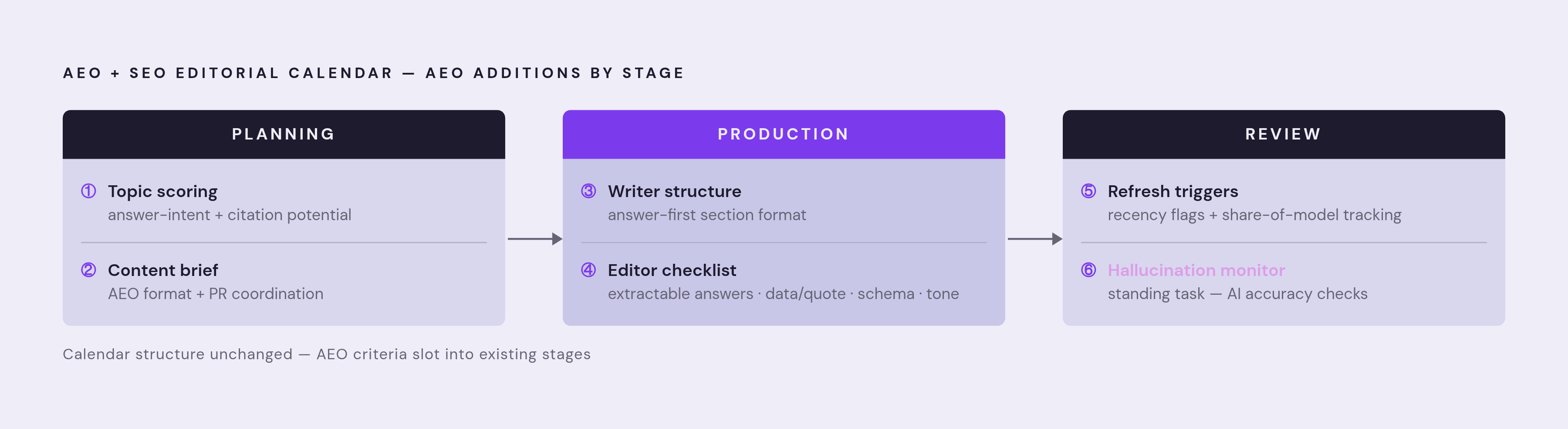
The integrated AEO-plus-SEO editorial calendar looks nearly identical to the one most teams already run. The difference sits in the decision rules applied at each stage, not in any change to the calendar's underlying structure.
At the planning stage, topic scoring gains answer-intent and third-party-citation-potential criteria, content briefs specify AEO formatting requirements and PR coordination needs, and a one-time technical audit confirms AI crawler access and schema readiness before any of it matters. At the production stage, writers apply answer-first section structure, editors add AEO checklist items covering extractable answers, original data or expert quotation, schema implementation, and editorial versus promotional tone, and PR coordination gets confirmed before publication. At the review stage, refresh triggers add recency-based AEO risk alongside the traditional SEO signals already tracked, performance reports add share-of-model data alongside traffic and rankings, and hallucination monitoring runs as a standing task, not a one-time check.
The right place to start is not new content. Sites with strong existing authority profiles are significantly more likely to be cited by AI engines than sites with minimal backlinks. The pages already ranking well represent the fastest path to AI citation. Retrofitting the strongest existing pages with answer-first structure, citations, and schema markup will produce faster AEO results than standing up a parallel content track from scratch.
Most small and mid-size businesses have not yet started GEO or AEO work in any organized way, which leaves a real first-mover opportunity for brands willing to act now, and teams that move do so with an existing SEO foundation already in place, the hardest part to build from nothing. Integrating AEO into the editorial calendar is a series of explicit decisions inserted into the planning, production, and review stages a team is already running. The calendar is the infrastructure. AEO is the layer.


