AI Citation Outreach and Digital PR Tactics for Third-Party Endorsement
Brands must build reputation across earned media to appear in AI citations.

When a buyer asks an AI system which brand to trust in a category, the answer is not drawn from that brand's homepage. It is synthesized from industry publications, analyst reports, consumer reviews, trade press, and earned media. The strategic consequence is significant: AI citation is fundamentally a third-party game, and it demands a fundamentally different outreach program.
Traditional SEO was a first-party discipline. Generative engine optimization operates on a different premise entirely. AI systems do not read a brand's website first. They read its reputation, as the Writer 2026 GEO guide frames the shift. That reputation is an aggregated external signal, built across sources you do not own and cannot directly control. A brand that only talks about itself may fail to get cited at all. A brand mentioned across credible publications, review platforms, partner pages, comparison articles, communities, case studies, podcasts, and expert content carries the external validation that AI systems are designed to retrieve.
The data makes the point starkly. Some 82% of AI citations come from earned media mentions, not brand-owned pages. Brands must proactively architect how AI platforms perceive and describe them, or risk being misrepresented or ignored. That architecture is built through outreach and digital PR, not through changes to a sitemap.
How AI systems decide what to cite — and why third-party sources dominate
AI citation behavior systematically favors earned, third-party sources over brand-owned pages, and this pattern holds across every major platform. The reason lies in how these systems are built. They are trained and retrieval-tuned to privilege sources that exhibit independence, corroboration, and structural clarity. A press mention or a community discussion reads as validation. A product page reads as a claim.
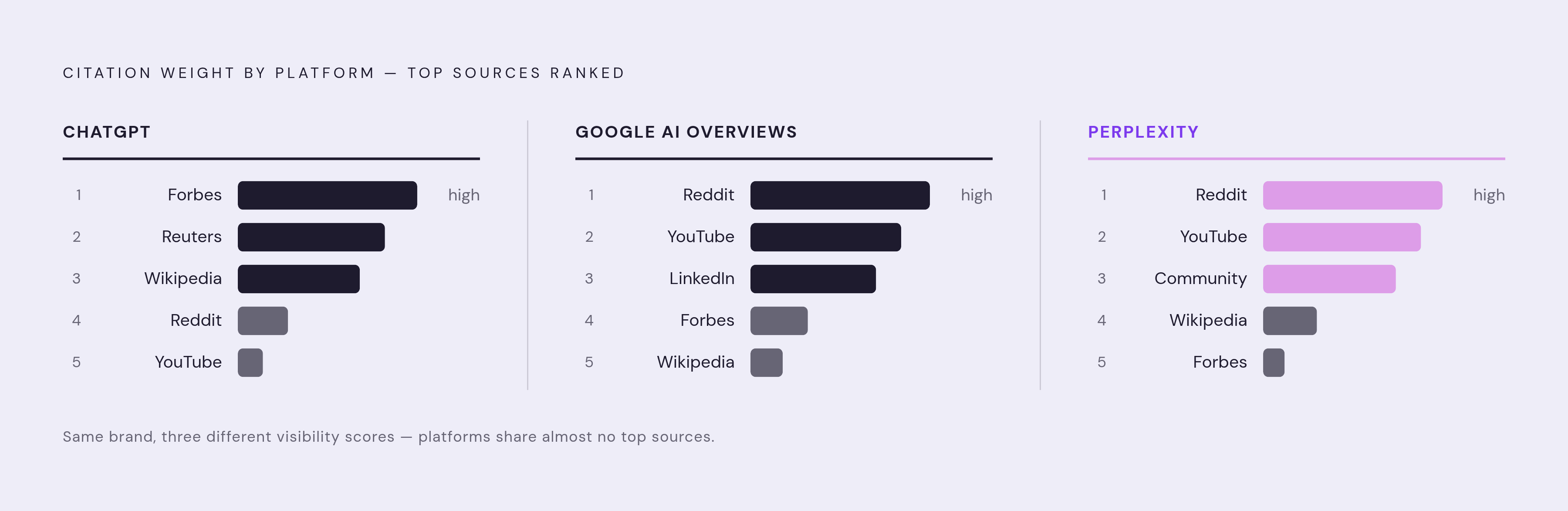
The retrieval preferences are not uniform, which means a single content strategy cannot satisfy every platform simultaneously. ChatGPT rewards traditional media citations, outlets like Forbes and Reuters, along with Wikipedia presence. Google AI Overviews prioritize community and video platforms such as Reddit and YouTube, with LinkedIn rising as a secondary source for professional queries. Perplexity emphasizes community sources, again Reddit and YouTube, with particular weight on peer-validated discussion. The same brand can hold meaningfully different share of voice on different platforms for identical queries, and the gap between the model that cites it most and the one that cites it least can be enormous. A brand prominent in ChatGPT may be nearly invisible in Perplexity, or the reverse.
Beneath these platform preferences sits a technical mechanism worth understanding. They break a user's prompt into sub-queries, retrieve passages from web sources or vector databases, and synthesize an answer from those fragments. The practical implication is that the content retrieved must rank for those decomposed sub-queries, not just for the original question a person typed. A well-ranked page on a brand's own domain that does not match the sub-query structure simply does not enter the synthesis window. Strong SERP performance is necessary but insufficient.
What "third-party endorsement" actually means as a citation signal
Third-party endorsement is not a diffuse concept. It is a taxonomy of specific signal types, each carrying a distinct weight in how AI systems evaluate a brand. The strongest signals are identifiable and actionable. Guest posts and bylines on authoritative publications place brand-attributed content inside high-authority domains that AI systems already retrieve. Original research that other sources cite compounds: each downstream reference adds a new external validation node. Brand mentions in trade and industry press signal relevance within a category. Presence on review and comparison platforms such as G2 and Clutch feeds the comparison queries that dominate buyer research. Community validation in relevant forums carries peer authority that models weight heavily on certain platforms. Podcast transcripts and video content indexed on authoritative hosts extend the retrieval surface into multimedia.
Together these signals form what functions as a citation network, a web of corroborating external references that AI engines recognize as a trust signal. A single mention is a data point. A pattern of consistent references across independent sources is the foundation of an entity's standing in a model's representation. This is why entity consistency matters so much. Conflicting foundational facts across third-party profiles, on LinkedIn, Crunchbase, G2, industry directories, and elsewhere, create confusion in how AI models build their understanding of a brand. When one source lists a founding date or a product description that contradicts another, the model weakens its confidence in all of them. The outreach program exists to shape that signal deliberately.
Building the outreach target list: which placements move the needle for AI citation
A citation-focused PR program does not begin with a media list. It begins with prompt coverage gap analysis. The first step is to identify the queries where the brand should appear but currently does not. For each gap, the next step is to trace which sources AI systems are actually citing in their answers to those queries. Those sources reveal the outreach target list. The methodology is operational rather than aspirational: find where the model already looks, then place accurate, authoritative brand content there.
Prioritization then follows citation yield, not traditional PR metrics like readership or domain authority. The real filter is whether AI systems are already retrieving from a given source for the brand's relevant queries. A trade publication with modest readership but heavy retrieval weight for a vertical query set is more valuable than a general-interest outlet that generates impressions but never enters a synthesis window.
The priority placement categories, ordered by citation yield, are identifiable. Industry trade publications and vertical media carry high citation weight across both ChatGPT and AI Overviews. They are the workhorse placements for category-specific queries. Community platforms and niche forums, Reddit, Quora, industry Slacks, are disproportionately influential for Perplexity's retrieval, where peer validation carries outsized weight. Podcast transcripts and video content on indexed hosts represent a growing retrieval surface, particularly for platforms that index multimedia sources. Each category serves a different platform profile, which is precisely why a multi-platform outreach strategy is a structural requirement rather than a matter of preference.
Digital PR tactics that generate the citation-quality coverage AI systems pull
The placements that move AI citation are not automatic byproducts of standard media relations. Citation-quality coverage requires a different pitch and a different content brief, one designed around the structural and authority signals that make a placement retrievable by AI. The tactics below each connect to a specific retrieval mechanic.
Original research as a citation engine
Research that generates citable statistics creates a compounding citation network. The structural requirement is non-negotiable: findings must include named statistics, clear methodology attribution, and quotable conclusions. Research pitches should be designed with the downstream citation chain in mind from the start: who will cover the study, which of those outlets AI systems retrieve from, and whether the study's framing maps to the queries where the brand needs to appear. A research program built backward from prompt coverage gaps is far more efficient than a study designed for headline appeal alone.
Guest bylines and contributed content
Guest posts on authoritative publications are among the strongest GEO levers available because they place brand-attributed content inside a high-authority domain that AI systems already retrieve. The content brief should require answer-first structure: the core claim stated early, supported by data and inline citations, mirroring the structure AI retrieval favors. Author credibility signals on the byline, a bio, credentials, a LinkedIn link, strengthen the E-E-A-T signals the host publication carries. The byline is not decorative. It is part of the entity resolution that models perform when weighing a source.
Newswires and correction velocity
AI crawlers ingest newswires rapidly. A well-structured press release on a reputable wire service can influence AI retrieval within days, which makes it function as a corrective mechanism as well as a proactive signal. The speed of wire ingestion makes this the fastest lever available, which matters when a brand needs to close a gap or counter a misrepresentation quickly.
Review and comparison platform cultivation
Actively soliciting reviews on G2, Clutch, and sector-specific aggregators builds the third-party validation layer that comparison-query responses draw from. The discipline here is systematic rather than occasional. A thin profile with two reviews is itself a signal, and not a favorable one.
Community participation and expert presence
Substantive participation in Reddit threads, industry forums, and Q&A platforms generates the kind of peer-validated mention that Perplexity retrieves at particularly high frequency. The discipline is quality over volume. A well-sourced, expert answer in the right community thread outperforms a dozen thin mentions, and the distinction is visible in how models weight authoritative contributions within those sources. This tactic requires subject-matter depth and genuine engagement. It is the least automatable part of the program.
Podcast and video appearances
Transcripts from podcast appearances create indexable, citation-quality text at a publication that already carries its own audience and authority signals. Video content on platforms AI systems index adds a retrieval surface that most brands have not yet optimized deliberately for AI citation. The combination is meaningful: a transcript gives a model quotable text, while the video source provides the platform authority that weights it.
How hallucination risk changes the outreach calculus — and what to do about it
A brand with thin or inconsistent third-party coverage is more vulnerable to AI hallucination because models fill information gaps with inference. When an AI system invents a product capability, a pricing figure, a personnel detail, or a policy statement, the root cause is typically one of two things. Either there is a gap in the brand's external information footprint, what practitioners call a parametric memory error, or a low-authority third-party source was retrieved and treated as canonical, known as RAG retrieval pollution. Both failure modes trace back to a deficiency in the external signal layer, which is precisely the layer that outreach builds.
The corrective mechanism is the same as the proactive one. Publishing authoritative content at high-authority external sources that AI crawlers retrieve rapidly overwrites the hallucinated assumption with a higher-trust signal. A brand cannot submit a guaranteed, brand-specific correction request. It can only improve the information models can access. That constraint reframes hallucination risk as an ongoing exposure managed through the same outreach program, rather than a discrete crisis handled by a different team.
Entity consistency across third-party profiles is a prerequisite for that defense. Conflicting founding dates, personnel records, or product descriptions across LinkedIn, Crunchbase, G2, Wikipedia, and industry directories create the conditions hallucinations exploit, because the model has no stable baseline against which to resolve contradictory fragments. The risk and the opportunity are coextensive, and they are managed through the same resource allocation.
Measuring whether the outreach program is actually producing AI citation
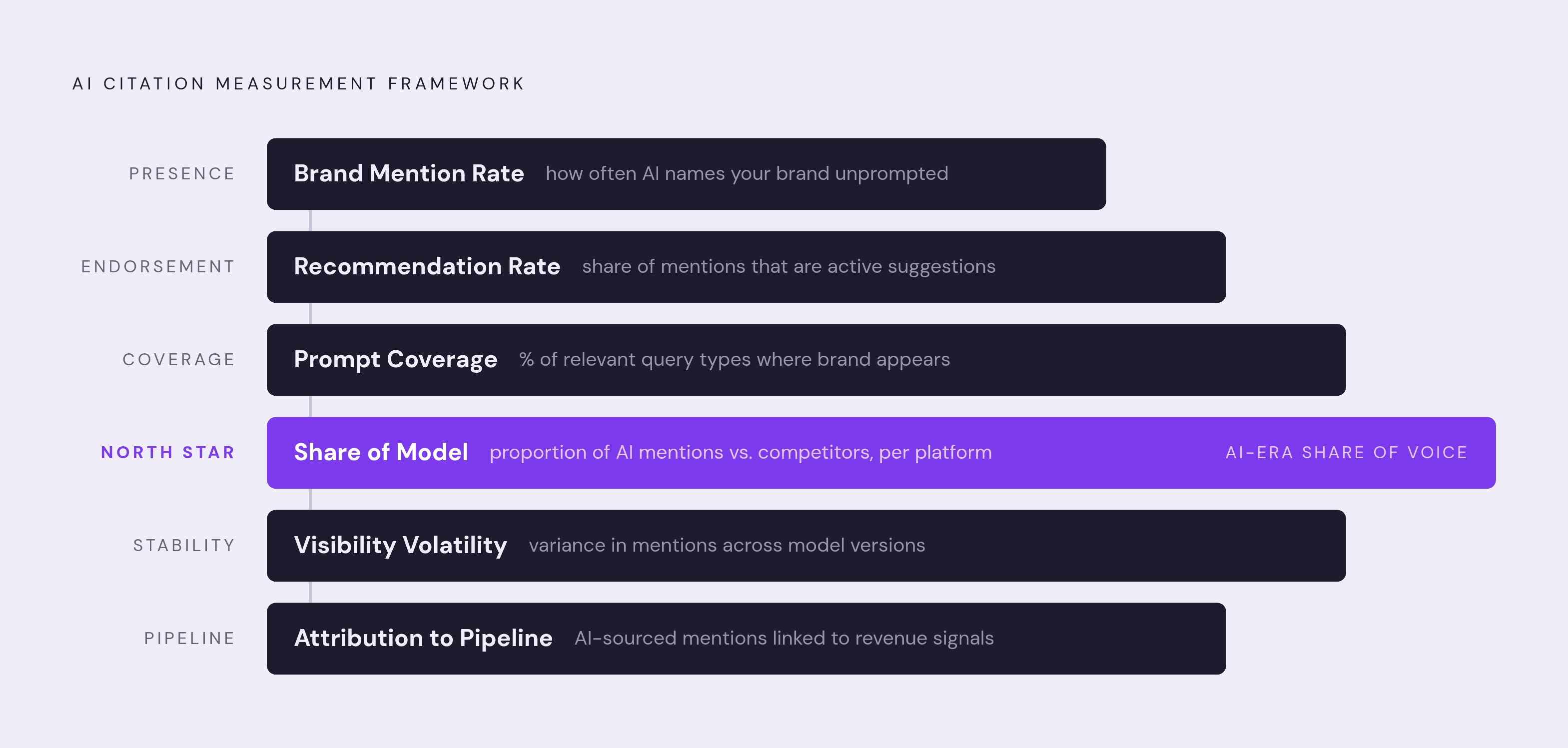
AI citation impact from a digital PR program is measurable, but it requires a different metrics framework than traditional PR measurement. Media impressions and referral clicks do not capture what is happening. The framework operates on citation frequency, share of model, and prompt coverage instead, and it is specific enough to make this a board-reportable program rather than a faith-based one.
The core metrics are six. Brand Mention Rate measures how often the brand appears in AI responses across a defined prompt library. Recommendation Rate goes a step further, measuring how often the AI actively recommends the brand rather than merely mentioning it. The distinction between presence and endorsement matters. Prompt Coverage tracks the share of the prompt library where the brand is visible, and the gap between current and target coverage is the strategic brief for the next outreach cycle. Share of Model, coined by Jack Smyth and Tom Roach and referenced in the Writer 2026 GEO guide as the AI-era successor to share of voice, measures the brand's proportion of AI mentions relative to competitors, across each platform separately. Visibility Volatility tracks how stable citation frequency is across repeated prompt runs, a leading indicator of whether the citation network is robust or fragile. High volatility means the brand's presence depends on fragile retrieval circumstances. Low volatility means the network is doing its corroborative work.
Attribution to pipeline requires layering three signals together. Share of model movement in AI platforms is the first. Self-reported AI discovery in inbound lead surveys is the second. The pipeline created by those leads is the third. It moves before pipeline moves, the same way brand awareness preceded revenue in pre-AI measurement frameworks, and it should be framed to a CMO or CFO the way media mix models frame upper-funnel spend. Tracking cadence matters as much as the metrics themselves. Citation share is earned, tracked, and grown deliberately, and the cycle is the program.


