Answer-First Writing for AI Extraction
AI systems now decide what brands exist in answers before users see search results.

AI answer engines now decide whether a brand exists in a conversation before the user ever sees a list of blue links. If the answer an AI system hands back never mentions you, you didn't lose a ranking position. You never showed up. Gartner forecast a 25% drop in traditional search volume by 2026, and an enterprise guide from writer.com found that drop had already arrived by mid-year. What follows is the mechanics behind that shift, and the structural changes a brand has to make to survive it.
What answer-first writing means as a content discipline
Most content teams treat answer-first writing as a style preference, something for the copy desk to enforce. Most content teams treat answer-first writing as a style preference, something for the copy desk to enforce, and that treatment is a mistake because it's a structural requirement: the answer comes before the evidence, every section stands alone well enough to get pulled out on its own, and every claim carries backing an AI retrieval system can che... It's a structural requirement: the answer comes before the evidence, every section stands alone well enough to get pulled out on its own, and every claim carries backing an AI retrieval system can check, not phrasing that merely sounds convincing to a human reader.
That breaks from two decades of web copy. Traditional SEO writing builds toward its point through an introduction that sets context, a body that develops the argument, and a conclusion that lands the payoff. AI systems don't read that way. They scan the opening lines of a page to figure out what it covers, and they make that call before anything resembling a scroll happens. If the answer isn't sitting in the first few sentences, the model has already moved to a page that put it there.
The formula runs three parts. Lead with the answer, follow it with one piece of supporting detail (a data point, a named source, a concrete example), then keep the section locked to a single idea that doesn't need the paragraph before or after it to make sense.
AEO and GEO get used interchangeably, and they shouldn't be. AEO, answer engine optimization, structures content to get extracted for direct answers, featured snippets, and AI Overviews: it targets the answer that's already been written and cached. GEO, generative engine optimization, targets what an AI synthesizes when generating a response, aiming at citation preference across models like ChatGPT, Claude, and Perplexity. Answer-first writing produces both GEO and AEO outcomes, because a section built for extraction is structured the same way an AI needs content structured to synthesize an answer. A section built for extraction ends up more likely to get pulled into a synthesized answer too, by the same structural logic.
None of this makes SEO obsolete, whatever the panic cycle says. Forrester analyst Nikhil Lai has argued that AEO and GEO are "significantly, but not fundamentally, different from SEO." Google's own documentation states that "optimizing for generative AI search is optimizing for the search experience, and thus still SEO." Writer.com's guide puts the split at roughly 80% strategic work (positioning, ecosystem presence, brand authority) against 20% technical execution. Answer-first writing is that 20%, and it's what makes the other 80% retrievable.
The structural rules that determine whether a section gets extracted
Attribution works as a citation lever. GenOptima's citation performance research found that data-backed claims with clear source attribution get cited by AI models at a substantially higher rate than unattributed claims. A model choosing what to quote behaves, in this narrow sense, like an editor: it prefers the sentence it can defend.
The clearest rule to come out of that research amounts to a 40-to-60-word answer window. The direct answer to a question needs to land within the first 40 to 60 words after a question-based heading, and GenOptima found answer blocks under 40 words get extracted at several times the rate of longer passages. Heading phrasing matters too: a heading written as a question, "What does X cost?", outperforms a flat label like "Pricing Information," because it mirrors how a person actually types a query into an AI system rather than how a marketer organizes a spec sheet.
Position on the page compounds all of this. Research tracked by HumanizeAI found that roughly 44% of citations pull from the first 30% of an article's text. Burying the strongest answer in paragraph six is a structural error with a measurable cost attached. It's a structural error with a measurable cost attached.
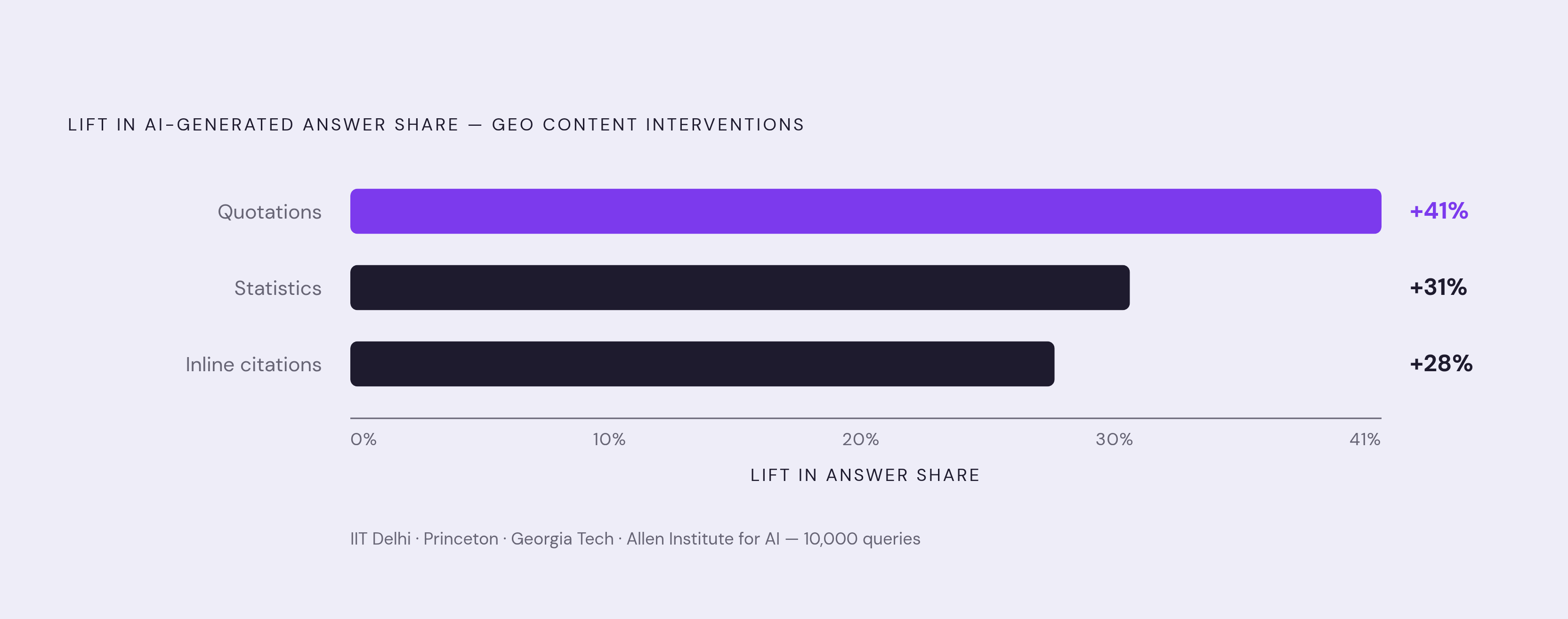
The most rigorous evidence on tactics comes from a GEO benchmarking study run by researchers at IIT Delhi, Princeton, Georgia Tech, and the Allen Institute for AI, tested across 10,000 queries. Three interventions stood out: adding quotations from credible sources raised a source's share of the AI-generated answer by around 41%, including statistics raised it by about 31%, and adding inline citations raised it by roughly 28%. All three demand the same discipline from a writer: sourcing has to happen before the drafting starts, not get bolted on afterward as a row of hyperlinks.
Format matters for a plain mechanical reason. Tables and clean lists get cited more often than dense prose because an AI system can lift a table row as a discrete fact, but it can't cleanly pull one fact out of the middle of a six-sentence paragraph without dragging the surrounding sentences along with it. FAQ schema built around prompt-matched questions drives extraction rates several times higher, the same GenOptima dataset found. Google retired FAQ rich results from the search interface, but that's beside the point: FAQPage markup still works as machine-readable structure for AI extraction, so the implementation still earns its place, just not for the reason it used to.
Vague sourcing gets ignored. "Studies show" reads, to a retrieval system, about the same as a sentence with no source attached. Named sources, specific figures, and dated claims get extracted, because the model is applying the sourcing discipline the writer should have applied first.
Common page structures that prevent extraction entirely
Some page structures fail at extraction categorically, no matter how good the writing inside them happens to be, and broken HTML is the most common culprit of the four. They fail at extraction categorically, no matter how good the writing inside them happens to be, and broken HTML is the most common culprit of the four.
AI systems read HTML structure (headings, tags, hierarchy) as a map of the page. Missing H tags, headings out of sequence, vague title tags: none of that triggers a ranking penalty in the old sense. It causes a retrieval failure instead. The content can exist, can even rank respectably in a conventional search result, and still stay functionally invisible to an AI system trying to work out what the page is about.
A page with no summary at the top fails for a related reason. Old SEO convention says build to the point: open with context, brand history, a scene-setting paragraph, before getting to the actual answer. An AI system reads those opening lines first and takes them at face value. If a page opens with company background, the model concludes the page is about company background, not about the answer sitting three paragraphs down.
Content locked inside PDFs, especially older multi-column layouts, runs into the same wall. AI systems struggle to parse complex PDF structure, so research buried in a decade-old PDF rarely gets cited in AI answers no matter how good the work inside it is. Citations require clean, crawlable HTML instead.
Fragmentation across several thin pages covering the same topic is probably the hardest failure mode to fix after the fact. Split authority confuses an AI system about which page actually deserves the citation. No amount of on-page polish undoes what that fragmentation costs. Consolidating overlapping pages into one strong page has to come first. It's a precondition, not an optional cleanup step, and skipping it wastes whatever polish comes after.
Then there's the language itself. Phrases like "unlock value," "best-in-class," and "seamless integration" get passed over because they carry no verifiable content. A model trained to favor claims it can check has no way to check an opinion. "AI is changing search a lot" isn't citable. "AI Overviews cut click-through rate by 58%" is, because it's a specific number tied to a specific effect.
Google's systems are designed to understand multiple topics within a single page and surface the relevant section on demand. That makes artificial chunking, breaking content into unnaturally small fragments purely to game extraction, unnecessary work. Organize for a human reader first. The machine-readable structure tends to follow on its own.
Content freshness as an extraction signal
Freshness is a direct input into whether a page gets cited at all, not a proxy for how well-maintained a brand looks. AirOps research found that 83% of AI citations for high-intent, commercial searches came from pages updated within the past 12 months, and more than 60% came from pages refreshed within the last six. The same research found that pages left untouched on a quarterly basis are roughly three times more likely to lose their AI citations than pages that get regular updates.
For fast-moving categories, the decay window is tighter. Practitioners tracking Perplexity's citation mechanics have observed that content older than 90 days starts losing retrieval priority to newer competing pages once it crosses that line. Time-sensitive pages are at the front of that decay curve and need review well within an annual cycle, not the periodic refresh most content calendars default to.
None of this calls for a wholesale rewrite every quarter. It calls for auditing which pages carry time-sensitive claims and updating them before the decay window closes, not after it already has.
Citation share doesn't bank itself, either. A page that earned a citation last year and then went stale doesn't fade quietly out of rotation. It actively loses ground to whatever fresher page replaced it in the retrieval pool. Getting cited once buys nothing permanent, and treating a strong citation as a finished project is how brands lose it.
How AI hallucinations turn a visibility problem into a brand integrity problem
A significant share of brands report that AI hallucinations have already damaged their reputation. That makes accuracy monitoring a baseline requirement, not an advanced tactic reserved for enterprise teams with the budget for it.
The mechanism is specific. An AI system can present outdated documentation as though it's current. Someone asking a chatbot about a product's integration capabilities might get an answer built on information that predates a major update, simply because the older documentation was cited more often, or represented more heavily, in the training data or retrieval index than the current version. Training data bias compounds the problem: if a wave of forum complaints from 2023 described a support issue that's since been fixed, the model can still be repeating that complaint years later, long after it stopped being true.
A brand that shows up often in AI answers but gets described inaccurately hasn't won anything. High mention volume paired with frequent inaccuracy is a content and entity-clarity failure, not a visibility success, and treating the two as the same metric is how that failure goes unnoticed.
The fix leans less on correction and more on saturation: flooding the context window with correct information until it outweighs the outdated version. That starts with a dedicated facts or accuracy page covering pricing, capabilities, and product category, written in the same extractable, answer-first format as everything else. It also requires entity consistency across the web: the company name formatted identically everywhere, executive names attributed the same way each time, product and category language aligned across every property, and clean Schema Organization markup with sameAs links pointing to canonical profiles like LinkedIn, Crunchbase, or Wikipedia where one exists. When a company name appears in three different formats across the sources a model draws from, its entity graph fragments, and mentions that should consolidate into one clear signal end up scattered instead.
Anthropic introduced a Citations API in mid-2025. Early testing reported by Endex showed source hallucinations and formatting errors dropping from 10% down to 0% with the API in place, alongside a 20% increase in the number of references per response. The underlying infrastructure is moving toward rewarding clean, well-sourced content even more than it does now, though that shift belongs to the platforms, not to any single brand's own effort.
The third-party ecosystem that AI reads first
Owned content isn't where most AI citations come from, and brands that pour their whole budget into their own blog are optimizing the wrong asset. Research tracking AI citations found that roughly 85% of AI references pull from third-party platforms rather than brand-owned domains.
That reframes the whole problem. When a buyer asks an AI system which brand to trust in a category, the answer gets synthesized largely from industry publications, analyst reports, consumer review sites, trade press, and earned media, drawing far more on those sources than on the brand's own homepage copy. A brand can write the most disciplined, answer-first content in the world on its own site and still lose the citation to a third-party comparison article that did the same thing better, or just got indexed more heavily.
So the answer-first discipline has to travel with the content wherever it goes, not stay parked on the blog. Guest posts and editorial features need the same structure, because the AI system citing them pulls a clean claim out the same way it would from an owned page. AI training data skews heavily toward community-validated responses over polished marketing copy, so Reddit threads and forum answers carry real weight in what brand information surfaces. Video descriptions on platforms like YouTube function as a citation surface too: AI systems index descriptions directly, so quotable, structured language there carries the same weight a well-built webpage would.
Reaching the scale where this actually shifts perception takes volume. A substantial volume of published documents across owned content, guest posts, editorial placements, forum contributions, and video reviews marks the rough threshold where brand perception in large language models moves from absent to consistently present. Below that number, a brand appears in AI answers only sporadically, which is a different problem than appearing inaccurately.
Listicles, comparison guides, and FAQ-rich formats get favored by AI models across all these surfaces, owned or earned, for the same structural reasons they get favored on a brand's own site. Given that 85% of citations trace back to third-party sources, PR, content marketing, and brand authority work aren't adjacent to AI citation strategy anymore. They're the primary mechanism producing it, and budgets that still treat them as secondary are misallocated.
Measuring whether the writing is working: AI share of voice as the primary signal
AI Share of Voice is the number of times a brand gets mentioned, divided by the total number of AI responses across a defined set of target queries, multiplied by 100. It functions as this discipline's closest equivalent to a scoreboard, and any report on whether the work is paying off should be anchored to this number.
Consistency turns out to be rarer than raw share numbers suggest. A 2026 AI Visibility Index from Semrush, analyzing 126 million U.S. AI search prompts, found that only 36 of 1,200 studied brands appeared consistently across ChatGPT, Gemini, Google AI Mode, and Google AI Overviews every single month. Most brands that show up in one system disappear in another, and a single strong month in ChatGPT means very little if Gemini has never heard of you.
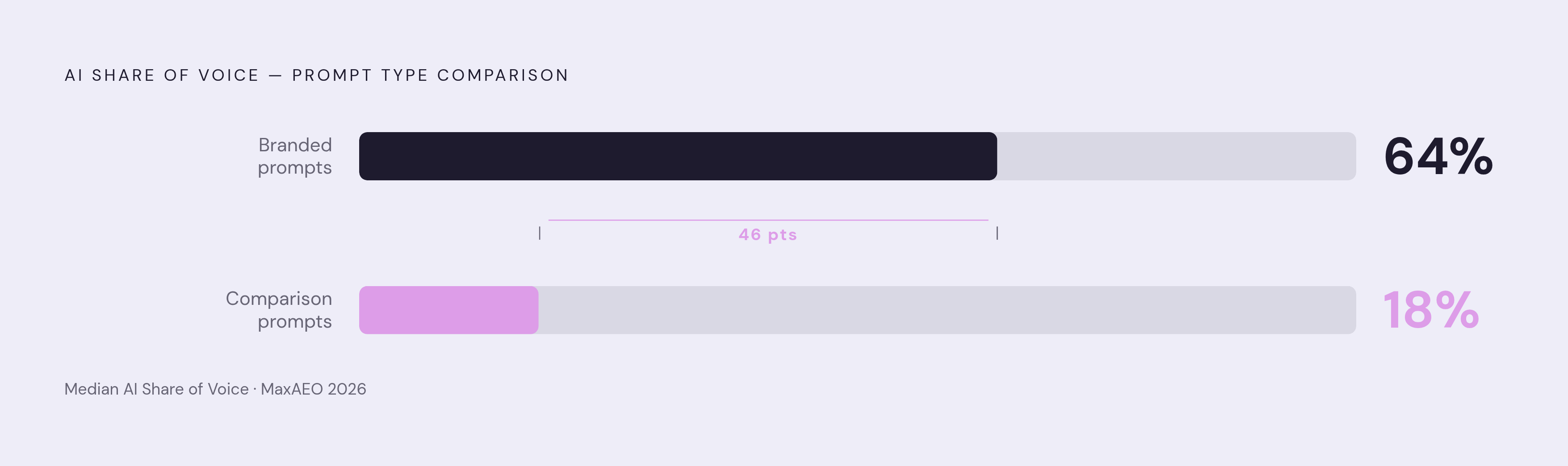
Prompt type moves the number substantially, and any benchmark quoted without saying which type it covers is close to meaningless. MaxAEO's 2026 research found branded prompts carrying a median share around 64%, while comparison prompts, where a brand competes directly against named alternatives, fall to a median around 18%. A brand comfortable with the first number and ignorant of the second is measuring the wrong fight.
Almost nobody measures any of this. McKinsey found that only 16% of brands systematically track their AI search performance today, which turns the measurement gap itself into a competitive opening for whoever closes it first.
Share of voice alone isn't the whole picture. It needs to sit alongside a factual accuracy rate, tracking whether AI systems describe the brand correctly, in the right product category, with the right capabilities attached, and alongside referral traffic from AI engines, which requires setting up a custom channel group in analytics tools to recognize referrers like perplexity.ai, chatgpt.com, and copilot.microsoft.com as a distinct channel rather than folding them into generic referral traffic.
Visible movement in AI share of voice typically appears within 60 to 90 days of running a systematic, answer-first content program, so a slow start in that window isn't a sign of a failed strategy. Meaningful shifts in how a brand is perceived across large language models take 6 to 12 months of sustained, consistent output. Anyone expecting month one's numbers to match month nine's is measuring the wrong thing at the wrong time, and calling it quits at week six is the single most common way this work gets abandoned before it has a chance to show anything.