Microsoft Copilot Brand Citation Behavior in Commercial and Enterprise Queries
Copilot cites pages through its own internal search phrases, not the keywords ranking them on Bing.

Copilot does not take the words you type and run them against Bing. Microsoft's webmaster blog explains that it builds its own internal phrases, called grounding queries, written for retrieval rather than for a human reader, and those phrases are what actually pull candidate pages and passages before the model writes its answer. So a page can be ranked at the top of Bing's organic results for a given keyword and never once appear in a Copilot answer built around a differently worded grounding query. The ranking and the retrieval are not the same contest; they run on separate phrase spaces that don't map cleanly onto each other.
The gap widened further in 2026, when Microsoft rebuilt part of this retrieval layer under an initiative it called Web IQ. Microsoft describes Web IQ as reasoning about how to search, not matching keywords one for one. That distinction matters because it means the system is making a judgment call about what a query is really asking, then translating that judgment into its own internal phrasing, rather than echoing back the words a buyer typed into a search box.
The most common mistake brands make is treating Copilot optimization as a rebranded version of Bing SEO. Bing SEO gets a page ranked for a keyword. Copilot citation depends on whether that page's content happens to match a grounding query the model generated on its own, often in language no human would type. The rest of this piece works through that distinction layer by layer: the surfaces Copilot actually operates across, the audience it reaches, the indexation it depends on, the content structure it rewards, the authority signals it leans on, and the measurement tools now available to track all of it.
The two retrieval surfaces Copilot operates across
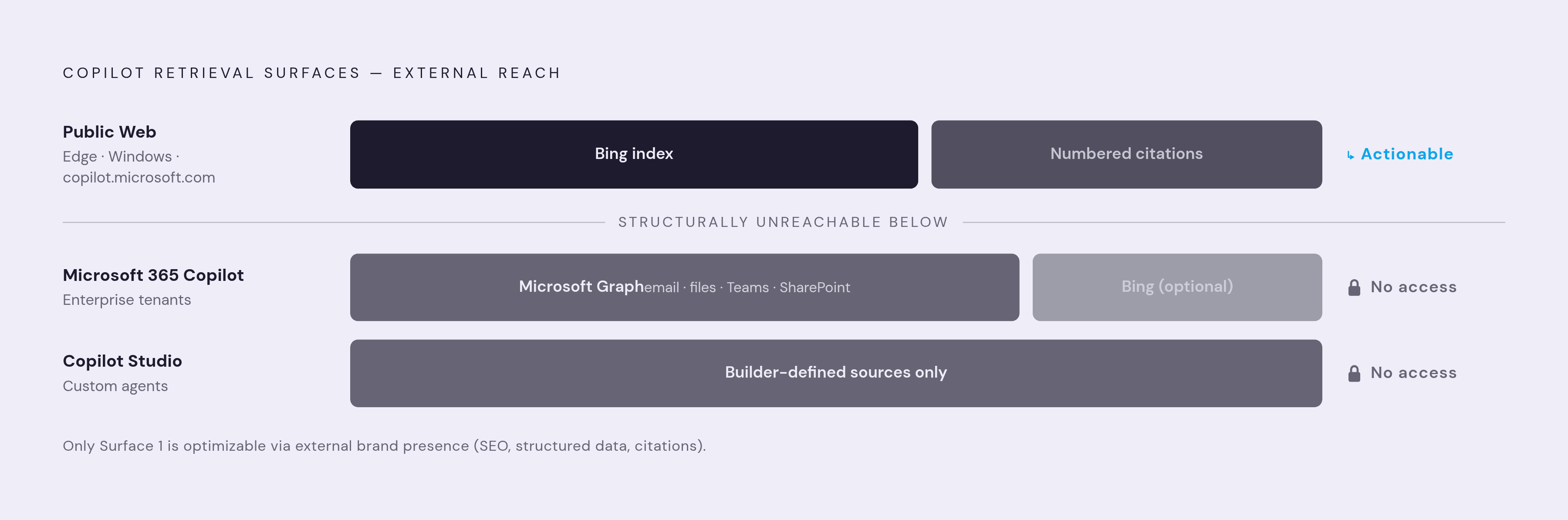
"Copilot" is not a single product behaving one way everywhere. It spans at least three distinct environments, and if you confuse them, your optimization plans fall apart before they start.
The first is the public web surface: consumer Copilot inside Edge, Windows, and copilot.microsoft.com. This layer retrieves candidate pages straight from Bing's index and attaches numbered citations to the specific passages it drew from. This is the only surface an outside brand can actually influence, and everything in this piece concerning content and authority signals applies here and nowhere else.
The second is the enterprise layer inside paid Microsoft 365 Copilot seats. Those seats pull from organizational data through Microsoft Graph, which covers emails, files, meetings, calendars, Teams conversations, and SharePoint documents, alongside an optional web layer powered by Bing that admins can turn on or off independently. That organizational layer sits entirely outside any external brand's reach. If a procurement team has never exchanged a document with a given vendor, that vendor has no footprint in the tenant at all, and no public content strategy changes that fact. A brand either has a prior relationship inside that organization's own data, or it is invisible to that specific retrieval layer, full stop on the mechanism, not on the stakes.
The third surface is Copilot Studio, where organizations build custom agents, and the person who designs the agent picks its source documents. Microsoft's own documentation notes that knowledge sources get added when an agent is created or afterward, and a published agent draws only on the sources its builder configured. External optimization has no path into that layer either.
What that leaves is one actionable surface: the public, Bing-grounded layer. Every tactic discussed from here forward, indexation, content structure, authority signals, measurement, applies to that layer specifically, not to the organizational or Copilot Studio layers a brand cannot touch from outside.
Why Copilot's smaller citation share matters more given who uses it
Copilot's raw citation volume trails both ChatGPT and Perplexity, based on a 90-day cross-engine citation study. On its own, that figure might suggest Copilot is a lower priority. The audience using it tells a different story.
Copilot's users skew toward finance, procurement, legal, and operations staff already working inside the Microsoft ecosystem, often at the exact moment a buying decision is taking shape, as Cognizo's enterprise analysis describes. B2B buyers using generative AI tools consult an average of seven information sources during a recent purchase, and if a buyer already works inside the productivity software they use daily, Copilot can be one of those seven sources without the buyer ever opening a separate browser tab for it.
Most B2B marketing teams pour their AI-visibility effort into Google and treat Copilot as secondary, or skip it. That imbalance means competition for Copilot citations stays lower than in more contested engines, so a brand willing to do the work described in this piece earns a citation more easily than it would fighting for the same ground on Perplexity or ChatGPT. A citation that lands early in an enterprise buying cycle also tends to stay relevant through a process that can run months, because enterprise procurement rarely moves fast enough for an early citation to go stale before it matters. The case for Copilot is where that smaller volume sits in the buying process and how little competition stands in the way of earning it.
The Bing index as the non-negotiable prerequisite for any Copilot citation
Copilot has no index of its own. It retrieves exclusively against Bing's index, so a page absent from that index cannot appear in a Copilot answer no matter how well it's written, according to a citation optimization breakdown covering the mechanism directly. Every tactic in the sections that follow assumes this first condition is already met.
Ranking well on Google carries no weight here. Bing runs its own crawl schedule and its own ranking logic, crawls smaller domains less often than Google does, and depends more heavily on brands submitting URLs than on organic discovery.
Before you do any content work, open Bing Webmaster Tools first and check for crawl errors or robots.txt blocks. If Bing has never crawled a page, it cannot enter Copilot's retrieval pool, so this check is the starting point, not an optional cleanup step. If a brand needs new or recently updated pages cited on a near-term timeline, submitting URLs directly through Bing Webmaster Tools matters more than waiting for organic discovery.
The payoff for getting this right is a feedback loop tighter than what other AI engines offer. A Copilot tracking guide describing that cycle notes that if you update the content and let Bing re-index it, Copilot can begin citing the updated version within a short window. That responsiveness is itself a reason to treat Bing indexation as the first and most urgent piece of any Copilot strategy, not a background technical task handled once and forgotten.
How Copilot extracts citable content from a page
Once a page is indexed, Copilot doesn't retrieve the whole thing. A breakdown of the extraction mechanics shows it pulls individual passages, so the sentence meant to answer a question has to stand on its own without depending on a paragraph above or below it for context.
Position on the page carries real weight. Putting a direct, self-contained answer to the page's core question in the first paragraph under the H1, ahead of market background or scene-setting, measurably improves the odds of citation. Two competing pages can carry identical information, and the one that states its answer first gets cited over the one that makes a reader scroll for it.
Specificity does the rest of the work. A named figure, a dated source, a concrete comparison gives Copilot something it can quote and attribute directly. A vague claim about being "industry-leading" or "best-in-class" gives the model nothing extractable, because there's no fact inside the sentence to cite.
FAQ or Article schema markup adds a machine-readable layer telling Copilot what a page answers, and a Copilot citation guide from OmniCite states that this signal counts for more on an index-grounded engine like Copilot than it does on engines built around broader open-web retrieval. Freshness is scored as well: content left stale faces a real disadvantage, since Copilot's grounding queries favor pages that have been crawled and updated recently over ones that haven't changed in months. None of this is generic content advice. Each recommendation traces directly back to something Copilot's retrieval mechanism does, measurably, with the passage it pulls.
Why third-party authority signals matter more than a brand's own site
Bing weighs backlink profiles and established domain trust more heavily than it weighs on-page optimization by itself, so a brand's own website rarely earns a Copilot citation without some outside corroboration backing it up.
That reality shifts where effort belongs. A Copilot tracking guide covering this pattern notes that analyst mentions, review platforms, and comparison articles on sites a model already trusts for a given topic often earn a Copilot citation faster than a full rewrite of a company's own homepage can. A brand that invests in getting named accurately on a trusted third-party comparison page may see results sooner than one that spends the same effort polishing owned content that Bing has no independent reason to trust yet.
Inside the Microsoft ecosystem specifically, certain properties carry outsized weight because they sit inside the same trust graph Bing and Copilot already draw on: a listing in a relevant app marketplace, documentation hosted on an official support domain, and standing inside a recognized partner network all function as authority signals that a page on a brand's own domain cannot replicate on its own. The same tracking guide notes that a LinkedIn company page, a GitHub presence where relevant, and consistent brand details repeated across third-party sites round out the picture, reinforcing how clearly Copilot's underlying model understands a brand as a distinct, verifiable entity rather than a name it's encountering for the first time.
Measuring Copilot citation performance in Bing Webmaster Tools
Microsoft's AI Performance report entered public preview on February 10, 2026, and no other major AI engine offers publishers this kind of first-party citation data. An enterprise visibility guide covering the report's launch notes that it reports Total Citations, Average Cited Pages, Grounding Queries, and page-level citation activity, giving brands a direct window into how Copilot is actually using their content.
On June 16, 2026, Microsoft expanded the report with Intents, Topics, Compare, and Citation Share. Citation Share is calculated as the percentage of citations attributed to a given site out of all citations shown across all sites for that same grounding query, giving brands a direct read on competitive position beyond a raw citation count.
The grounding queries surfaced in the report are the most useful content signal available, but they need to be read correctly. Microsoft describes them as grouped phrases that summarize related activity across multiple AI answers, not the individual questions you typed, so the exact phrasing you see can vary. Treat these as directional topics to write toward, not as literal search strings you need to match word for word.
The report has a real limit. It shows what Bing believes it grounded, but it doesn't always capture the exact passage or ranking order a buyer actually sees rendered inside Copilot on screen, so the dashboard can understate or misrepresent real citation behavior in some cases. Brands get the clearest picture by going beyond a simple cited-or-not check: tracking citation position within the numbered source list, noting which domain gets cited (a brand's own site versus a third-party review platform), watching coverage across Copilot in Bing, the Edge sidebar, and M365 apps separately, and comparing all of it against Bing's organic ranking for the same query.
Why Copilot-only measurement understates brand visibility risk in AI search
A brand that tracks Copilot alone sees only a fraction of how it performs across AI search, since citation behavior differs by engine. A brand tracking analysis comparing engines directly shows that citation behavior swings widely by engine for the exact same prompt: Perplexity may cite a brand many times more often than Gemini does on an identical question, while Claude and DeepSeek may not mention that brand. A Copilot-only view simply can't see the rest of that picture.
Six core metrics now define AI visibility across the category: Brand Mention Rate, Recommendation Rate, Prompt Coverage, Share of Voice, Model-Specific Visibility, and Visibility Volatility. A Copilot-only dashboard captures, at best, one engine's slice of each of those six, leaving the other engines' behavior completely unmeasured.
The risk goes beyond missed opportunity. Watching only one engine creates a real blind spot around brand integrity: a hallucination on Perplexity or inside Google AI Overviews that attributes a false claim to a brand can go undetected entirely if Copilot is the only engine under watch, and in regulated categories like financial services and healthcare, that kind of undetected misattribution turns into genuine compliance and reputation exposure. A brand left out of an answer needs a different response than a brand misrepresented inside one, and a monitoring setup built around a single engine can't tell those two situations apart, let alone respond to both.


