How Grok and xAI Search Differ From OpenAI and Google in Source Attribution
Grok's dual retrieval system rewards engagement and authority differently than Google and ChatGPT.

Grok is the only major AI assistant built on two fully independent retrieval tools: a real-time X Search tool and a separate Web Search tool, both documented openly in xAI's API. No competitor runs this split. OpenAI and Google each read from one combined pipeline, but Grok treats live social posts and the open web as two separate sourcing systems that feed the same answer. That architecture, not any single model update, is why Grok's citation behavior looks nothing like what brands have learned to expect from search or from other AI engines.
Once content starts to circulate, a piece that sparks real conversation on X can land in both layers at once: the thread itself becomes eligible for citation through X Search, while the article it links to becomes eligible through Web Search. You won't find that kind of double-surface exposure on ChatGPT or Google AI Overviews, because neither treats social posts as a first-party retrieval source the way Grok does. A study of more than 150,000 citations found Grok had the lowest organic top-10 overlap of six platforms measured. Most of what Grok cites doesn't come from pages that rank well on Google. A brand's SEO standing is the asset most marketing teams have spent the last decade building, but it carries far less weight here than anywhere else.
How the X Search and Web Search tools each select sources
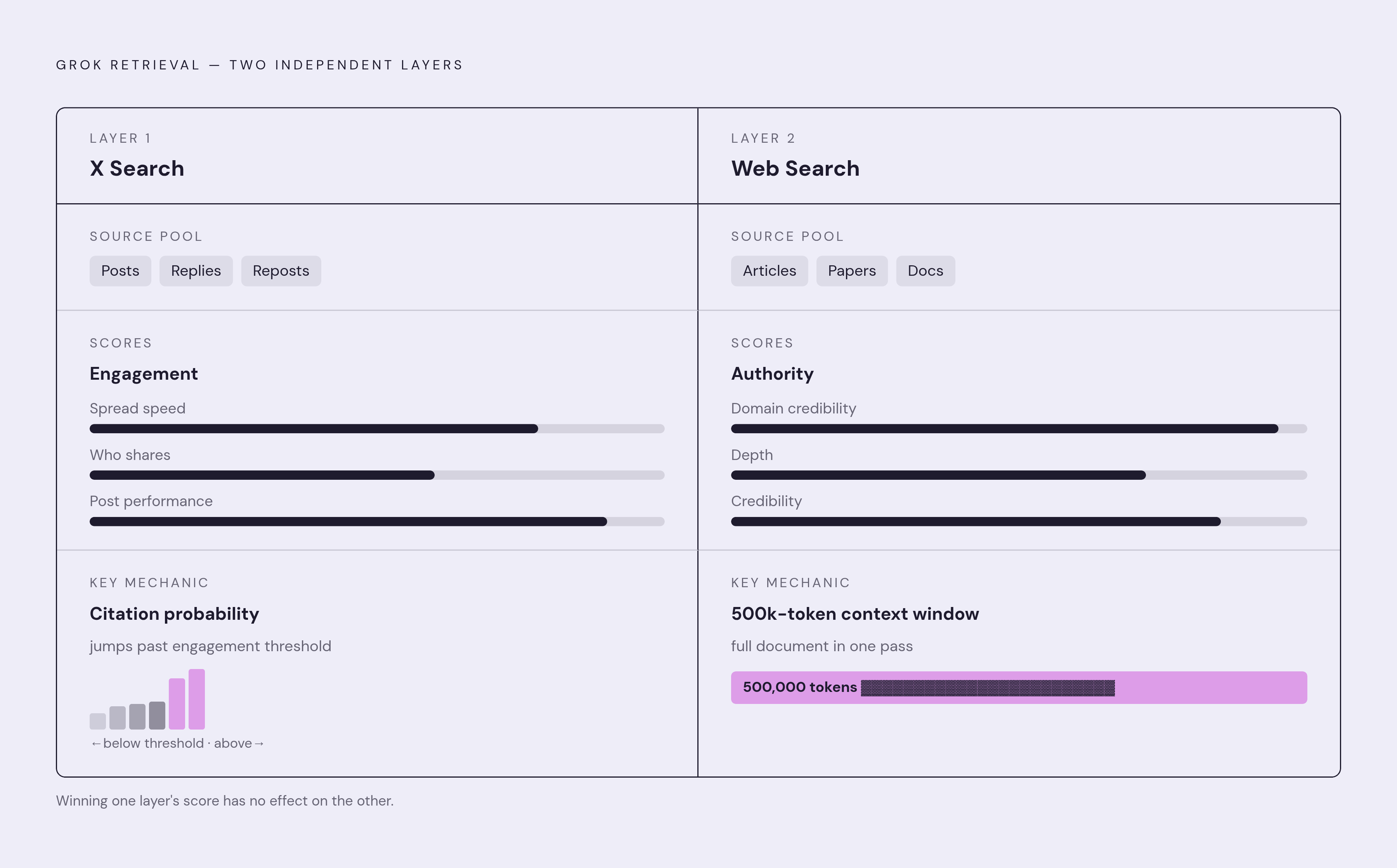
The two tools don't just pull from different pools of content, they score content by entirely different rules. X Search weighs engagement: how a post performs in real time, who shares it, how fast it spreads. Web Search weighs domain authority, how deep a page goes, and how credible it looks on its own terms. A brand that wins one of these contests has done nothing to win the other, so treating Grok as a single target misses how the system actually works.
Inside X Search, citation selection is engagement-weighted but not in a straight line. Citation probability jumps sharply once a post crosses certain engagement thresholds, so a handful of posts that clear that bar will outweigh a much larger volume of posts that stay just below it. Because the layer runs in real time, the set of posts eligible for citation can shift within hours of something going viral, which makes a one-time audit close to useless. The only way to track standing in this layer is to watch it continuously.
Web Search runs on steadier ground, but its mechanics are just as specific. Grok 4.5 and 4.6 carry a 500,000 token context window, large enough that it can take in a full long-form guide or a data-dense report in one retrieval pass. That's a real gap from platforms that only process a few thousand tokens of a given source at a time. Because Grok can read that much of a document at once, a single well-built article can surface across many related sub-queries rather than just the one it was written for, which argues for putting the most important facts in the opening third and then building out full coverage from there. Citation studies across platforms, Grok included, keep finding that most cited sentences come from the first half of a document, but Grok's larger context window means its deeper sections can still stay citable in a way other engines' don't allow. One finding holds everywhere, not just on Grok: cited sentences tend to fall in a narrow word-count range, so writing in short, direct, self-contained clauses makes a passage easier for any AI system to lift as a citation.
What the citation source mix reveals about which brands Grok surfaces
Organic X posts accounted for the biggest share on their own, with verified-account posts forming a smaller, distinct tier that shows up more often on news and opinion queries. Set against that, news publications, high-authority pages such as Wikipedia, Britannica, official documentation and government sites, and brand or company sites add up to a combined share that runs close to, and at times past, what X posts alone deliver. Long-form blogs and independent newsletter platforms round out the mix, skewed toward pieces built around a named author's own analysis.
The brand sites category comes in smallest of the group, appearing almost only when someone asks about a company by name. A business with strong Google rankings but no active presence on X, no verified account, and no third-party conversation happening about it there sits in that smallest tier by default, visible only to people already searching for it directly. Flip the setup around: a company that publishes original data as an X thread, lets that thread generate real discussion, and links it to a well-built web article can land in both layers at once on broader category queries, the kind of queries that bring in people who've never heard of the brand yet. None of that requires a top-ten Google ranking. It requires presence in both retrieval systems Grok actually reads from.
How ChatGPT and Google AI Overviews select sources differently
Every major AI engine reads its own corpus and rewards its own signals, so a brand built around one engine's preferences can end up poorly matched to another's without changing a single fact on the page. That mismatch is the real strategic problem Grok's dual-layer design makes hardest to ignore, because it shows, more clearly than any single-pipeline competitor can, how little these systems have in common under the hood.
ChatGPT runs on a hybrid index built from Bing as its official partner, an expanding proprietary index of its own, and Google functioning as a reported fallback. Wikipedia sits on top of that mix as ChatGPT's leading citation source, though its share dropped from a majority of prompts to a much smaller fraction after a change made in September 2025. Wikipedia's weight is reduced, but it is still large enough that solid encyclopedic coverage works as a meaningful signal if a brand wants to show up in ChatGPT answers. ChatGPT also pulls in several candidate pages per query but ends up citing only a portion of what it retrieves, favoring pages with clear headings, direct answers near the top, FAQ schema, and claims that are backed up within the text itself. Citations cluster heavily on the first turn of a conversation, with later turns producing fewer of them, a pattern that points to a retrieval approach built around the start of a session rather than Grok's habit of sourcing each answer fresh.
Google AI Overviews works on a different logic again. A page can answer a question fully and on its own, without sending the reader elsewhere, and that semantic completeness predicts citation selection strongly. Structured data, schema markup, and sections that lead with a direct answer before expanding into detail: these are the signals Google's system rewards consistently. None of these three engines, Grok, ChatGPT, Google, select sources the same way. A single piece of content optimized for one will rarely perform the same way across all three. Brands chasing visibility across AI engines are managing three separate systems; they do not share one discipline with three names attached.
The hallucination and brand integrity risk Grok's architecture introduces that other engines do not
The same dual-layer design that gives Grok its reach also creates a risk the other engines don't carry in the same form. Because one of Grok's retrieval tiers is built from unverified, real-time social posts, the system can present a peer-reviewed paper and an unchecked X post with the same visual authority in a cited answer, with nothing in the presentation to tell a reader which is which.
The harder question for a brand isn't only whether Grok cites it, but which sources Grok is pulling from to build that answer, whether those sources are even accurate, and whether a competitor is getting credited where the brand should be. Being cited is not the same as being represented correctly. Grok can cite a source that only supports part of a claim, pull from a page that's gone stale, misread a figure in a table, treat a scheduled rollout as something already completed, or repeat an unverified X post as settled fact. These are risks every retrieval-based AI system carries to some degree, but they get sharper on Grok because one whole tier of its sourcing is made up of social posts that were never fact-checked.
For healthcare, financial services, and legal brands, an inaccurate AI-generated claim built on a miscited or hallucinated source isn't just a reputational problem, it's a compliance exposure. That turns citation monitoring into a governance function, not something marketing handles on its own schedule. A brand can appear in Grok's answers constantly and still be misrepresented the whole time: summarized through a competitor's framing, sourced from a page that hasn't been updated in months, or described using an X post that's since been corrected or taken down. Tracking how the brand is being attributed is the baseline discipline any brand operating on Grok now needs in place, since none of this is visible otherwise.
Grok's User Base and Traffic Share
Grok's share of total AI web traffic is smaller than ChatGPT's or Google's, and that number alone understates how much weight a Grok citation actually carries. Grok's user base skews toward technical, financial, developer, and policy audiences, the kind of readers whose decisions carry outsized influence relative to their numbers. A citation in front of that audience is worth more than a flat traffic percentage would suggest.
SpaceX's SEC filing puts Grok AI features at 117 million monthly active users as of March 2026, a figure that reflects Grok's integration directly into the X app itself, where people run into AI-generated answers without ever opening a separate product. That gap between Grok's share of AI web visits and its actual active-user count is the number that matters most here: most Grok usage happens inside X, not on a standalone site that traffic trackers measure cleanly. Grok is a larger channel in practice than the web-traffic numbers alone would lead anyone to believe.
Because that user base leans so heavily technical, financial, and politically engaged, an inaccurate or missing citation in those categories costs a brand more, reputationally and competitively, than the platform's headline size implies. People often object that Grok's traffic share is too small to earn a dedicated strategy, but that misses the actual shape of the opportunity. You can't win Grok's citations through conventional SEO as easily, but once you do win them, you face less competition, since most brands haven't adjusted their approach yet. Moving early here carries a disproportionate payoff precisely because so few competitors are doing it.
Building a content and distribution strategy that earns citations in both of Grok's retrieval layers
Because Grok's two retrieval layers run on separate signals, a strategy built for one alone will always leave half the system untouched. The work has to run on two tracks at the same time: one that builds durable, technically solid web content, and one that builds a genuine, high-engagement presence on X. Each track reinforces the other, and neither one works as a substitute for the other.
On the web side, original data should sit at the center of the content plan, benchmark results, proprietary research, firsthand findings that don't exist anywhere else. Grok's web layer leans hard toward technical credibility, so content built on original data can earn citations on broad category questions, not just ones that name the brand directly. Timing matters too: publishing within a day or two of something significant, a product launch, a funding round, a new research release, a regulatory change, puts a brand inside Grok's retrieval window right when query volume on that topic peaks. Within the writing itself, facts should sit in short, self-contained sentences, with the most important points placed in the opening third of the piece and fuller detail built out from there, so Grok's full-document retrieval pass has as much to work with as possible. Entity markup matters as well: using sameAs tags to connect a brand or an author to a Wikidata ID helps the system resolve claims to a verified entity instead of leaving them attached to an ambiguous string of text.
On the X side, the goal is real conversation, not a scheduling calendar. Posts that cross Grok's engagement threshold are the ones that get pulled into the real-time layer, and because that layer moves fast, standing there needs to be checked continuously. Run well, these two tracks don't just add up, they compound: a strong piece of original research turned into an X thread that takes off can enter both of Grok's retrieval layers inside the same news cycle, something no other major AI engine's architecture currently allows.


