Entity Clarity and Named Entity Disambiguation in AI-Optimized Content
Most brands ignore the entity layer that determines whether AI systems cite them correctly.
Entity disambiguation is the layer every AI citation strategy depends on, and most brands never think about it. When an AI answer engine cites a source, it has already done something a search engine never had to do: decide which real-world entity a name refers to. Get that resolution wrong, and the model either skips the source entirely or hallucinates details from a different company with the same name. None of the tactics that follow, schema markup, earned media, content structure, matter if this layer fails first.
Consider what happens when a prospect asks ChatGPT what a company does. The model returns a confident, sourced answer, complete with specifics about the product and the market it serves. Nothing about the response looks broken. It describes a different company, though, a larger firm that happens to share the same name. The citation went somewhere. It just didn't go to the right place.
Two distinct failures get lumped together here, and they shouldn't be. Training data lag is a timing problem: the model knows the brand but is working from stale information, a pricing page that changed eighteen months ago or a product line that's since been discontinued. Brand disambiguation failure is an identity problem: the model has confused the brand with something else. The first is annoying. The second is structural, and whether a brand shows up in AI-generated answers at all depends on fixing it. Research tracking 140 SaaS brands in 2026 found that 61 of them carried at least one material discrepancy in how AI systems described their own company. Ambiguous entities don't get cited with confidence. They get skipped, or swapped out for whoever else answers to the same name.
How search evolved from matching strings to resolving entities
Traditional SEO worked on a simple premise: match the words in a query to the words on a page. Rank for "project management software" by making sure that phrase, and its close variants, showed up in the right places. Success was measured in string overlap, nothing deeper.
Google broke that premise in 2012 with the Knowledge Graph, and the phrase used at the time, "things, not strings," was the whole argument in three words. A brand, a founder, and a product aren't just terms that happen to appear near each other on a page. They're distinct objects with relationships between them, nodes in a graph rather than tokens in a string. That graph now holds more than 500 billion facts about roughly five billion entities, according to Google. The infrastructure for resolving who's who at scale already exists, and has for over a decade.
AI answer engines inherited that premise and pushed it further. An LLM resolving a name in a prompt or in retrieved text does what a knowledge graph does: treating the name as a pointer and asking which real-world thing it points to. That's named-entity disambiguation, a core problem in computational linguistics long before anyone was optimizing content for ChatGPT.
A page can rank well in organic search while remaining completely ambiguous to the AI layer sitting above it. Keyword optimization touches the string-matching layer. It does nothing for the entity layer, and no amount of additional keyword work will fix that gap. Brands treating AI citation as a new technical problem to solve are, in a real sense, already a decade behind the infrastructure quietly built around them.
What makes an entity ambiguous to an AI system
Ambiguity has a default behavior, and it isn't neutral. When two or more entities share a name, an AI system defaults to whichever one has the larger digital footprint. A startup with the same name as a well-known mapping company, mythological figure, or city will lose to that better-known referent every time, unless something in the data actively pulls the model toward the correct one.
Naming inconsistency is the most common structural cause, and it's the one brands control. "Acme Corp," "Acme Corp.," and "Acme" look identical to a human reader and register as three separate entities to a system built on exact-match graph nodes. Multiply that across a brand's own site, its Crunchbase profile, its LinkedIn page, its G2 or Capterra listing, and whatever Wikipedia or Wikidata entry might exist. The model is left holding fragments instead of one coherent record. It can't merge signals into a single authoritative entity if the signals disagree with each other.
Think of it as a comprehension budget. When an ambiguous reference can't be cleanly resolved, a model takes a shortcut: it hallucinates based on statistical probability, substitutes a more prominent entity, or drops the source. Unstructured, inconsistent data forces that outcome. Clean, structured data resolves quickly, and that difference determines directly whether a brand gets named.
Different engines lean on different disambiguation signals, so a fix that works on one platform won't necessarily travel. ChatGPT draws heavily on training data. Perplexity leans toward the live web. Gemini has the Google Knowledge Graph sitting right behind it. Claude tends to work well with long-form documents. Ambiguity that tanks a brand's presence on one platform might not touch another, but a brand with genuinely clean entity signals wins across all of them, because the underlying data holds up no matter which resolution method gets applied to it.
There's a diagnostic hiding in plain sight here: ask several AI platforms what a company does, and compare the answers side by side. Consistency across platforms is a good sign. Divergence means the entity record is fractured somewhere upstream, and chasing that down before it costs more citations matters.
The three costs a brand pays when disambiguation fails
Lost citations are the most direct cost. Every answer that resolves to the wrong entity is a citation the correct brand never gets credit for. The model answers confidently, the user reads it and moves on, and the brand that should have been named never enters the conversation.
Misattribution is subtler and arguably worse. A brand's differentiators, its specific positioning language, its unique technical capability, all of it can get folded into a competitor's description simply because the model resolved the query to the wrong node. The right information technically exists somewhere in the AI's answer. It's just credited to someone else.
Then there's audience misdirection. Users walk away with an impression of an entity that isn't the brand they'd have actually chosen: wrong use case, wrong market segment, wrong price tier, formed before they ever land on the actual site. Buyers increasingly build what one industry guide calls a "silent shortlist" through AI conversations before visiting any website. By the time someone does show up on a site, a misattributed impression may already be baked in, with no obvious moment where it gets corrected.
The asymmetry matters most here, and it's what makes this worse than a normal ranking problem. A traditional SEO mistake is usually recoverable: a page ranks on page two instead of page one, a bad outcome but not an actively false one. An entity disambiguation failure is different in kind, because the model states its wrong answer with the same confidence it would give a right one. That confidence is what makes the failure so hard to catch and so damaging once someone finally does catch it.
The entity signals AI systems use to resolve a brand's identity
Knowledge graphs and the models built on top of them lean on a small set of core fields to anchor disambiguation: the brand's canonical name, its legal or registered entity name, founding date, founders, headquarters location, and its core use case or product category. These are anchors, and every one of them needs to say the same thing everywhere it appears.
That means alignment across the brand's own site (homepage, About page, footer), its Crunchbase profile, its LinkedIn company page, its G2 or Capterra listing where relevant, any Wikipedia or Wikidata entry, and its Google Business Profile, alongside consistent name, address, and contact details across directories and app stores. It sounds tedious because it is tedious. It's also foundational, in the way a building's foundation is tedious right up until it isn't there.
The sameAs schema property is the technical bridge that does a lot of this work quietly. It links a brand's entity record to authoritative external references, Wikipedia, Wikidata, official social profiles, and tells AI systems exactly who this entity is within the broader knowledge ecosystem, rather than leaving the model to guess from context. Organization schema on the brand's own site (name, URL, description, foundingDate, founders) does the parallel job of making those fields machine-readable, which drops the model's comprehension cost close to zero.
None of this works if it stays confined to owned properties, though, and this is where most entity clarity efforts quietly fail. Analysis cited in a GEO guide found that roughly 85% of brand mentions in AI search originate from third-party pages rather than from the brand's own site. Entity clarity on owned channels alone addresses a small fraction of the problem. When the name, URL, and description line up consistently across Wikidata, LinkedIn, Crunchbase, and a brand's own schema markup, something like entity consolidation happens on the graph's end: the model sees one authoritative node instead of several competing half-matches.
How content architecture either reinforces or undermines entity clarity
Metadata alone doesn't finish the job. Whether a model can extract entity relationships cleanly, without having to guess at what refers to what, depends on how a page is written.
A GEO study by Aggarwal and colleagues, accepted at KDD 2024, put actual numbers behind this. Adding quotations from credible sources raised a source's share of the AI-generated answer by roughly 41%. Including clear statistics and data raised it by about 31%. Adding inline citations raised it by about 28%. The mechanism behind all three is the same: each tactic makes a claim verifiable and attributable, letting the model anchor the assertion to a named entity instead of treating it as a floating, unsourced statement.
That principle translates into concrete writing habits. State the brand name, the product category, and the core use case explicitly in the first paragraph of every major page, rather than assuming the model carries context over from some other page it may or may not have read. Write question-based headings that name the entity directly, "What does Acme do?" rather than the vaguer "What we do," because the named entity in the heading works as a disambiguation anchor all by itself. Follow question headings with direct 40 to 60 word answers; the tighter the answer, the less inference work the model has to do to bind it to the right entity.
Pronoun drift is a quieter version of the same problem, and it's the one most brand style guides actively encourage. A page that leans on "we," "our," and "the platform" for paragraph after paragraph without ever naming the brand again gives the model nothing to anchor to. Repeating the canonical brand name at regular intervals is what keeps the entity binding intact across the whole page.
The ghost mention deserves a direct name of its own. A model trained on a brand's proprietary terms, frameworks, or data can end up regurgitating them in an answer with no citation at all, absorbing the substance while dropping the attribution. The fix runs through the content itself: phrasing like "According to Acme's 2026 research" makes the entity-claim binding explicit rather than implicit, leaving the model less room to strip the attribution away. The same logic applies from the model's perspective: content merely restating what already exists elsewhere gives a model little reason to anchor it to any particular source. Original data, first-hand experience, and a genuinely distinct point of view are harder to abstract away from whoever actually produced them.
Where third-party sources fit into an entity clarity strategy
The 85% figure from the last section is the whole argument for why entity clarity can't stop at the brand's own domain. Most of what an AI system pulls to build a citation comes from what other people and other sites say about a brand, not what the brand says about itself.
Different platforms pull from different corners of the web, and the split is not subtle. Analysis of AI citations found ChatGPT drawing on Wikipedia for 47.9% of its citations, followed by Reddit at 11.3% and Forbes at 6.8%. Google AI Overviews leans toward Reddit (21.0%), YouTube (18.8%), and Quora (14.3%). Perplexity leans hardest on Reddit (46.7%), with YouTube (13.9%) and Gartner (7.0%) behind it. A brand can't pick one ecosystem to show up in cleanly and assume the rest will follow, because each platform is effectively reading from a different library.
Earned media carries particular weight here, more than most PR budgets currently reflect. Earned and news media have emerged as a leading category of AI citations, and treating PR as entity-signal infrastructure rather than just brand awareness spend changes what counts as a win. PR and media relations function as entity-signal infrastructure now, not just brand awareness spend.
What consistency looks like in practice is fairly plain. Every external mention should use the brand's canonical name, not a shortened internal nickname or an informal variant that happens to circulate on social media. Coverage that describes the brand's category, its use case, and its differentiators in language that echoes what the brand says about itself reinforces the entity record every time it runs. Coverage that gets the naming wrong or misattributes a capability to the brand does active harm to entity clarity, not just neutral noise, so the quality of earned media matters here every bit as much as the volume of it.
Auditing this isn't complicated in concept, even if it's tedious in execution: search the brand name across several AI platforms and note where the descriptions start to diverge. Divergence there is a signal about the external ecosystem's entity consistency, not a flaw confined to the brand's own site.
Measuring entity clarity
AI Share of Voice is the percentage of brand mentions a company receives across AI-generated responses, relative to total mentions across the whole competitive category for a given set of tracked prompts. The formula is straightforward, brand mentions divided by total category mentions, times 100, but the number only means something once tracked over time and against named competitors.
Two things get conflated under that single metric that shouldn't be. Citation selection asks whether the brand shows up in the model's reference list. Citation absorption asks something different: the brand's actual content either shapes the generated answer, or it just sits in a footnote nobody reads. A framework analyzing 21,143 citations in 2026 found that Perplexity tends to cite more sources per prompt but extracts less influence from each one, while ChatGPT cites fewer sources but pulls more substance from each of them. A brand can turn up in Perplexity's reference list without moving the needle on the answer itself, or land a single citation in ChatGPT that ends up shaping several paragraphs of the response.
Inconsistency in how AI platforms describe a brand belongs in the tracking dashboard right alongside Share of Voice, not off to the side as an anecdote mentioned in a quarterly review and then forgotten.
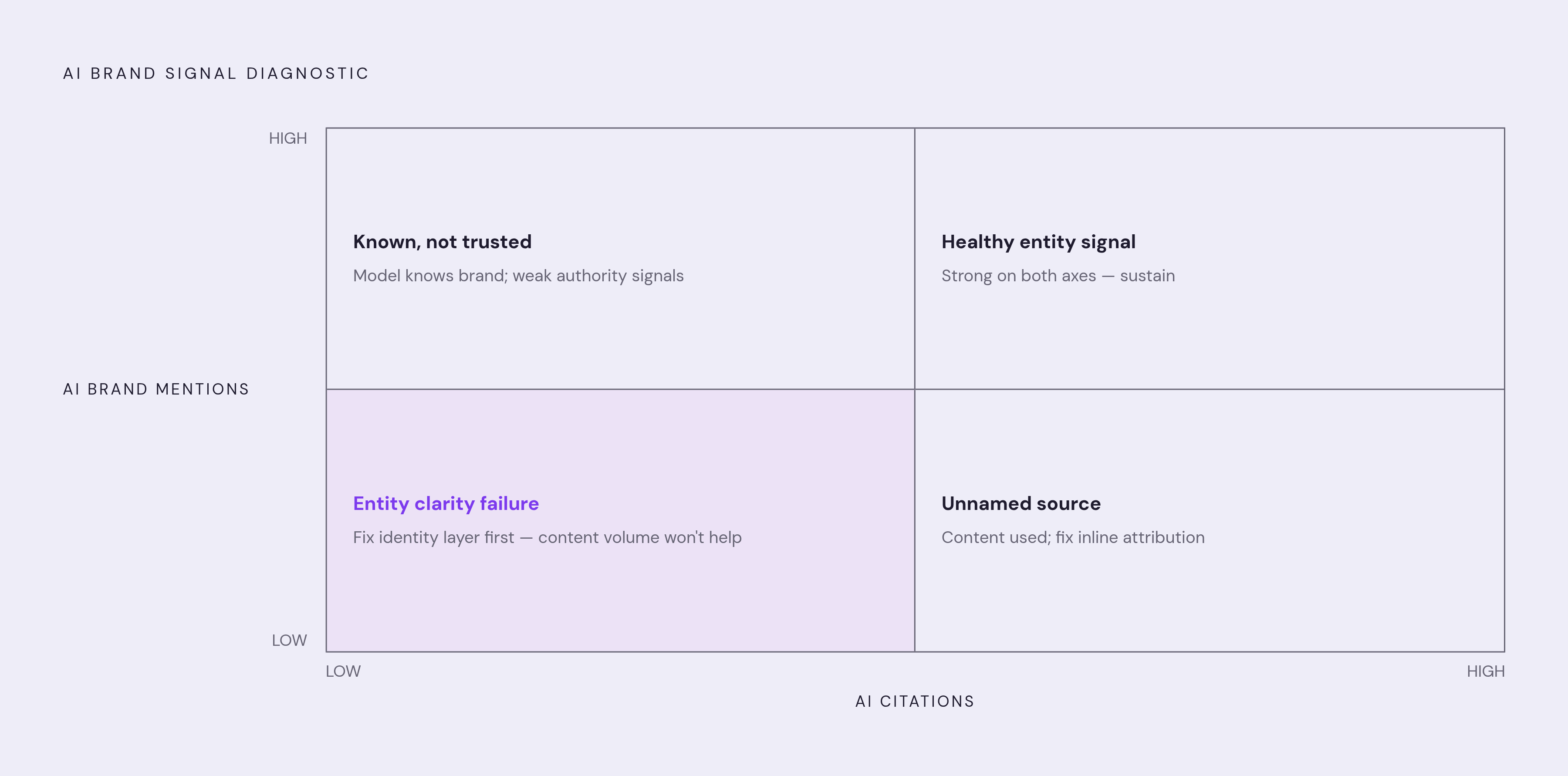
The relationship between citations and mentions works as a rough diagnostic on its own, and it's the fastest way to tell which layer is actually broken. High mentions paired with low citations suggest the model knows the brand but doesn't trust it as a source to cite directly, pointing to weak authority signals more than weak entity signals. High citations paired with low brand-name mentions suggest the model is using the content without naming who it came from, fixable at the content level with clearer inline attribution. Low numbers on both sides point to an entity clarity problem, and fixing that comes first: no amount of additional content volume closes a gap that starts at the identity layer.