Why Thin Content Farms Beat Expert Pages in AI Citations and the Structural Fix
Restructure expert content to match how AI systems extract answers from passages.

AI citation gap analysis and content restructuring for AI-generated answers means finding why relevant pages are passed over, then making their expertise easier to extract. Thin content farms beat expert pages for a time because retrieval can use short, answer-first passages more easily than expertise buried under context. The durable fix is to restructure authoritative content at page and domain level, remove access barriers, and measure citation share across AI platforms.
How AI retrieval actually selects sources — and why it is not the same as ranking
Search engines decide which pages should appear above others, while retrieval-augmented generation pipelines look for passages they can use to support an answer. A page may therefore compete well in organic search without supplying the passage an AI system selects. The distinction is between finding a relevant document and extracting usable evidence from it. Those are not the same editorial test.
Retrieval favors content that makes it easy to pick out the answer, its subject, and the evidence that supports it. Entity coverage helps show what a passage is about, while structural coherence makes clear how it relates to the question. Source citation behavior and comprehensiveness help the system judge whether a passage has enough evidence and answers enough of the question. Publishing more pages or having topical authority is not enough to meet those needs. An authoritative page can enter the consideration set and still be discarded before citation.
An opening that states the answer gives retrieval an immediately relevant entry point to the supporting argument, whereas an extended introduction postpones that opportunity. When Google rankings are strong but AI visibility is weak, a practitioner needs to check how passages are structured as well as how pages rank.
Why thin content farms temporarily outperform expert pages in AI citations
Thin content farms often have that entry point built in. Their short paragraphs, declarative openings, and minimal preamble resemble the format retrieval systems can extract efficiently. Cheap, fast production converges on those conventions even when citation performance was not the original goal. A shallow page can give a usable answer before a stronger page has finished setting out the context.
Expert publishing frequently makes the opposite trade-off. It introduces background, develops qualifications, and places its strongest conclusion late in the argument. That sequence can serve a human reader who follows the entire piece, but it asks retrieval to reconstruct the answer from dispersed material. The presentation of that expertise simply makes the strongest evidence harder to select as a self-contained passage.
Production economics amplify the difference because automated operations can publish at a scale that manual correction cannot match. Thousands of pages give a thin-content operation many opportunities to supply a short answer to a narrow query. That advantage can raise citation counts before the systems that correct it catch up. The broader inversion is visible in Google AI Mode, where a significant majority of citations originate outside the organic top 10. That finding establishes that high organic rank does not control source selection.
Why the farm advantage is decaying and what replaces it
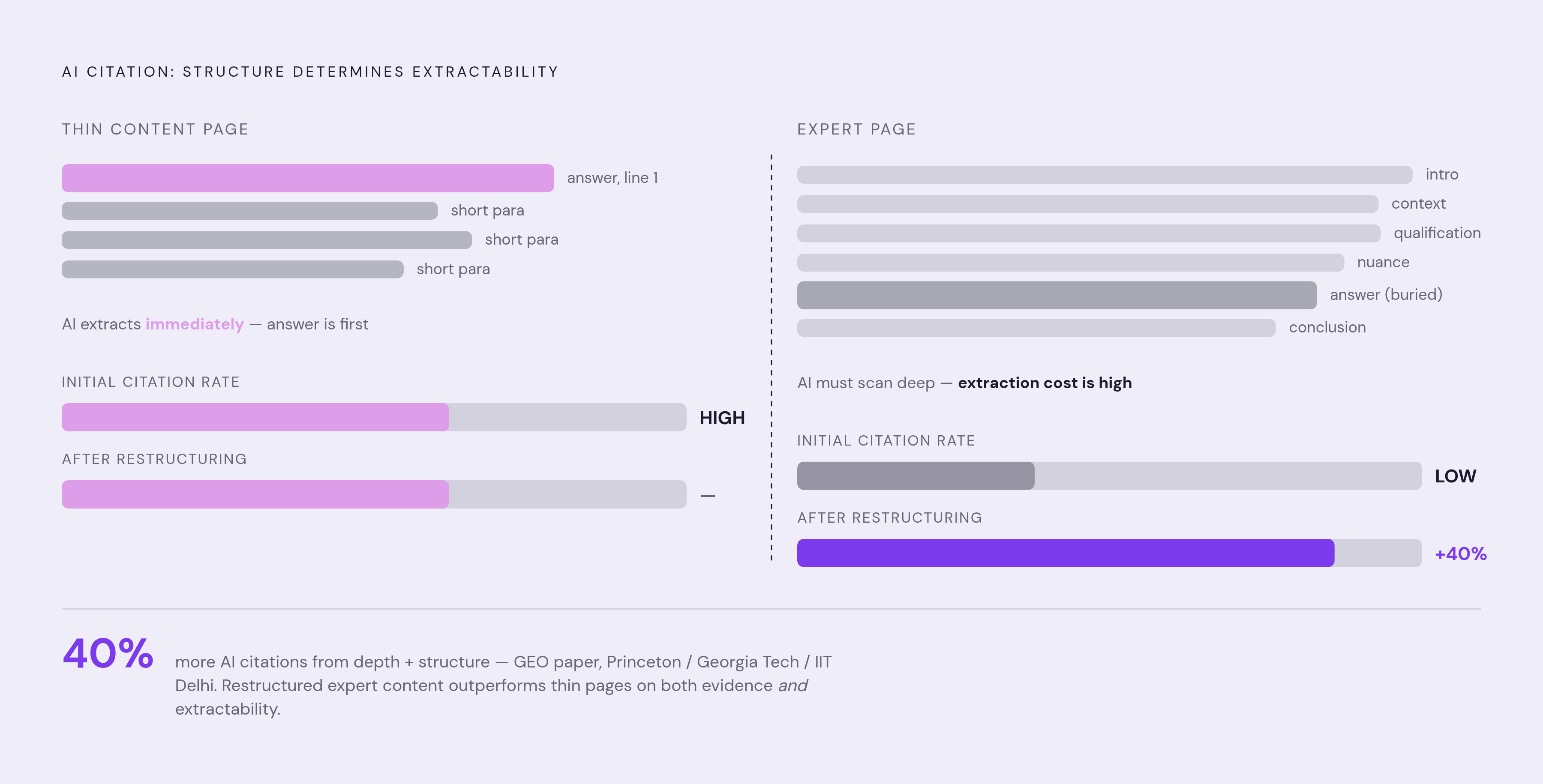
The farm advantage weakens as retrieval systems incorporate authority signals more robustly. A short answer is easy to extract, but brevity cannot supply missing evidence, subject depth, or coverage of related questions. Expert content can compete on both dimensions. It can present a direct answer while retaining the supporting material that thin pages lack.
The Princeton, Georgia Tech, and IIT Delhi paper that coined the term GEO found that retrieval optimization using specific depth and structure signals earned up to 40% more AI citations than unoptimized content covering identical topics. The comparison is important because topic choice alone did not explain the gain. How the content presented and supported its answer changed its visibility. Remove the extraction disadvantages from expert work.
One substantial article can earn citations for the questions it covers, while a maintained topic cluster can address related questions across a domain. As the site covers more of those questions, it has more relevant passages without having to churn out pages that stand apart from one another. Maintenance is part of the advantage. A cluster becomes durable through supported answers that remain useful.
The structural properties that make content extractable to AI retrieval models
The page-level fix is to organize expertise around four signals, namely entity coverage, source citation behavior, structural coherence, and comprehensiveness. For content teams, that begins with placing the direct answer at the opening of the page and each section. The argument then supplies evidence, conditions, and detail beneath it. The opening should stand on its own. Making the first 30% of the page citation-worthy does not require compressing all the expertise into that space.
Sequential headings should mark clear topic boundaries so that a passage has an identifiable purpose. Short paragraphs keep distinct claims separable, while lists make individual items parseable and tables support direct comparisons where those formats fit the material. Entity coverage also needs explicit language about the subject, the offering, and the conditions being discussed. Comprehensiveness comes from answering the relevant question in full.
Evidence should be equally accessible. The GEO paper found that quotations from credible sources did the most to raise source visibility, as measured by position-adjusted word count, with statistics addition and citing sources close behind. Those results support using primary-source evidence where it strengthens a claim. They do not justify ornamental quotations or unsupported numbers. The claim and its supporting source need to remain intelligible when read together as a passage.
Recency provides another selection signal. Cited sources tend to be fresher than equivalent SEO sources for the same query, and visible publication dates and year signals can improve citation rates. For content teams, the implication is to make the date of relevant material visible. Freshness belongs beside depth and structure. It cannot replace the evidence that makes an answer authoritative.
How topic cluster architecture scales extractability across an entire domain
Topic clusters extend the page-level fix to the full set of questions a brand can credibly answer. When an AI system breaks a complex question into sub-queries, related pages give it several opportunities to retrieve evidence from the same domain. A single page has a narrower reach. A pillar-cluster architecture links broad coverage to focused answers so that genuine expertise can help in several retrieval contexts.
An accounting firm illustrates the change. A firm publishing scattered thin posts could audit its archive, consolidate around two or three genuine areas of expertise, and organize those areas into pillars and supporting pages. Each supporting page would address a distinct question with an answer-first opening and relevant evidence. This architectural example shows how a scattered archive can become coherent coverage.
Search Console gives teams a place to start by showing pages that have impressions but low click-through rates. Those pages need a look because they already seem relevant to search queries, though low click-through on its own does not prove an AI extraction failure. Rewriting or consolidating existing material can move citation performance faster than publishing more disconnected pages. Platform differences should inform that consolidation. Google AI Mode favors structured product pages and listicles, while Perplexity emphasizes community discussions and forums, so one page type cannot serve every citation opportunity equally well.
Technical access: ensuring retrieval models can reach the content at all
AI crawlers must be able to access and parse the passages that editorial work makes useful. For teams implementing the fix, the first technical step is to inspect robots.txt and CDN settings for inherited AI-bot restrictions, including configurations associated with Cloudflare. Important content should be server-side rendered rather than dependent on JavaScript that the relevant crawler does not execute. Access comes before extraction. Logins, paywalls, and interactive elements can also prevent the system from reaching an otherwise well-structured answer.
An llms.txt file offers a proposed way to provide AI agents with a curated index of important content. It can help describe site structure, but it does not replace accessible pages. Index coverage also differs by platform. ChatGPT draws on Bing, OpenAI’s own “Labrador” index, and other external sources, while Perplexity combines lexical and vector-based retrieval and Google AI Overviews draw from Google’s index. A page that one system can reach may still be out of reach for another, so teams need to check access across platforms as well as indexing.
Why structural extractability is also the fix for AI hallucination risk
Structural clarity also reduces the gaps that can lead an AI system to misstate a brand’s offering. Clear, consistent content, metadata, and schema help establish entity confidence, meaning how clearly the system can parse what a brand is, what it offers, and on what terms. This gives restructuring a second purpose beyond visibility. The same passages that support citation can also support accurate representation of the business.
A pricing page makes the distinction concrete. If the offering and its terms are difficult to extract or inconsistent across the page and metadata, the system has a weaker factual basis for describing them. Presenting those terms clearly gives retrieval a more dependable reference. The supplied material gives no details of a specific change to a pricing page or a measured drop in errors.
IBM describes retrieval-augmented generation as grounding language models in factual, authoritative, current data. The generator still creates an answer from the query and retrieved material, so retrieval reduces risk without guaranteeing factual accuracy. Expert content must first be retrievable to contribute that grounding. For financial services, healthcare, and insurance brands, inaccurate statements about terms, eligibility, or claims can also create compliance exposure, even when the brand did not publish them, making precise source material important.
Measuring whether the re-architecture is working across AI platforms
AI citation gap analysis compares the answers a brand should support with the sources platforms actually select. For teams measuring restructuring, the workflow begins with a shared set of relevant questions across ChatGPT, Perplexity, Gemini, and Claude. The next step is to compare cited competitor passages with the brand’s corresponding material for answer placement, entity coverage, evidence, coherence, comprehensiveness, and access. A ranking report shows search performance.
AI share of voice measures the percentage of brand mentions a company receives across category responses relative to all competitors mentioned. Citation performance needs separate attention because a source citation and a brand mention are different outcomes. The same brand can have sharply different citation rates across platforms for identical prompts. Teams should compare results for each engine instead of relying only on a total that combines them. Repeating the query set after restructuring makes the change trackable.
Search Console and GA4 serve narrower diagnostic roles. The former helps identify existing pages for review, while the latter records direct click-through traffic. Neither alone explains why a competitor was cited. ChatGPT cites sources in the majority of answers but names brands in only about 20% of them, and only a small minority of brand exposures become site visits visible in conventional analytics.
Conversion quality completes the business view. AI search visitors tend to arrive with stronger intent and convert at higher rates than organic search visitors because they have already read a synthesized answer referencing the brand. Tracking those outcomes and citation share on each platform shows how restructuring relates to the value the business gets. The objective is to appear more often and make real expertise available at the point where an AI answer selects its evidence.


