Diagnosing Why Competitors Win AI Citations Your Brand Should Own
AI models cite competitors based on fixable content gaps, not luck.

A competitor showing up in ChatGPT's answer where a brand expects to see its own name is not bad luck. It's a diagnosable outcome: AI models select sources based on trust signals they've learned to weigh, and a brand losing that selection almost always has a specific, findable gap in content structure, authority signaling, or third-party presence. ChatGPT alone fields over 2 billion queries a day, AI-referred traffic to websites climbed 527% year-over-year through mid-2025, and G2's Answer Economy 2026 report found 51% of B2B software buyers now start research in a chatbot more often than in Google, up from 29% just months earlier in April 2025. Of those buyers, 69% ended up choosing a different vendor than the one they walked in planning to buy. That's not a vanity metric. That's pipeline, decided by a machine's source selection, before a salesperson ever hears about it.
What the data shows about which brands actually get cited
Start with the baseline: 53% of brands don't show up in AI answers at all. Not "underperform." Invisible. That's the majority condition, not some edge case affecting laggards.
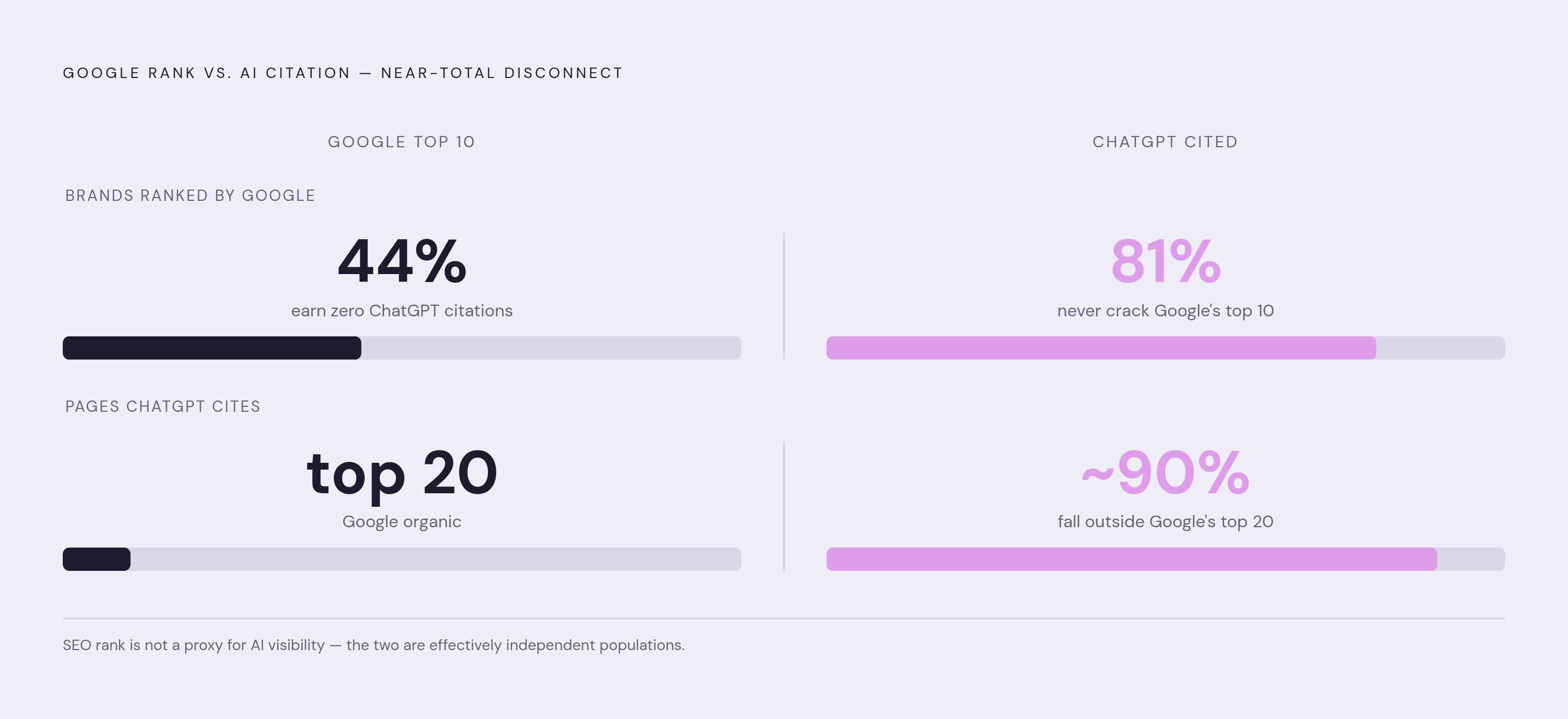
The overlap between traditional search rank and AI citation is thin enough to call it decoupling. 44% of brands sitting in Google's top 10 get zero ChatGPT citations for those same keywords, and 81% of brands ChatGPT recommends never crack Google's top 10 for the query in question. A Semrush study found nearly 90% of the pages ChatGPT cites fall outside Google's top 20 organic results entirely, which means a decade of SEO habits doesn't transfer over automatically. Whatever ranked a page for Google doesn't buy it a seat at ChatGPT's table.
Cross-platform performance doesn't hold together either. Less than 11% of cited domains overlap across platforms for identical queries, so winning on one model says almost nothing about standing on another. Multi-platform invisibility isn't the exception, it's the default setting most brands are operating in without knowing it.
The mechanism becomes clear at the page level. An audit of 2,225 pages found 36% were thin or simply couldn't be extracted cleanly, 77% carried no visible publish or update date, and only 21.2% showed any author signal at all. Those are the specific, fixable deficits that get a page skipped over, and most brands don't track their AI search performance in the first place. Most brands can't see the gap they need to close because nobody's measuring it.
None of this means the losing brand has a worse product. It means the winning brand built content a model can parse, trust, and safely attribute. Those are different problems with different solutions.
The four root causes behind a competitor's citation advantage
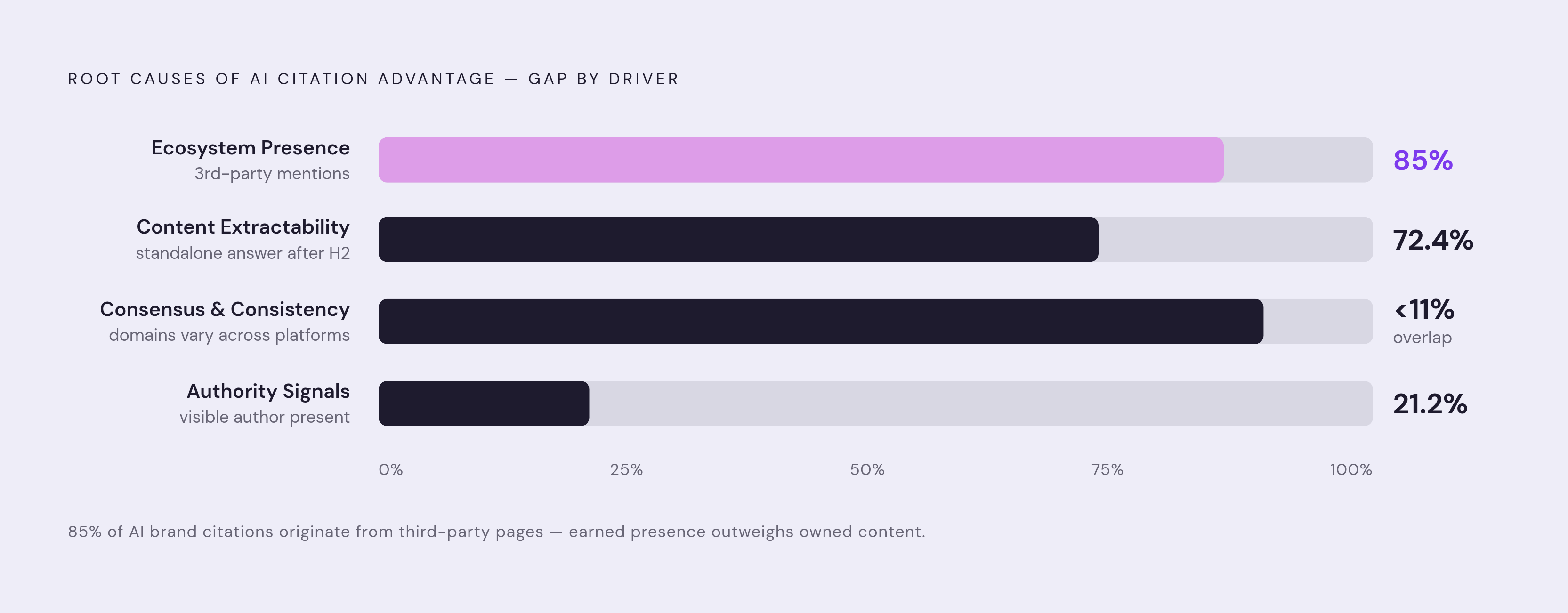
Content extractability means AI systems break pages into chunks before they ever weigh them for citation, and a chunk without a clear, self-contained answer gets passed over even when the underlying information is accurate and useful. 72.4% of cited content includes a standalone answer sitting right after the H2, making it the single strongest structural predictor found in the data. Pages built around original statistics or first-party research pull in several times more AI citations than pages repeating what's already out there, and anything updated within the last two months earns 28% more citations than stale copy. Ask plainly: does the competitor's content answer the question immediately under every heading? Do they have data your brand doesn't?
Authority signals are how models treat bylines, citations, and quoted expertise as trust proxies, similar to how Google reads E-E-A-T signals, but weighted differently because the model is synthesizing a recommendation rather than ranking a list of links. Content packed with statistics, citations, and quotes runs 30 to 40% more visible in AI answers, yet only 21.2% of pages studied show a visible author at all. A 2025 Relixir study of 2,100 pages found FAQPage schema correlates with substantially higher odds of citation, and most brands still haven't gone past basic Article markup. Does the competitor put a named, credentialed author on the page? Do they cite primary sources? Is their schema actually validated, not just present?
Ecosystem presence is the one brands miss most often because it happens off their own domain. An AirOps analysis found 85% of brand mentions in AI search come from third-party pages, not the brand's own site, making a brand several times more likely to get cited through someone else's page than through its own. Third-party mentions correlate with AI visibility roughly three times more strongly than traditional backlinks do, which flips the old SEO priority list on its head: digital PR and community footprint now outweigh link building. Reddit shows up in AI answers for 56% of audited brands, YouTube also appearing regularly across audited brands. Where does the competitor show up that the brand in question doesn't: trade press, analyst notes, a Reddit thread with real detail in it?
Consensus and consistency matter because language models generate text on probability, and information repeated consistently across training data earns higher confidence than information that contradicts itself from source to source. A brand name spelled two ways, a product description that shifts between the website and Crunchbase, a founding date that doesn't match LinkedIn: any of it can push a model toward omission rather than risk stating something wrong. Call this the Consensus Engine effect. A competitor whose facts repeat cleanly across dozens of sources builds an advantage that compounds, because every fresh mention reinforces the last one. Is the competitor described the same way everywhere? Is the brand in question?
How each major AI platform weights these signals differently
The fact that less than 11% of cited domains overlap across platforms means a single audit covering "AI search" broadly isn't enough. Each platform has its own retrieval logic, and the fixes differ accordingly.
ChatGPT pulls from the Bing index and rewards broad web authority and editorial press coverage. It tends to paraphrase without naming a source unless SearchGPT mode is active, which makes citation tracking murkier here than elsewhere. With more than 800 million weekly users as of Q1 2026, it offers the largest citation surface of any platform, but citation rates per query remain limited.
Perplexity searches the live web and leans on Reddit, vertical directories, and data-dense pages, with recency playing a notable role in what surfaces. Citation patterns shift here faster than anywhere else, so a freshness problem can surface quickly on Perplexity given its live-web retrieval. Its citations are also traceable, with clickable source links, which makes it useful for identifying which third-party pages are feeding a competitor's advantage.
Gemini pulls from Google's index and YouTube, so brands with strong Google authority and a real video presence tend to do well here. Schema markup on the brand's own domain is worth particular attention given Gemini's reliance on Google's index.
Claude retrieves through Brave Search or its own Claude-SearchBot crawler, and it rewards well-sourced, high-authority content. Blocking Claude-SearchBot in robots.txt (a different crawler entry than the general Claude bot) cuts off that crawler's access to the brand's content, a gap that often goes unnoticed without a direct check.
Put together, the pattern reads like a diagnosis in itself. Given how differently each platform retrieves content, gaps tend to cluster around the signals each platform weights most: freshness and community footprint, schema and Google authority, or crawl access. Each pattern points toward a different fix.
Running the competitor citation audit: what to look for and where
Mapping the losing queries first starts with building a prompt set covering core category terms, product names, and head-to-head comparisons, then running every prompt across ChatGPT, Perplexity, Gemini, and Claude, logging every brand mentioned in every response. From that log, calculate AI Share of Voice per platform: brand mentions divided by total brand mentions across every tracked competitor, times 100. Available benchmarks suggest top performers capture 15% or more of share on their core query set, and enterprise leaders in specialized verticals are reported to reach 25 to 30%, giving a rough reference to calibrate against. Tracking tools built for this now include Profound, which closed a $96 million Series C in February 2026, along with Otterly and modules inside broader marketing platforms.
Auditing the competitor's winning pages means pulling whatever page is likely driving each citation and checking it for answer capsules after every H2, fact density (a statistic every 150 to 200 words is a common pattern in cited content), visible author credentials, and a clear publish or update date. Check the schema: Article, FAQPage, HowTo, Organization, and whether a Person entity sits nested inside Article with sameAs links pointing to real, authoritative profiles. Note what content type is winning. Research reports, data-driven articles, detailed FAQs, and structured comparisons show up again and again as the formats that perform.
Mapping the third-party footprint means searching the competitor's name across Reddit, industry forums, LinkedIn, and niche directories, and noting every place they show up that the brand in question doesn't. Check whether they're cited in analyst reports, trade press, or Wikipedia, since ChatGPT's Bing-based retrieval draws on that kind of coverage. Profound's citation pattern analysis found LinkedIn jumped from outside the top 20 to become the single most-cited domain for professional queries across every major AI search platform between November 2025 and February 2026, so a brand's presence there is worth checking against the competitor's directly.
Checking the crawl access means pulling up robots.txt and looking for blocks on GPTBot, ClaudeBot, PerplexityBot, and Google-Extended. A block on any one of them means that platform can't see the content at all, regardless of how good it is. Confirm Claude-SearchBot specifically isn't blocked, since it's a separate entry from the general Claude crawler and its absence is otherwise invisible until someone looks.
Check consistency everywhere the brand appears. Compare the brand name, product description, founding date, and core claims across the company's own site, Wikipedia, Crunchbase, LinkedIn, and major trade coverage. Every discrepancy found is a small tax on the model's confidence, and confidence below a certain threshold gets a brand omitted rather than cited.
Closing the gaps: prioritizing fixes by impact and platform
Generative engine optimization runs roughly 80% strategic and 20% technical. Content structure and ecosystem presence move the needle far more than technical cleanup alone, so fix in that order.
On content, the single highest-leverage change is adding a direct, self-contained 40-to-60-word answer immediately after every major heading, since that structure alone correlates with 72.4% of citations in the data reviewed. Original research and first-party data matter almost as much: a model can't cite a fact it's never encountered, and proprietary data earns several times more citations than content that just restates the existing consensus. Refreshing high-priority pages pays off too, worth 28% more citations for anything updated within two months, and recency carries extra weight on Perplexity specifically. Forrester's 2026 research adds a useful frame here: content offering genuine "information gain" ranks three times higher in AI responses than content repeating what's already out there, so every update should be built around one clear question, what does this page now say that it didn't say before.
On schema, implementing FAQPage markup on question-and-answer content correlates with substantially higher citation odds per the Relixir 2025 study. Robots.txt blocks against major AI crawlers need to come down, with particular attention to Claude-SearchBot access. Worth noting, Google has said explicitly that brands don't need to build AI-specific markup files or new machine-readable formats. Effort belongs in filling out standard schema types thoroughly, not inventing new ones.
On ecosystem building, find the two or three platforms where the competitor holds ground the brand doesn't, and build a real, sustained presence there before spreading effort thin across everywhere else. Placement in analyst reports and trade press pays off disproportionately given how heavily ChatGPT's Bing-based retrieval weights that kind of coverage. Detailed, specific discussion on Reddit and in niche forums matters too: models place real trust in granular, specific community reviews, and a smaller brand with substantive discussion in the right forum can outperform a bigger competitor that only has generic press coverage to show for itself.
On consistency, treat it as a one-time infrastructure project rather than an ongoing chore. Audit every major third-party profile, reconcile every discrepancy found, and put a process in place so the next product change or rebrand doesn't quietly reopen the same gap.
Measuring whether the diagnosis is working: the metrics that matter
AI Share of Voice per platform is the primary number to watch, calculated weekly against a fixed prompt set and a fixed competitor list, tracked as a trend rather than checked once and filed away.
Weekly cadence isn't a nice-to-have. Roughly 30% of brands visible in one AI response show up again in the very next response to the same query, which means the output is probabilistic by nature. A single measurement is noise. A run of weekly measurements is signal.
Two metrics belong alongside AI Share of Voice. Citation rate tracks what percentage of the tracked prompt set returns any mention of the brand at all, separate from how that mention compares to competitors. Sentiment and context matter just as much: is the brand described positively, neutrally, or negatively when it does show up, and can that framing be traced back to a specific review site or comparison page the model is pulling from. A negative citation is still a citation, but it points to a different fix than an absent one, and conflating the two wastes the diagnosis just done.