AEO Program Iteration Cadence Based on AI Platform Algorithm Changes
Separate weekly monitoring from monthly updates to avoid chasing platform noise.

An AEO program needs an iteration cadence that separates routine content work from responses to meaningful AI platform changes. Because engines change their retrieval and citation behavior on different schedules, one refresh calendar cannot serve them all. Weekly detection, monthly content iteration, and quarterly strategic review give teams a way to act on evidence without treating every citation fluctuation as an emergency.
Why the same content refresh schedule no longer works across AI platforms
A team refreshes a page, sees no movement in AI visibility, and cannot tell whether the content missed the mark or the platform changed. That uncertainty is the operational cost of treating AI search as one channel. The six grounded engines brands must plan for, namely ChatGPT Search, Perplexity, Claude, Gemini, Google AI Overviews, and Bing Copilot, have distinct retrieval logic, training pipelines, and citation behavior. A change that improves visibility on one can have no effect, or a different effect, on another.
A calendar based only on the team’s quarters tells the team when work is due while leaving unresolved whether the work addresses the cause of lost visibility. As a result, a program can keep optimizing for platform behavior that has already changed. The cadence must therefore separate changes in content effectiveness from changes in the systems selecting that content.
How each major platform actually selects and updates its citations
Perplexity carries the strongest recency bias of the major AI search platforms, particularly for fast-moving queries. Newer pages can displace older content within a relatively short decay window. For settled, evergreen questions, however, that window is longer. Prompt sets therefore need triage by query volatility as well as business priority. Perplexity also rewards topical authority and data-rich content, while backlinks are a low direct signal.
Gemini places importance on strong Google organic ranking, but that ranking is no longer a strict prerequisite for consistent citation. With the Gemini 3 update in January 2026, citations reached well beyond top-10 ranked pages. Claude, by contrast, favors highly structured, clearly sourced, information-dense content. Practitioner guides, documentation, and listicle-style pages that name their authors and use primary sourcing do especially well.
ChatGPT and Perplexity also use third-party authority signals from sources such as review platforms, forum presence, and earned media. First-party content alone cannot replicate those signals, so an owned-page review covers only part of the citation environment. Google AI Overviews and Bing Copilot remain distinct monitoring surfaces rather than substitutes for results from another engine. Teams need platform-specific evidence across all six.
Selection is also only the first stage of visibility. Yao et al., 2026 distinguish citation from absorption, in which retrieved content contributes to the synthesized answer. A brand can appear in footnotes without shaping that answer at all. Meanwhile, cited domains shift month over month in active categories, making a quarterly snapshot too coarse to detect the movement. Teams need to observe both which sources are selected and whether those sources influence what the platform says.
What "a meaningful platform-level change" actually looks like — and how to detect it
A meaningful platform-level change alters the conditions under which content is retrieved, cited, or used. A single changed answer does not establish that threshold. Competitor content appearing for previously uncovered queries can be an early symptom of changed retrieval logic, but it is not conclusive by itself. Synchronized accuracy declines across several brand prompts are more suggestive of a structural shift than scattered declines. New questions in related answers can likewise indicate that the platform’s topic modeling or knowledge graph has expanded.
OpenAI’s ChatGPT Atlas retirement in August 2026 illustrates how a core product change can invalidate assumptions about crawling architecture. Cloudflare’s September 15, 2026 default policy change shows how infrastructure can also be a trigger. It blocked Training and Agent crawlers on ad-displaying pages of new domains, new sites added by existing customers, and all existing free-tier customers. When such events occur, teams need to check product policy as well as page copy.
The structural test is whether the pattern and the event align. Citation drops isolated to one platform and correlated with a documented product or policy change point toward a platform trigger. When drops across platforms track the age of the content, they point toward staleness instead. Schema validation errors appearing at the same time as visibility losses indicate a technical trigger requiring its own escalation path.
The three-tier cadence structure: what to do weekly, monthly, and quarterly
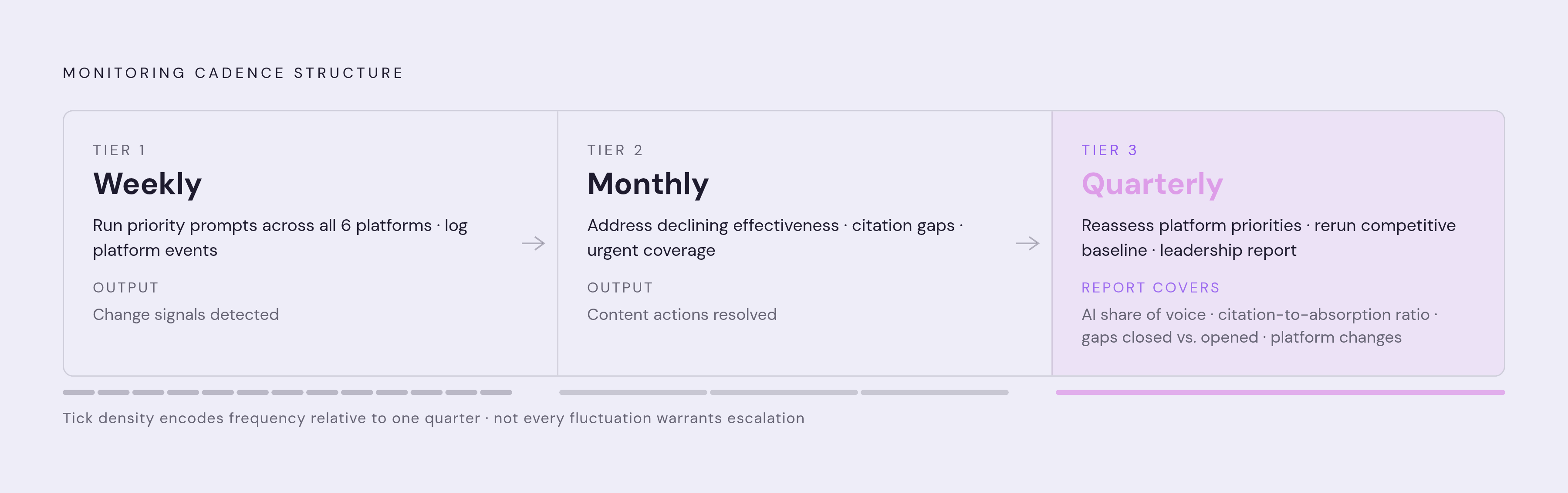
The three tiers have separate purposes. Tier 1 (Weekly monitoring) detects changes in current AI output. Tier 2 (Monthly content iteration) addresses declining content effectiveness and uncovered questions. Tier 3 (Quarterly strategic review) reassesses platform priorities, competitive position, and prompt coverage.
Weekly monitoring starts with a run of the priority prompt set on all six target platforms. The owner records brand mention rate, competitor mention rate, and new sources appearing in citations, then flags any prompt where the brand disappears entirely. That flag triggers a content review. The owner also logs product announcements, crawler policy changes, and feature rollouts so that platform events can be considered before action. New engines enter monitoring promptly after launch, while discontinued surfaces leave just as quickly.
Monthly iteration starts with pages that are losing citation share and the evidence of why they are losing it. The content operator checks for correlations between the decline and age, competitor displacement, or structural gaps identified during weekly monitoring. When pages still get cited but add less to answers, their factual claims, statistics, and product details need to be checked. Retrieval without absorption often signals an accuracy or freshness problem, so retained citations should not be mistaken for retained effectiveness.
The same monthly cycle closes urgent gaps where platforms answer new questions without citing the brand. It also handles content-layer responses to platform changes that do not require a new strategy. Google deprecated FAQ rich results on May 7, 2026, but schema markup retained value as a machine-readability layer for AI crawlers. The implication is to distinguish the loss of a search-result feature from the value of machine-readable content.
Quarterly review is structurally necessary because prompt sets decay in accuracy just as content does. The team adds new buyer questions surfaced in weekly monitoring, retires strategically irrelevant queries, and rebalances funnel coverage. It then reruns the competitive baseline against three to five key competitors across all six platforms. Review-platform presence, forum presence, and earned media also receive attention here because these signals operate on a three-to-six-month timeline. Finally, leadership assesses whether changes in recency weighting, source diversity, or absorption warrant engine-specific content restructuring, and receives a report covering AI share of voice, citation-to-absorption ratio by platform, content gaps closed versus opened, and material platform changes.
What triggers an unscheduled response — and how to escalate without derailing the program
An unscheduled event should enter a decision path within the ongoing cadence. The team first checks whether a citation drop is confined to one platform and correlates with a product change, policy change, or crawler update. If it does, the team logs the event and monitors for two to three weeks before changing content. The platform may resolve the issue through its own update cycle.
If the drop instead spans platforms and persists across two weekly monitoring runs, the next step is an unscheduled content review. The working diagnosis is content staleness or inaccuracy. If a competitor suddenly dominates citation share across multiple platforms, the decision changes again. That pattern calls for a change in strategy, so the team brings the quarterly competitive review forward.
Each escalation needs a defined owner and a maximum response time. Without them, urgency becomes a matter of internal influence rather than evidence, and the cadence loses credibility. Accuracy also matters independently of citation volume. When AI descriptions diverge from the brand’s actual positioning, pricing, or product scope, framing accuracy signals hallucination risk. A program cannot treat visibility as success when the answer that creates it is wrong.
Measuring whether the cadence is working — the metrics that reflect real AI visibility
A disciplined cadence can still produce a misleading account of performance if the team measures it only through traffic or rankings. Those measures do not show whether a brand appears in AI answers, receives a recommendation, or shapes the explanation. The primary visibility measure is AI share of voice, or AI SOV. It shows the percentage of brand mentions the brand gets compared with competitors across AI-generated responses. That competitive frame makes platform changes visible as shifts in position.
Citation rate measures how often the brand is cited across the prompt set, while mention rate tracks how often it appears without formal citations. Recommendation rate distinguishes a top pick or primary recommendation from a passing reference. Citation absorption records whether cited content shapes the synthesized answer. Framing accuracy tests whether descriptions match actual positioning, pricing, and product scope.
Teams need to view these measures for each platform because gains in the total can hide uneven results. Cross-platform consistency is difficult to achieve and strategically meaningful. A program that measures only ChatGPT leaves the brand’s position across the rest of the AI landscape unknown. The quarterly report should show competitive visibility alongside absorption and accuracy for each platform, and track how many content gaps were closed against how many new gaps opened. This gives leadership a way to distinguish broader progress from gains concentrated on one surface.
Even that view does not close the attribution gap. Buyers can form preferences in AI conversations and then navigate directly to a brand, leaving standard analytics to undercount AI-influenced traffic. Platform-level measurement therefore needs a self-report field in CRM and demo request forms as a complement. The measurement approach aims to connect AI visibility to business impact without assuming that every influential answer produces a traceable referral.
Building the cadence into the team and the budget — what sustainable execution actually requires
The framework becomes durable only when it is treated as a permanent operating function. Weekly monitoring needs a named owner with authority to flag issues without waiting for a meeting cycle. Monthly iteration needs a content operator who can act on those flags within days. Quarterly review needs marketing leadership because prompt design, competitive positioning, and budget are interdependent decisions.
Tooling and budget must support those responsibilities. Monitoring has to sustain repeated prompt runs across the target platforms and retain the measures the cadence depends on. Content capacity has to turn diagnosed issues into updates and new coverage. Strategic review then checks the allocation’s continued fit with the platforms and questions that matter. If any tier lacks support, detection, response, and strategy cease to function as one process.
Leadership should receive the same ROI structure used for other marketing channels. Citation trends and AI SOV show how visibility changes over time and how it compares with competitors, while framing accuracy flags risks to the brand. Content gap closure rate gives an early sign of what future citation share may be. Together, these measures give the cadence a basis for budget renewal when a platform update creates uncertainty. The first-mover advantage is not primarily content volume, but the operational maturity to recognize what changed, distinguish why it changed, and know which response belongs next.


