How Perplexity Selects and Ranks Web Sources for Inline Citations
The five-stage pipeline and six signals that determine which sources Perplexity cites.

Perplexity answers almost every query by searching the live web first and writing its response from what that search turns up, rather than drawing on a fixed body of training data. This design separates it from assistants that answer from memory: a page published today can appear in a Perplexity citation tomorrow, because the lever here is the current state of the web, not a training set frozen months earlier. The same design makes Perplexity the most transparent major AI surface to study, because it displays its numbered source list openly, and anyone can trace which pages fed a given answer. ChatGPT and Claude sometimes answer from memory with no live retrieval at all, and when they do pull in outside material, the sourcing gets blended into the response in a way that doesn't always let you pin a specific claim to a specific origin; Perplexity's citations are the actual input the model read, not a reconstruction assembled after the fact. That transparency carries real commercial weight: Perplexity's inline citations are clickable, and a user who clicks one has already chosen that source from inside an answer they trusted, which makes the resulting traffic pre-qualified in a way few other referral channels can match. Because the mechanism is observable rather than hidden, the rest of this piece can work through it stage by stage, signal by signal, and turn what looks like a black box into a set of decisions a content team can actually act on.
The five-stage pipeline that decides which pages reach the citation list
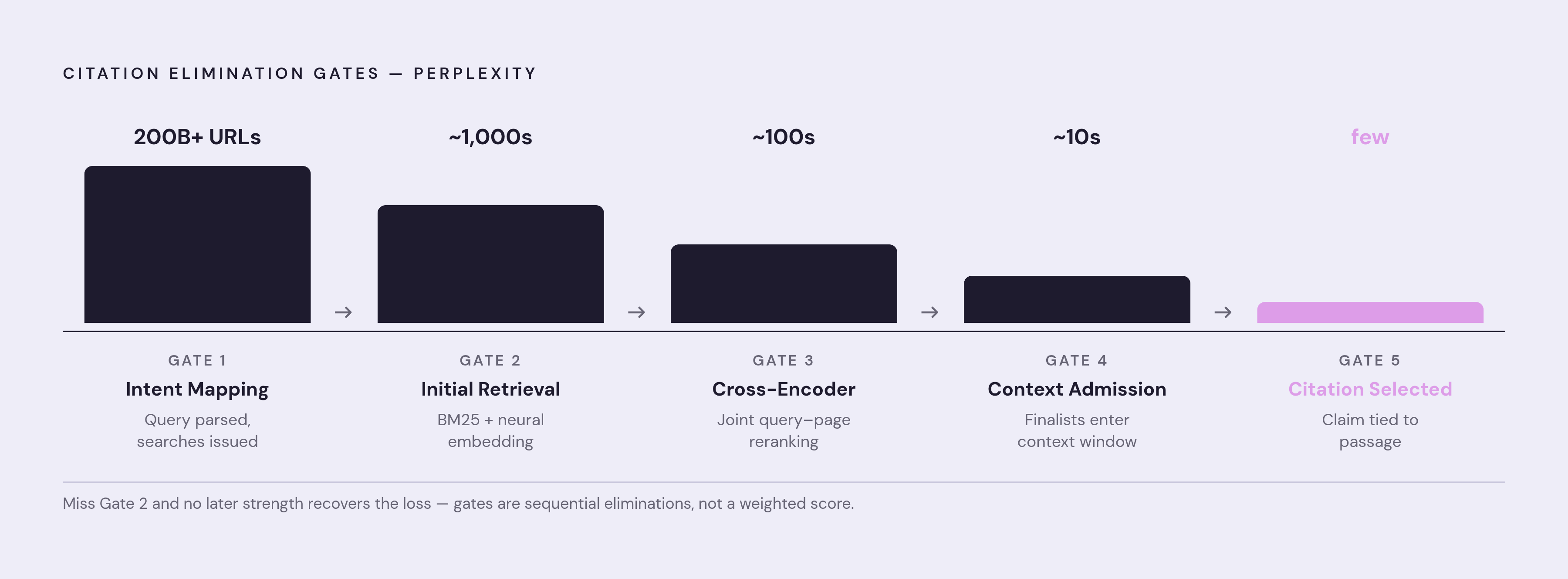
Perplexity's path from query to citation runs through five sequential stages, and the pipeline behaves less like a weighted scorecard and more like a series of gates, where failing one stage ends a page's chances regardless of how well it might have scored on the stages after it. The process starts with intent mapping: Perplexity reads the query, and when the question is ambiguous or layered, it issues several related searches instead of one, which widens the candidate pool before anything resembling ranking has begun. From there, the system moves into initial retrieval, where it combines BM25 keyword matching with dense neural embedding similarity to pull candidates from a proprietary index reported at more than 200 billion URLs, favoring recall over precision at this point so that nothing relevant gets excluded too early. The third stage narrows that wide pool through cross-encoder reranking, which evaluates each retrieved page jointly against the query rather than scoring page and query as separate, independent embeddings, and this joint evaluation is what turns broad topical relevance into a judgment of specific fit. By the time candidates reach the final stage, only a small number of pages remain to be packaged into the context window the language model actually reads, and the response it generates typically cites just a subset of those admitted pages, with each claim tied to the specific passage that backs it up. Understanding this sequence matters because it reframes the entire optimization problem: a page doesn't need to win on every dimension at once, it needs to survive each gate in order, and a weakness at an earlier stage, like failing to surface in initial retrieval, can't be compensated for by strength at a later one.
The six ranking signals that determine citation placement within the pipeline
Clearing the pipeline's gates is only half the problem, because once a page is admitted, six distinct factors decide where it lands in the final citation list, and those factors do not carry equal weight. Content relevance and semantic match are at the top of that hierarchy: how closely a page matches the intent behind the query and how thoroughly it covers the topic drives the heaviest share of the ranking decision, with informational queries leaning on this signal most heavily while commercial queries shift some of that weight toward trust markers and review platforms. Sitting close behind relevance is how the content is physically arranged on the page, because Perplexity extracts more literally than ChatGPT does: it lifts a single self-contained block of text that mirrors the query directly instead of synthesizing an answer from pieces pulled across the page, so content that front-loads its direct answer earns a better citation position than content that buries it. Domain authority, built through backlinks, brand recognition, and a consistent publishing history, still matters, but it functions as a tiebreaker among pages that have already cleared the relevance bar rather than as an entry ticket on its own, so a high-authority domain with poorly organized content will still lose a citation to a lesser-known page that answers the question cleanly. Mentions of a brand across Reddit, YouTube, LinkedIn, and forum discussions add a fourth signal, source diversity, which Perplexity reads as a proxy for genuine, earned credibility rather than something a brand manufactured through a single polished channel. Technical groundwork, schema markup, semantic HTML, and straightforward crawler access make up a factor that carries the smallest direct weight, but its absence creates friction that can cause an otherwise relevant page to get passed over anyway. Another factor is less obvious because it lives in how the prose itself is written: hedged, heavily qualified language is penalized in Perplexity's selection logic, while direct, declarative writing that commits to a claim and backs it with specific evidence gets rewarded, simply because that kind of writing produces cleaner, more quotable passages for the system to extract. Taken together, these six signals make the actionable priority clear: relevance and front-loaded directness do most of the work, authority breaks ties among qualified pages, and no amount of domain reputation rescues a page that fails on the first two counts.
Perplexity's source preferences and systematic avoidances
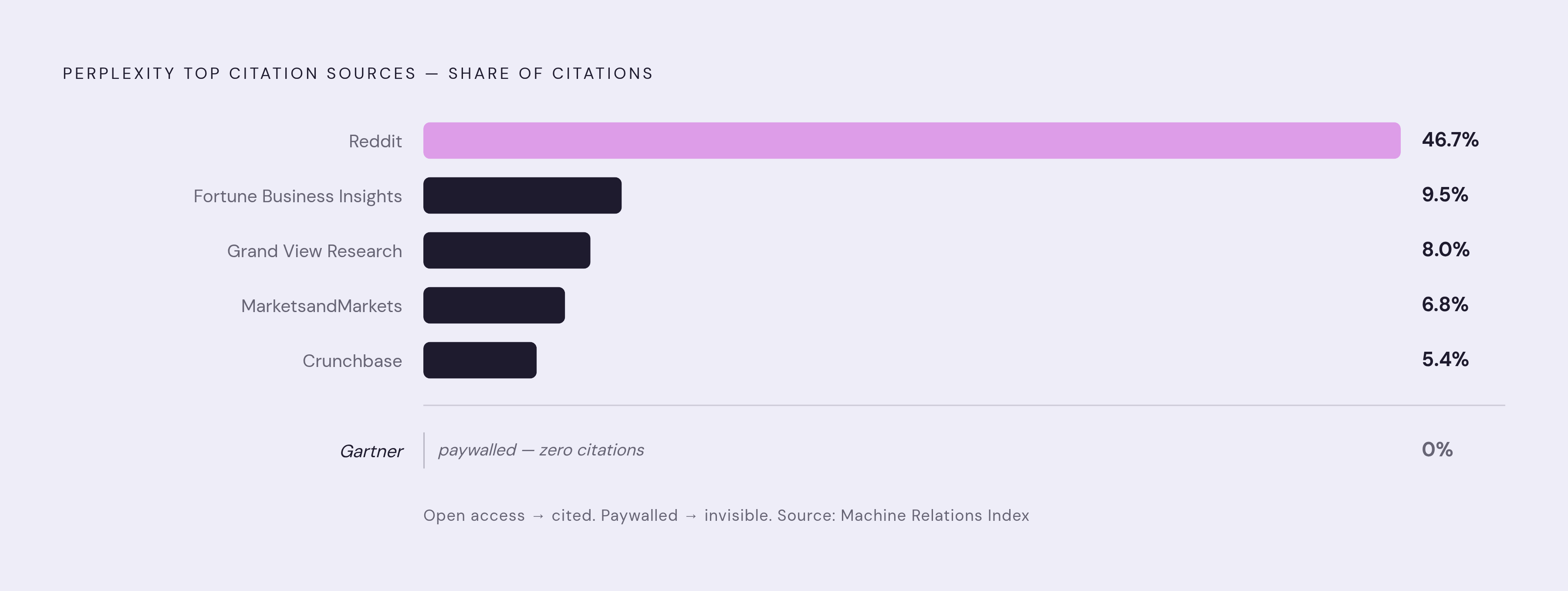
The pipeline and its six signals explain how an individual page gets evaluated, but Perplexity also shows strong, structural preferences at the level of source type, and those preferences mean the exact same domain can dominate on one AI engine while sitting nearly invisible on another, for reasons that have nothing to do with the quality of its content. Reddit alone accounts for 46.7% of top citations on Perplexity according to industry measurement, a figure that reflects the platform's emphasis on content that reads as authentic and experience-driven: active threads, recent opinions, a spread of viewpoints, and a question-and-answer structure that happens to match how people phrase queries to AI systems in the first place. Structured, openly queryable market databases, among them Grand View Research, Crunchbase, Fortune Business Insights, and MarketsandMarkets, also receive a disproportionately large share of Perplexity citations relative to how those same domains perform across other engines, and what they share is a structural trait rather than a content trait: data organized into clear categories with well-defined entity boundaries. Set against that, Perplexity systematically underweights analyst research firms and anything sitting behind a paywall or registration wall; Gartner received zero citations in Machine Relations Index measurement despite ranking among the most-cited domains on other engines, a gap consistent with a retrieval architecture that simply can't reach content gated behind a login. Wire distribution fares just as poorly: press releases sent through syndication services pick up more citations from Perplexity than from ChatGPT only in the narrow sense that Perplexity is the one major engine that cites raw wire URLs directly, a pattern that fits its broader preference for original, structured sources over syndicated or derivative copies of the same text. The strategic implication is direct: a brand that has invested heavily in Google SEO may be well-positioned for ChatGPT and Gemini but systematically undercited on Perplexity, and would not know it without engine-specific measurement.
Why Google rankings can't predict Perplexity's citation behavior
Ranking well in traditional organic search gets a page into consideration for a Perplexity citation, but it does not predict whether that citation happens, because Perplexity runs its own authority assessment independent of how Google has already ranked a page. Research into citation patterns finds that a meaningful share of what Perplexity cites comes from outside Google's top organic results entirely, so you need strong SEO performance for Perplexity visibility, but it alone won't get you there. A gap that wide between two AI engines looking at comparable queries shows that each one's retrieval architecture produces its own distinct citation profile, a different underlying list rather than a different sort of the same one. The consequence for brands is concrete: a company that has invested heavily in Google SEO over the years may already be well-positioned for ChatGPT and Gemini while being systematically undercited on Perplexity, and that gap is visible only by measuring Perplexity specifically, since general search rank data won't reveal it. That gap is also where the opportunity sits: Perplexity's architecture rewards topical breadth across a whole cluster of related prompts rather than a single optimized page, so early citations in a topic area tend to compound, building toward a default-source status that later competitors find hard to dislodge. If you treat Google rank as a proxy for Perplexity visibility, in other words, you miss both the risk of being undercited and the chance to become the default answer before a competitor claims it first.
The content architecture that earns and holds Top-3 citation placement on Perplexity
Winning a Top-3 citation on Perplexity calls for a different kind of content than the broad, comprehensive coverage that tends to win in Google: the synthesis stage needs precise, front-loaded, directly answerable passages it can lift cleanly and attribute without ambiguity. The first discipline follows straight from how the extraction step works: answer the exact question in the opening lines, because Perplexity quotes whatever passage most directly supports a claim, so a page that buries its answer behind several paragraphs of preamble will lose a citation to a lower-authority page that states the answer first. The second discipline is to build depth within one specific question rather than spreading coverage across a general topic: Perplexity elevates a source to the top of the list when that single page can ground most of an answer on its own, so you want to be the page so complete on one precise question that Perplexity cites it five times in a row instead of stitching an answer together out of five thinner sources. Beyond any single page, brands need to map and cover entire clusters of related prompts rather than optimizing one query at a time: brands that appear across clusters of related prompts, Nike, Salesforce, and Booking.com among them, post substantially higher visibility scores, because that repeated presence trains Perplexity's retrieval system to treat them as the default source for an entire topic area rather than a one-off answer. Structured formats carry real weight as well: tables, numbered lists, and question-shaped headings give Perplexity clean, quotable units to extract, and comparison tables in particular perform well on "best" and "vs" queries, where the synthesis step is assembling a structured answer rather than a narrative one. Original data carries weight too, because Perplexity favors sources carrying concrete numbers: a proprietary statistic or benchmark becomes a citation magnet because it's the cleanest available source for a factual claim and you can't source it anywhere else. Content also needs a refresh cadence that matches how fast a given category actually moves, because in fast-moving sectors, recently updated pages have displaced older, higher-authority incumbents, which makes freshness a genuine ranking lever rather than a cosmetic housekeeping task. Given how much weight Reddit carries in Perplexity's top citations, building a real, ongoing presence in relevant communities, answering questions in areas of real expertise without a promotional angle, creates citation surface that no amount of on-site optimization alone can replicate. Finally, citing authoritative external sources inside your own content turns out to be a symmetric signal: pages that cite trustworthy sources tend to be treated as trustworthy sources themselves, and this citation-of-citations effect showed up as a measurable visibility gain in academic generative-engine-optimization research, with the strongest lift found among lower-ranked sites.
Measuring Perplexity citation performance across AI engines
Measuring Perplexity visibility has to be its own discipline, separate from a general cross-engine approach, because the preceding sections show just how differently Perplexity's architecture behaves from both traditional search and from engines like ChatGPT, Claude, or Gemini. A brand that wants a real answer needs to track Perplexity citations on their own terms: which pages get cited, at what position in the list, across which clusters of related prompts, and whether those citations trace back to Reddit threads, structured databases, or owned content, since the source-type breakdown reveals as much about strategy as the raw citation count does. The gap documented between Perplexity and ChatGPT on something as basic as Wikipedia usage, zero citations against a substantial share, makes the broader point unmistakable: no single cross-engine metric can stand in for engine-specific measurement, and any team serious about AI search visibility needs a measurement approach built around Perplexity's actual retrieval and reranking behavior rather than assumptions carried over from traditional SEO.


