Building a Query Universe for Answer Engine Optimization Programs
Map buyer questions across AI search before content strategy.

Buyers now build what one industry guide calls "silent shortlists": preferences formed inside a conversation with ChatGPT or Perplexity, long before anyone visits a brand's website. A brand left out of that conversation gets crossed off a list it never knew existed, and the buyer never has to say so out loud. This is the central fact an AEO program has to work from. Traditional search ranked pages against keywords; an AI engine instead has to reconstruct an entire topic, pulling together whatever it can find across the web to answer a specific, often oddly phrased question. HubSpot's research on AEO best practices found that a large share of buyers already use AI search as part of how they evaluate a purchase, and that this behavior is one of the strongest predictors of buying intent available today. An AI engine will answer from whatever map of a topic it can piece together, built from brand material or built around the brand's absence. A brand that has not built that map on purpose is handing the job to chance, and chance tends to favor whoever did the mapping first.
What a query universe is
A query universe is a complete, deliberately built map of every question, comparison, and real-world scenario a buyer might bring to an AI system, sorted by intent and by where that buyer stands in the decision. It is not a keyword list padded out with synonyms, and that distinction matters more than it sounds like it should. A keyword names a topic. A query carries intent. "Project management software" is a keyword. "What is the best project management tool for a remote construction team" is a query, and it is the second kind of phrase that an AI engine is actually built to answer. HubSpot frames AEO as a shift away from chasing rankings and traffic and toward earning citations and direct-answer visibility, and that shift only makes sense once a team knows precisely which questions it wants to be cited for. A query universe is the decision that has to happen before any of that: before a single page gets written, before schema gets added, before anyone builds a citation strategy. Skipping it turns content work into a scatter of individually optimized pages rather than a program that actually covers the ground buyers walk. The map also has to work across two related but distinct disciplines: AEO, which aims at extractable, direct answers in places like featured snippets and AI Overviews, and GEO, which aims at getting a language model to cite a brand while it synthesizes an answer from multiple sources. The same buyer question can land in either system depending on where it's typed, so a query universe has to account for both.
Sources that keyword tools miss
Keyword tools are built to surface head terms and broad modifiers, the kind of short phrase that made sense when search engines returned a list of ten blue links. AI engines are built for something else: the specific, situational question a buyer asks when they trust a system to synthesize an answer for them directly. These questions rarely appear in keyword tools. They appear in support tickets, sales calls, and onboarding conversations, where buyers are already talking in their own words under real pressure to make a decision.
Support tickets carry some of the highest-fidelity language available, because confused buyers describe their problem exactly as they experience it, not as a marketer would phrase it. Sales call transcripts surface the comparison questions, the objections, and the competitor names that come up before a deal closes, things a buyer would never type into a search box but will ask an AI assistant directly. Onboarding conversations contain the "how do I actually do this" questions that buyers ask once a purchase decision is already forming. Picture a sales call where a prospect asks, "does this work if half my team is on iPads in the field and the other half is on laptops in the office?" Nobody searches using that exact phrase, so no keyword tool will surface it, but it's exactly the kind of situational question a buyer might put to an AI assistant while deciding.
External sources matter just as much. Community forums and subreddits in a given category are full of buyers working through a decision in public, phrasing their uncertainty the same way they'd phrase it to an AI. Review platforms capture the language people use to describe a problem they solved and the alternatives they weighed against it. The "People Also Ask" boxes and AI Overview expansions already visible in search results show, in effect, what AI systems are already trying to answer in that category. Research also shows that prompts built around words like "best," "trusted," "recommend," and "source" are more likely to trigger a brand mention in an AI answer, so a complete query universe should include prompts phrased the way a buyer actually talks when they want a confident recommendation, not just a definition. Pulled together, this sourcing work produces a raw query bank: unsorted, unweighted, but built from real buyer language instead of modeled keyword data.
Organizing the raw query bank by intent and buyer stage
A pile of real buyer questions is not yet a strategy. What turns it into one is sorting each query by intent type and by buyer stage, because AI engines do not treat every kind of question equally, and content work has to follow that weighting rather than fight it.
Start with intent. Informational queries ("what is," "how does"), comparison queries ("X vs Y," "best tools for"), and process queries ("how to," "step-by-step") carry high value for generative engine optimization, because these are exactly the question types most likely to trigger an AI system to synthesize an answer and cite a source while doing it. Purely transactional and navigational queries, by contrast, carry much less value here. An AI engine is unlikely to generate a synthesized answer for something like "buy X now" or "log in to X," so these kinds of queries shouldn't anchor a citation strategy, though they still matter for other parts of a marketing program.
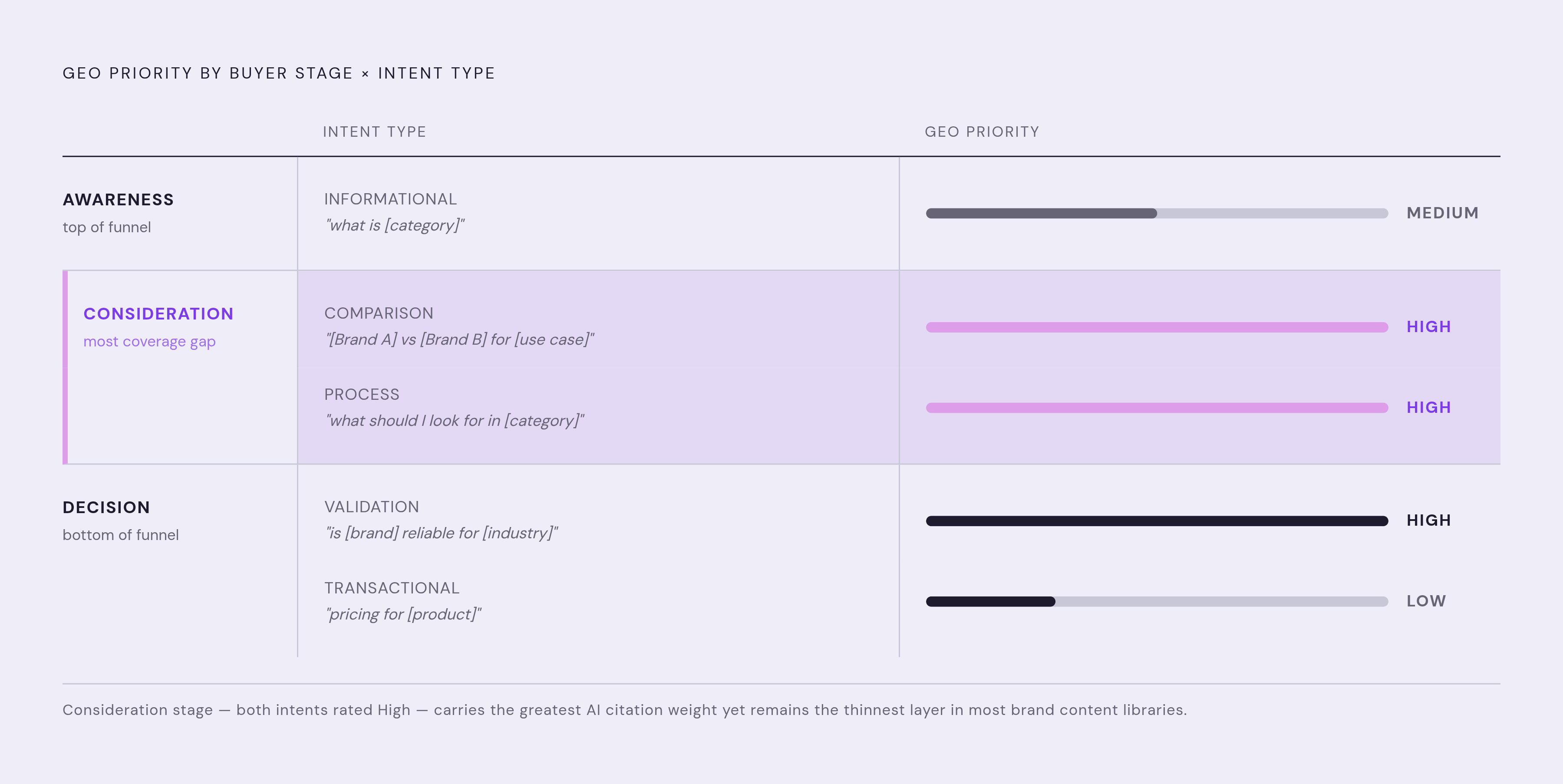
Buyer stage adds the second axis. Awareness-stage queries are definitional and category-level: "what is [category]," "why does [problem] happen," asked by someone who doesn't yet know a solution exists. Consideration-stage queries are comparative and evaluative: "X vs Y," "best [category] for [use case]," "what should I look for in [category]," the exact language of someone building a shortlist inside an AI conversation. Decision-stage queries test whether a brand on that shortlist survives scrutiny: "is [brand] reliable," "what do [role] use for [task]," "has [brand] worked for [industry]." HubSpot's research notes that consideration-stage questions in particular demand comparisons, frameworks, and real proof points, and that a brand absent from AI-generated comparison answers can lose buyer mindshare before a single click happens.
This mapping tends to expose an uncomfortable gap. Most brand content clusters at the two ends: definitional pages for awareness, product pages for decision. The middle, the comparison and validation queries where AI citation carries the most commercial weight, is usually the thinnest part of the content library. A simple matrix makes this visible at a glance:
| Buyer stage | Intent type | Example query | GEO priority | |---|---|---|---| | Awareness | Informational | "what is [category]" | Medium | | Consideration | Comparison | "[Brand A] vs [Brand B] for [use case]" | High | | Consideration | Process | "what should I look for in [category]" | High | | Decision | Validation | "is [brand] reliable for [industry]" | High | | Decision | Transactional | "pricing for [product]" | Low |
The output of this stage is a structured query matrix, with each cluster tagged by intent type, buyer stage, and an estimated GEO priority, which becomes the backbone for everything that follows.
Different answers across AI engines for the same query
No single AI engine owns this terrain. ChatGPT, Perplexity, Google AI Overviews, Claude, Gemini, and Copilot each retrieve information and build answers through different mechanisms. A brand can rank highly in how one engine cites sources and barely register in another, for the exact same question.
The citation patterns differ in specific, identifiable ways. ChatGPT tends to give disproportionate weight to Wikipedia presence and to traditional media citations from outlets like Forbes and Reuters. Google AI Overviews lean more heavily on YouTube content and professional platforms such as LinkedIn. Perplexity draws on community discussion forums and review platforms alongside the kind of traditional authority signals that have mattered in search for years. One model, notably, can execute embedded scripts when it evaluates a page, which changes what parts of a site it's able to read and cite compared to engines that work from static content alone.
These platforms are converging in some respects: ChatGPT now shows clickable links, Google increasingly folds AI-generated answers directly into its results pages, and Perplexity already blends traditional web search with generative synthesis. But convergence in interface doesn't mean convergence in citation logic, and the underlying systems still weigh sources differently enough that testing each one separately remains necessary. For query universe construction, this has a direct and practical consequence: each query cluster needs to be checked against each engine to find out where coverage already exists and where it doesn't. A gap on Perplexity is not the same problem as a gap on Google AI Overviews, and closing one won't close the other. Tracking cross-platform visibility, rather than relying on a single blended number, is the only way to see the full shape of where a brand actually stands in AI-mediated discovery.
Structuring content for AI extraction and citation
Once the query universe is built and sorted, the next job is making sure content is actually shaped so an AI system can pull an answer out of it cleanly. The thing doing the reading now is a model looking for a tight, extractable answer rather than a person scanning a page, which calls for a different content architecture than pages written for human skimmers or for traditional search rankings.
The foundational pattern is answer-first structure. Each piece of content should be built around one specific query from the universe, with that query used almost verbatim as a heading, typically an H2 or H3. Immediately beneath that heading, the first sentence or two should give a direct, complete answer, somewhere in the range of 40 to 60 words, with everything else on the page serving as supporting detail. Consider a B2B page built around the query "what is the best project management tool for a remote construction team": the ideal structure places that exact phrase as the H2, followed immediately by a 40-to-60-word answer naming the relevant features (offline mobile access, photo-based progress logs, permission tiers for subcontractors) before any further elaboration begins. That opening block is what an AI system extracts; the paragraphs that follow exist to support and substantiate it, not to carry the main point themselves.
Research backs up the value of going further than basic formatting. Work by Aggarwal et al. on generative engine optimization found that adding quotations from credible sources, relevant statistics, and citations each independently raised a source's share of the AI-generated answer. A separate 2024 study from researchers at Georgia Tech, Princeton, and IIT Delhi found that sites optimized specifically for generative engines achieve meaningfully higher AI citation rates than sites that haven't been optimized.
Schema markup plays a supporting role in this structure. FAQPage, HowTo, Organization, Product, and Service schema give AI systems a machine-readable version of the same question-answer relationship that the page content expresses in prose, and keeping entity details consistent across all of it (naming conventions, product descriptions, founding dates, factual claims) gives a model a stable fact to draw on when it fills a gap.
None of this works in isolation from what happens off the page. GEO is mostly a strategic discipline and only secondarily a technical one: positioning, presence across the broader ecosystem, and brand authority built through earned media, third-party citations, and analyst mentions all come before schema and formatting, because an AI model synthesizes an answer from a brand's entire digital footprint, not from its homepage alone. One industry guide puts it this way: AI doesn't read a brand's website first, it reads its reputation. The final step closes the loop back to the query matrix built earlier: once content exists for the queries already covered, that same matrix shows which clusters still have no content behind them. Those gaps are where an AI engine has nothing of the brand's to cite, and will either leave the brand out of the answer entirely or fill the space with a competitor instead.
Measuring whether the query universe is working: share of model
A query universe isn't finished once it shapes content. It has to double as the measurement instrument: the same structured set of prompts used to guide content decisions is the set a brand should run, repeatedly, to check whether AI engines are citing it.
The core metric here is share of model, sometimes called share of voice in AI answers: the percentage of AI-generated responses to a defined set of strategic prompts that mention the brand. That prompt set has to come directly from the query universe, or the number it produces won't mean much. The term itself is credited to Jack Smyth and Tom Roach, who coined "share of model" as the AI-era successor to share of voice, with the key distinction that this kind of visibility is earned rather than bought: there's no media buy that guarantees a citation inside a model's synthesized answer.
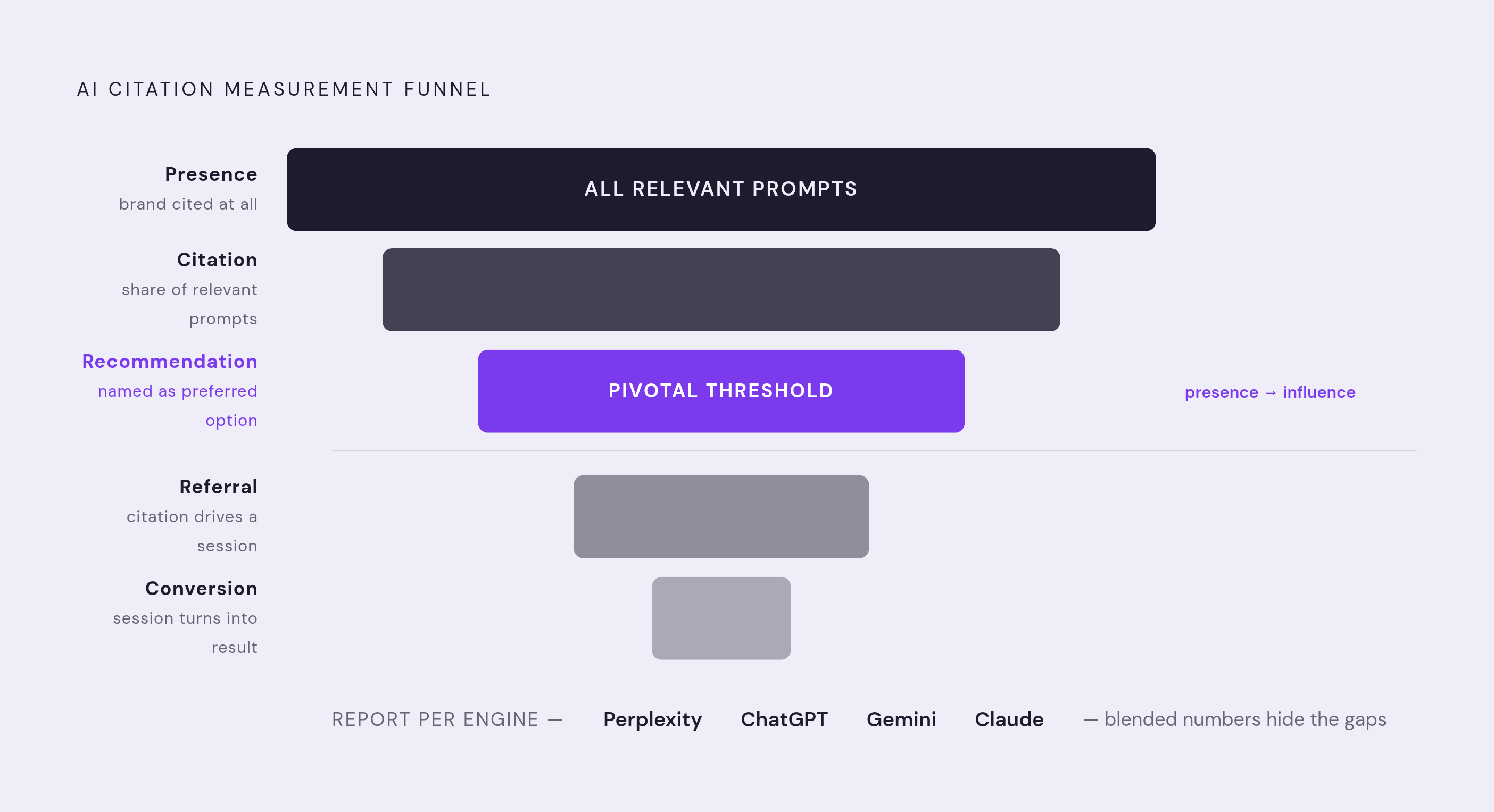
Measurement has to happen per engine, not in aggregate. The same brand, tested against the same query set, can produce dramatically different citation rates across Perplexity, ChatGPT, Gemini, and Claude, and blending those numbers into one score hides exactly the gaps a team needs to see in order to act. Brand Mention Rate, Recommendation Rate, Prompt Coverage, and Share of Model should each be reported separately, engine by engine.
This measurement work maps onto a full funnel: presence (is the brand cited at all), citation (across what share of relevant prompts), recommendation (is it named as the preferred option, not just mentioned), referral (does that citation actually drive a session back to the brand), and conversion (does that session turn into something). Each layer is trackable on its own, and each one traces back to the query universe that defined what counted as "relevant.
Brand integrity belongs inside this same measurement discipline. It isn't enough to confirm that an AI engine mentions a brand; what matters just as much is what it says while doing so. An outdated or simply wrong description can shape a buyer's impression before the brand ever gets a chance to correct it, and a well-built query universe makes it possible to monitor that risk on a regular schedule.