Iterative Optimization Cycles for AI-Cited Pages
Treat AI citation as a continuous experiment, not a stable ranking to chase.

AI citation does not behave like a search ranking, and treating it like one is the single biggest reason brands waste months chasing a visibility strategy that never stabilizes. A ranking is a fixed position: a page is number three, and it tends to stay near number three until something changes. A citation is a probability draw: a brand might show up in most responses to a query this week and in a small fraction of them the next, with no ranking logic to explain the swing.
Why AI citation is not a ranking
The instability has a structural cause, not a random one. A large share of the sources cited across Google AI Mode and ChatGPT change from month to month. The pool of material these systems draw from is itself in motion. A brand is competing to be resampled from a shifting set of sources every time a model generates an answer, and the set it draws from this month may look different by next month regardless of anything the brand does.
Layered on top of that instability is a second fact that reshapes the whole optimization problem: GEO is primarily a game played on other people's platforms, not on your own site. When a buyer asks an AI system which brand to trust, the model synthesizes its answer from industry publications, analyst reports, consumer reviews, and earned media. The homepage barely factors in. That means optimizing your own site, while necessary, cannot be the whole strategy. A brand can polish its own pages to a shine and still go unmentioned because the model is pulling its answer from a review site, a forum thread, or a trade publication the brand has no presence in.
The third fact compounds the first two: the citation sets barely overlap across platforms. Domains cited on ChatGPT and domains cited on Perplexity share very little common ground, so a brand that earns strong visibility on one platform cannot assume that visibility carries over to another. Each platform is, in effect, running its own separate citation economy.
Those three facts together mean the old playbook falls apart. You cannot rank your way into consistent AI visibility, because there is no stable position to claim. The only coherent response to a probabilistic, third-party-driven, platform-fragmented system is to stop treating any single page as a finished asset and start treating it as an open experiment: something to measure, diagnose, adjust, and measure again.
The Iterative Optimization Loop
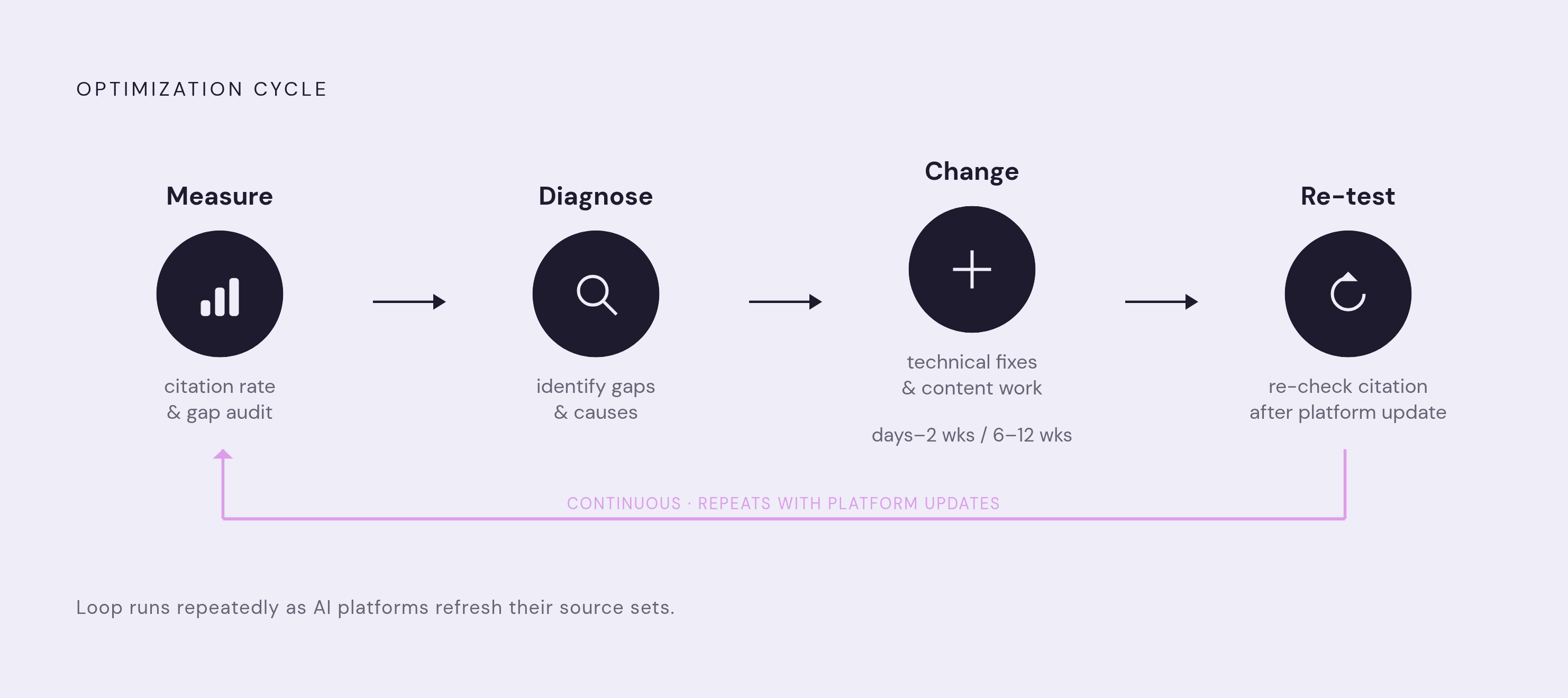
That experimental posture has a shape, and it runs as a defined four-stage cycle: measure, diagnose, change, re-test.
The cycle starts with measurement. A team establishes a citation baseline across platforms, tracking how often its brand shows up in AI-generated answers compared to competitors. This is the stage where you find out where you actually stand before touching anything.
From there, the team diagnoses why a given page is or isn't surfacing. Citation gaps come from a handful of distinct root causes, each with its own fix, and the work here is figuring out which cause is operating on which page.
Once the cause is identified, the team makes a change matched specifically to that diagnosis. A generic list of "GEO best practices" applied uniformly across every page wastes effort, because a technical fix does nothing for a page suffering from an off-site authority gap, and a content rewrite does nothing for a page a crawler cannot even read.
Finally, the team re-tests the same queries across the relevant models to see whether citation rate actually moved. Not traffic. Not rankings. Citation rate, measured the same way it was measured at baseline.
These four stages do not run at the same speed, and sequencing matters because of it. Fixing a technical access problem, such as unblocking a crawler or moving content out of a JavaScript-rendered tab, can show measurable impact in roughly days to two weeks. Restructuring content for better extraction is slower, typically taking six to twelve weeks to move the needle. A team that expects a content overhaul to produce results on the same timeline as a technical fix will misread normal lag as failure.
The loop does not close. Re-testing produces new findings, and those findings feed directly into the next diagnosis. This is a continuous operating rhythm, run repeatedly as platforms update their source sets and competitors make their own changes.
Establishing a citation baseline: what to measure before you change anything
None of the four stages work without a credible starting point, and that starting point is a defined Share of Model baseline, broken out by platform, measured before a single change is made. If this step is skipped, every later result becomes unreadable, because you have no way to tell whether a shift in citation rate came from the change you made or from the normal churn in the model's source set.
Share of Model is the right metric to anchor a baseline because it reflects the probabilistic nature of the problem directly. A large language model might mention a given brand in most of its responses to a query like "best organic skincare," or it might mention that brand in only a small minority of responses to the same query. A single query, run once, cannot tell you which of those is true. Only repeated sampling across a defined set of queries reveals the actual rate, and that rate is the number a baseline needs to capture.
Platform coverage has to be tracked separately rather than folded into one aggregate figure, because the same brand answering the same query can show sharply different mention rates on Perplexity, on ChatGPT, and on Gemini. The citation pools behind these platforms barely overlap, so a single blended score hides exactly the gaps a team most needs to see. A brand performing well on one platform and poorly on another needs to know that split, not a number that averages the two into something falsely reassuring.
A workable measurement stack for this purpose has three tiers. The visibility tier tracks citation rate, share of voice, and platform coverage broken down by query segment. The traffic tier tracks AI referral sessions against organic conversion rates inside standard analytics tools. The business tier tracks pipeline correlation, lift in branded search volume, and self-reported discovery channel data gathered from demo or inquiry forms. Each tier answers a different question, and a baseline that only covers the visibility tier will struggle to make the case, later, that any of this work affected revenue.
One recent development changes what's available at the visibility tier. As of August 31, 2026, Google Search Console began surfacing impressions from AI Overviews and AI Mode for sites worldwide, though not every property may yet have access to that data. This gives teams a direct impressions signal tied to Google's AI surfaces rather than an inferred one, making it a meaningful addition to the baseline toolkit. It still measures impressions, not pipeline, so it belongs in the baseline stack as one input among the three tiers, not as a replacement for the business-tier work that connects visibility to revenue.
The baseline is the comparison point every later cycle gets measured against, and a team that treats it as a one-time exercise loses the ability to distinguish real improvement from the ordinary noise in a probabilistic system.
Diagnosing why a page is not being cited: the four failure modes
Once a baseline exists and a gap is visible, the work turns to finding the cause. Most citation failures trace back to one of four root causes, and the fix depends entirely on identifying the right one. Applying a content fix to a page suffering from a technical access problem produces no movement at all, because the model can't read the improved content any better than it could read the old content.
The first failure mode is technical access. Most AI crawlers, including GPTBot, ClaudeBot, and PerplexityBot, cannot read content that is rendered through JavaScript, hidden inside tabs or accordions, or loaded dynamically after the initial page load. Googlebot is a notable exception here, since it feeds Google AI Overviews and Gemini and renders JavaScript using headless Chromium, so a page invisible to GPTBot may still be visible to Google's systems. The diagnostic question for this failure mode is simple and concrete: is the page's key content present in the raw HTML source, or does a user (or a bot) need to click, hover, or expand something to see it? If the answer sits behind an interaction, a crawler that doesn't execute scripts will never see it, regardless of how well-written it is.
The second failure mode is freshness decay. Pages that go without an update for an extended stretch, roughly a quarter or longer, become substantially more likely to lose citations. The diagnostic question here is whether the page has a legitimate, visible update in the last few months, not just a changed timestamp but revised facts, figures, or examples that reflect something the earlier version didn't have.
The third failure mode is an off-site authority deficit. AI engines treat mentions in outside sources as a trust signal, and a brand whose only presence is its own description of itself carries less weight in a model's eyes than one that shows up across credible third-party sources. Sites with strong referring domain profiles tend to be cited more by ChatGPT than sites with minimal backlinks, though this relationship behaves more like a threshold to cross than a smooth, continuous advantage, and brand mentions (being talked about, even without a link) carry a signal that's at least as strong. AI engines also pull frequently from Reddit, YouTube, and LinkedIn, so a brand with no footprint in those three ecosystems is simply missing from a meaningful part of the source set a model consults. Check which third-party sites the target AI engine cites most often for the relevant query category, then honestly assess whether the brand shows up anywhere in that list.
Tracing a citation gap to one of these causes turns a vague sense that "the page isn't working" into a specific, answerable question, and that specificity makes the next stage of the loop effective.
Making targeted content changes that move citation rate
Once a cause is identified, the interventions that follow share one underlying mechanism: they make it easier for a model to extract a confident, citable answer from the page, and they raise the density of signals a model reads as authoritative.
For pages suffering from poor extraction, the research on this points to a short list of changes with outsized effect. Adding quotations from credible sources produces a substantial lift in how much of a generated answer a given source ends up occupying. In the Aggarwal et al. study, quotation addition scored the strongest result on the paper's primary position-adjusted word count metric, with statistics addition and citing sources close behind and, on some secondary metrics, ahead of it. Improving the plain readability and fluency of a page, and adding inline citations to outside sources within the body text, each produced meaningful gains as well. Embedding a specific, verifiable fact attached to a named source at regular intervals through a longer page keeps that fact density consistent.
Structural formatting changes address a related but distinct problem: whether a model can extract the content at all, cleanly, once it finds the page. HTML tables, question-and-answer blocks (particularly ones marked up with FAQPage schema), structured lists, and paragraphs that lead with a direct definition are among the formats AI engines pull from most reliably. Long-form narrative writing and unstructured blog posts get extracted far less often, even when the underlying information is accurate and complete, simply because the model has a harder time isolating a clean, quotable answer from them.
For a diagnosed off-site authority deficit, the fix lives off the brand's own site. Guest articles placed in industry publications, mentions picked up by analysts, a visible presence on review platforms, and participation in the community forums an AI engine already pulls from are the moves that shift the third-party signal environment a model is reading. This work runs on a different cadence than on-site content changes and should be tracked as its own line of effort.
One intervention belongs on a list of what to avoid rather than what to try: keyword stuffing. In the Aggarwal et al. findings, keyword stuffing actually reduced position-adjusted word count, making it worse than neutral. A page padded with repeated keywords doesn't just fail to help; it actively works against the citation outcome a team is trying to produce.
Re-testing across models and knowing when a change has worked
A change that lifts citation rate on one model doesn't necessarily do anything on another, so re-testing has to sample the full set of platforms where the brand needs visibility. Checking the result on a single platform and declaring the work done produces false confidence, given how little the citation sets overlap across systems.
The query set used for re-testing should mirror how buyers actually talk to these systems. Buyers ask ChatGPT, Perplexity, and Google AI Mode the same kinds of questions they used to type into Google, so the re-test queries need to reflect full natural-language questions. Queries built around framings like "best," "trusted," and "recommend" are worth including specifically, since these phrasings increase the likelihood a brand gets named and reflect how real buyer intent sounds.
Because the underlying system is probabilistic, a single response before and a single response after a change prove nothing. Each query in the set needs to run multiple times both before and after the intervention, and the signal to look for is directional movement in mention rate across the whole query set, not the appearance of one lucky citation.
Divergence between platforms at re-test is itself useful diagnostic information, not just noise to average away. If citation rate improves on Perplexity but stays flat on ChatGPT, that gap usually points to a different failure mode behind each platform, often an off-site authority gap on the ChatGPT side and a freshness issue on the Perplexity side. Reading that divergence correctly sends the team straight back into the diagnosis stage with a sharper, platform-specific question than the one it started with.
The strongest re-test results connect citation movement to business signals, not just visibility counts. Correlated lift in branded search volume, in AI referral sessions, and in self-reported AI discovery on inquiry forms together build the kind of triangulated picture that holds up in front of a board. The AI Overviews and AI Mode impressions data that Google Search Console has surfaced since August 31, 2026 adds one more layer to that picture, measuring impressions rather than confirmed pipeline like the rest of the visibility tier.
What a re-test ultimately confirms is not that a page is fixed, but that the loop worked once. Consistent citation is the product of running this cycle repeatedly, measuring, diagnosing, changing, and re-testing, as the platforms, the competitors, and the underlying source sets keep shifting beneath it.


