Cross-Functional AEO Team Roles and Handoff Workflows
AI search reshapes how brands must coordinate across engineering, content, PR, and analytics.

AI search has changed where a buyer's decision actually gets made, and that change is what turns AEO into a problem no single team can own. Buyers now form what amounts to a shortlist inside a conversation with an AI system well before they land on a brand's website, so the brand's standing is decided before any owned channel ever gets a turn. The strategic work behind that standing (positioning, presence across the wider ecosystem, authority within a category) runs through brand, content, PR, analyst relations, and product marketing all at once, putting it in the CMO's span of control. Writer's enterprise guide describes generative engine optimization as "primarily a third-party game": when someone asks an AI system which brand to trust in a category, the answer gets built from industry publications, analyst reports, consumer reviews, and earned media. That means the work that actually moves citation share is split apart from the start: technical access belongs to engineering, answer-shaped writing belongs to editorial teams, off-site authority belongs to PR and comms, and measurement belongs to analytics, with no single team holding all four at once. Left alone, each function will keep optimizing its own slice while the connective tissue between them goes unattended, so the real question an organization has to answer is not who owns AEO, but who owns each stage of the work and how that work actually moves from one owner to the next.
The four functional shapes that AEO work takes
AEO work sorts into four distinct scopes, each demanding a different set of skills, reporting into a different part of the organization, and producing a different kind of output, so treating the whole thing as one job or one team's job is where most execution gaps start. Sloane Staffing looked at AEO and GEO job postings in August 2026 and found four such shapes by tracking how similar work showed up under different titles across the market. The technical shape covers structured data, making a site crawlable to AI agents, site architecture, and data feeds, and it usually reports to the head of SEO or to engineering. The content shape covers answer-shaped writing, entity coverage, and editorial standards, and it usually reports to a content or brand lead. The off-site shape covers review sites, comparison pages, forums, PR, and the broader set of sources that models actually cite, and it usually reports to demand generation or comms. The measurement shape covers prompt-set testing, citation tracking, attribution, and reporting, typically sitting with marketing ops or analytics. These four shapes are not arbitrary categories: the technical shape builds the infrastructure that the content shape writes into, the content shape produces the material the off-site shape distributes, and the off-site shape builds the third-party presence that the measurement shape then tracks. Sloane Staffing's analysis also found that very few people are genuinely strong across all four shapes at once. AEO hiring tends to fail on a vague job scope rather than a shortage of good candidates, and deciding which shape is actually being hired for, before the job req goes live, is the single highest-leverage decision most teams skip. The shapes also work as a diagnostic: if competitors keep getting cited and a brand doesn't, the gap is in the off-site shape; if the content is strong but models still can't parse it, the gap is in the technical shape.
AEO workflow ownership by stage
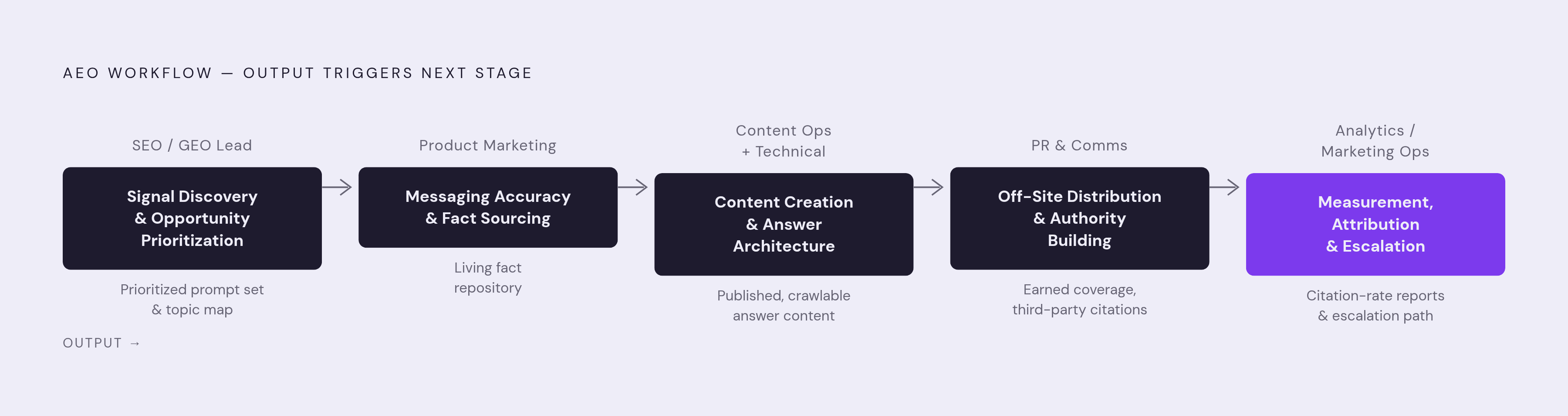
A working AEO workflow assigns a primary owner to each stage and a specific output that triggers the next stage, and without that handoff logic spelled out, work simply stalls at the boundary between functions. Stage one is signal discovery and opportunity prioritization, owned by the SEO or GEO lead. Its output is a prioritized set of prompts and a topic map showing where the brand is absent, misrepresented, or losing out to competitors in AI-generated answers, and this output is what triggers the content team's brief. Writer's enterprise guide calls the metric this stage is built to move "share of model," the measure of how often a brand shows up in AI-generated answers relative to its competitors, positioned as the AI-era successor to share of voice. Stage two is messaging accuracy and product-level fact sourcing, owned by product marketing. Its output is a living fact repository of approved claims, positioning language, and product capabilities that content operations draws from during drafting. LSEO's guide to enterprise AEO workflows points out that no single central team can hold factual accuracy and strategic nuance across a wide product line by itself: product marketing understands positioning, product managers understand what the product actually does, and support teams hear the real questions customers ask. Fact sourcing is a distributed job that product marketing has to coordinate. Stage three is content creation and answer architecture, where content operations owns the drafting and the technical shape owns the structural review. The output is published content that reads as an answer and is technically reachable by AI crawlers. Before writing starts, the SEO or AEO team shares its research on target questions, structured data needs, and user intent with writers; during drafting, writers fold that guidance into the brand's voice; before publishing, a technical check confirms the piece is crawlable and AI-friendly. Writer's guide is specific that AEO content has to be built differently from content written for traditional search, with answer-first structure and easily extractable blocks as the features that define AEO work (context-rich framing, by contrast, is a GEO feature in Writer's framing, not an AEO one). Stage four is off-site distribution and authority building, owned by PR and comms. Its output is earned editorial coverage, third-party citations, a presence on review platforms, and participation in forums, all of which give AI models outside signals to draw on. The AEO/GEO retail playbook is direct that retailers and brands need to design off-site distribution and PR strategy as a deliberate part of AEO and GEO work. PR needs to work from the same prompt-derived opportunity map that SEO produces in stage one. Stage five is measurement, attribution, and escalation, owned by analytics or marketing ops. Its output is citation-rate reporting broken out by engine, brand representation accuracy scores, and a clear escalation path for when an AI platform misrepresents the brand.
Choosing the right structural model: centralized hub vs. embedded specialists
The stage map above can live inside either of two organizational structures, and picking the wrong one for a company's size and complexity can create enough coordination overhead to cancel out the clarity the map was supposed to provide. The first option is a centralized GEO hub, where all four shapes report to a single team lead and operate as one unit. This model tends to work best for mid-size brands where AI discoverability is already a primary growth lever and where coordination across channels is critical to getting it right. A centralized hub cuts down on duplicated effort, keeps messaging consistent, and lets resources move quickly across the four shapes as priorities shift. The second option is an embedded model, where GEO specialists sit inside existing marketing pods such as content, PR, performance, and product marketing, with a lightweight coordinating layer, often called a GEO Council or a standing weekly sync, holding the cross-pod work together. This model suits large enterprises with established team structures where a full reorganization isn't realistic. It demands stronger governance to keep execution from splintering into silos, and the coordinating layer's job is to maintain the shared prompt set, the content calendar, and the escalation path across every pod involved. Neither model changes who owns each stage. What changes is where those owners physically sit and how often they have to communicate: a centralized hub shortens the path between handoffs, while an embedded model lengthens that path in exchange for keeping deep domain expertise inside each existing team.
The mechanics of a shared AEO workflow
Organizational structure decides where the owners sit, but the mechanics of the workflow decide whether the handoffs between them actually happen, and in most teams, those mechanics are the piece left undone. The first mechanism is a unified cross-channel content calendar, spanning SEO content, off-site distribution, and influencer activity, tagged by channel, format, and funnel stage. A single long-form piece built for AI citation can also generate social content, influencer talking points, and structured FAQ blocks, but only if every downstream use of that piece is visible at the planning stage, which a unified calendar makes possible. When SEO content and PR pitching run on separate calendars, owned content and off-site authority end up misaligned, so brands keep publishing regularly while still going uncited. The second mechanism is a pre-creation research brief shared across functions: before any content gets written, the SEO or GEO lead passes target questions, structured data requirements, and user intent signals to writers and product teams. This brief is the formal handoff between stage one and stage three, and without it, content teams default to writing in brand voice rather than in the extractable answer patterns AI models actually pull from. The third mechanism is a technical review gate before publication, the handoff from the content shape to the technical shape: a structured data and crawlability check confirming that AI crawlers aren't blocked in robots.txt, that the content isn't locked behind JavaScript rendering, and that the right schema markup is in place, all required before any AEO-targeted content goes live, a check that gets skipped constantly when the two shapes sit in different parts of the org with no documented dependency forcing it to happen. The fourth mechanism is a living brand entity knowledge base, maintained jointly by product marketing and content operations, holding approved brand claims, product facts, and authoritative sources that every content creator and PR team draws from. Consistency across owned channels, including the website, the Google Business Profile, social bios, and press coverage, has a direct effect on how accurately AI models represent the brand, and inconsistency across those channels is one of the main reasons models end up hallucinating or repeating outdated descriptions. The fifth mechanism is a data-driven weekly sync, a standing cross-functional meeting built around performance signals, such as AI citation trends, shifts in organic visibility, and gaps in off-site coverage.
Where handoffs break down: unmanaged seams between teams
Most AEO execution failures don't come from a flawed strategy. They come from work falling through a specific, predictable seam between two functions that each assume the other is covering it. The first seam sits between SEO and PR: SEO builds the opportunity map showing where the brand is missing from AI responses, and PR runs the outreach campaigns meant to close that gap. Without a formal handoff, PR ends up pitching topics that have nothing to do with the actual citation gaps, and the authority it builds doesn't move the citation metrics SEO is watching. The AEO/GEO retail playbook is explicit that off-site distribution and PR have to be built into AEO and GEO strategy rather than run as a separate brand function, and that framing identifies the failure here as organizational. The second seam sits between product marketing and content operations: product marketing holds the authoritative facts about the product and its positioning, while content operations writes the pages AI models actually index. When there's no structured way to pull facts from product marketing into the drafting process, writers fall back on whatever the existing page copy says, which may already be out of date or not shaped as an answer. The third seam sits between content operations and engineering: an answer-shaped page blocked by JavaScript rendering or by a restricted AI crawler is invisible to a model no matter how well it's written. The technical review gate described above exists to close exactly this seam, and it fails whenever content and engineering run on separate publishing timelines with no formal dependency connecting the two. The fourth seam sits between analytics and everyone else: citation-rate data and brand representation scores only matter if they reach the owner who can act on them inside a cycle fast enough to still be relevant. None of these seams are mysterious once named, and that predictability is the point: a seam that can be named in advance is a seam that can be designed around before it costs a brand its citations.
How measurement closes the loop across functions
Measurement in a cross-functional AEO workflow does more than report what already happened. It's the mechanism that routes the next round of work back to the right owner, and that routing function lets the workflow correct itself as conditions change. The central object of measurement is citation share, tracked separately by engine. Sloane Staffing's 2026 analysis points out there's no equivalent of Search Console for AI citation, so the measurement function has to build this signal itself through prompt-set testing run across engines, which makes it a constructed metric, not one any platform hands over directly. Keeping that measurement broken out by engine matters because AI citation behavior differs meaningfully from one platform to the next: a single blended citation score obscures which function's work, whether technical, content, or off-site, is actually moving results on which surface. A second layer of measurement is brand representation accuracy: testing brand-specific prompts across major platforms to catch hallucinated claims, outdated product information, or positioning the brand never actually claimed, with findings feeding straight back to the product marketing and content operations owners responsible for the knowledge base. The measurement function's weekly output should answer three routing questions: which citation gaps call for new content, which routes to content operations; which citation gaps call for more off-site authority, which routes to PR; and which representation errors call for a correction in the knowledge base, which routes to product marketing. That routing is what turns the weekly sync into a decision meeting instead of a status update, since the measurement data sets the agenda and names who owns the next move. For executive reporting, AI visibility metrics deserve the same scrutiny applied to any other marketing channel: share of model trends, citation rate broken out by product category, and representation accuracy scores are the outputs a mature cross-functional AEO workflow should be able to put in front of a board.


