Citation-Earning Content Templates for Comparison Queries
AI systems skip comparison content that buries verdicts in prose instead of stating them clearly.

Comparison content works differently than search-optimized content, and most brands still write it for the wrong audience. When a buyer asks an AI system to compare two tools, a category of vendors, or two approaches to a problem, the model is hunting for content that has already done the comparative work. It's hunting for content that has already done the comparative work: entities named, dimensions scored, verdicts stated. Content that hasn't done that work gets skipped, regardless of how well it ranks in traditional search.
That gap matters because comparison queries mark a specific moment in a buyer's decision. Someone typing "X vs. Y" Someone typing "X vs. Y" or asking an AI for "the best options for Z" is evaluating, often close to a purchase. They're evaluating, often close to a purchase. Gap analysis for e-commerce treats these as high-intent moments for exactly this reason: the buyer has moved past discovery and into judgment. Yet available measurement on comparison prompt mention rates consistently shows brands appearing at substantially lower rates than they do for branded prompts. Brands go nearly invisible at the exact moment a buyer decides between them and a competitor. It's a structural problem, and it has a fix. It's a structural one, and it has a fix.
How AI systems process and cite comparison queries
A retrieval-augmented generation pipeline handles a comparison query in five stages, and each one behaves differently than it does for a single-entity question.
First, the system parses the query to figure out which entities are being compared and which dimensions the buyer cares about, price, features, use case fit, and so on. Second, it retrieves candidate pages that are semantically relevant to that entity set and those dimensions. Third, it ranks and scores those candidates on relevance, authority, recency, and structural quality. Recency carries real weight here: one analysis found AI-surfaced URLs run about 25.7% fresher than traditional search results, which tells you these systems actively favor content that's been touched recently.
Fourth comes synthesis, and this is where most comparison content quietly fails. The AI has to extract facts across multiple sources and stitch them into a side-by-side answer. If a page buries its comparative facts inside dense prose, the model has to do inference work it would rather not do. It will reach instead for a page that already organizes the entities, the dimensions, and the verdict into an extractable form. Fifth, citation: the engine attributes specific claims to specific sources, and content with clean, citable facts wins that attribution over content that hides its evidence in narrative paragraphs.
One measurement of AI search citation patterns found that roughly 85% of brand mentions in AI search come from third-party pages rather than brand-owned domains. For comparison queries specifically, review sites, analyst write-ups, and trade press often do the citation-winning work. Brands can still build first-party comparison pages that earn citations, but only if those pages are built to the same structural standard a good third-party comparison would meet. Separate research on retrieval behavior found that these systems favor pages that answer directly and completely within the first 40 to 60 words, that use clear H2 and H3 headers aligned with how people phrase their queries, and that embed specific data points the model can lift wholesale into its answer. Content that has been indexed and referenced across multiple sources also tends to accumulate broader citation reach over time. Structural quality is the mechanism. It's the mechanism.
The five structural components that comparison content must contain to earn citations
The query-matching headline and opening block. The headline needs to name the actual entities being compared and the decision context, something like "Tool A vs. Tool B: Which Fits a 10-Person Sales Team?" rather than a vague category title. Then the opening block has to deliver the answer immediately, within the first 200 words: no scene-setting, no history of the category, just a direct verdict. A direct recommendation sitting right at the top of the page is among the most extractable units in the entire piece.
The structured comparison matrix is a table, or clearly parallel sections, that maps every entity against the same set of dimensions. Those dimensions should mirror how buyers actually think: use case fit, pricing tier, core features, known limitations, ideal user profile. Tables get extracted; prose that requires inference does not. Foundational research on generative engine optimization, published by Aggarwal and colleagues at KDD in 2024, found that embedding statistics and citations from credible sources produced a measurable lift in how often content gets pulled into AI-generated answers. Put sourced figures inside the matrix cells themselves where the data supports it.
Entity-specific deep sections: after the matrix, each option compared gets its own dedicated section: what it is, who it's built for, its concrete strengths, its concrete limitations. This does double duty. It reads well for humans, and it gives the AI clean boundaries for entity resolution, so the model doesn't have to guess which fact belongs to which brand. That confusion is a documented source of hallucination; ambiguous entity boundaries force a model to fill gaps with invented detail. Each section should carry at least one specific, citable claim, a sourced number, a named feature, a documented outcome.
Use-case-based verdict blocks should be written as "Choose Option A if you need X" and "Choose Option B if your team does Y." These are the exact units models reach for when resolving a follow-up question like "which is better for a five-person startup." Vague superlatives ("great for most users") don't get cited because there's nothing in them to extract. Specificity is the whole point. Hedged non-answers get skipped.
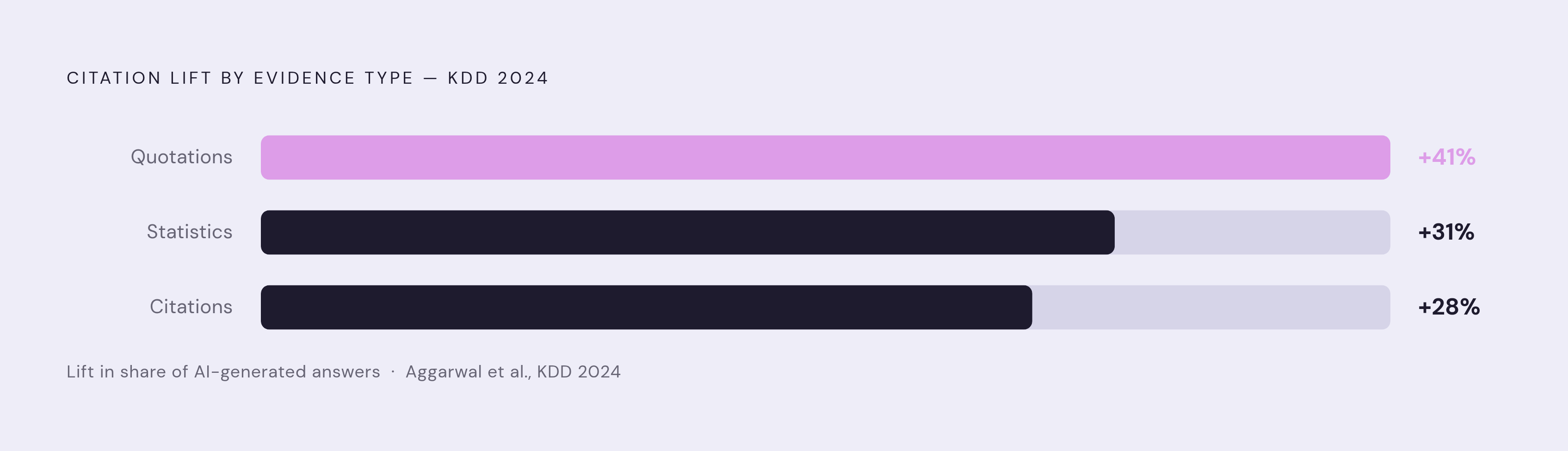
Supporting evidence layer: inline citations to primary sources, vendor documentation, named practitioner quotes where they exist. The KDD research quantified this: quotations from credible sources produced roughly a 41% lift in share of AI-generated answers, statistics produced roughly 31%, and citations roughly 28%. Evidence isn't decoration here, it's the actual mechanism by which content earns a citation. Date-stamp everything, because these systems actively weight recency during retrieval for fast-moving queries.
Two template formats
Two formats cover nearly every comparison query a buyer might ask.
Template A, the direct head-to-head, fits binary "X vs. Y" queries where the buyer has already narrowed to two named options. The structure includes a headline naming both entities and the decision context, an opening verdict block of 150 to 200 words, a side-by-side table across six to ten dimensions, a full section on Option A, a full section on Option B, a "which to choose" section built from "Choose A if / Choose B if" statements, and a short FAQ block phrased the way buyers actually ask questions. The opening verdict and the "choose if" statements are the highest-extraction units on the page. The most common failure mode is burying the verdict at the bottom after pages of entity description. Since these systems retrieve early content preferentially, a late verdict might as well not exist.
Template B, the category roundup, fits "best X for Y" queries where the buyer hasn't built a shortlist yet and is asking the AI to build one. Structure: a headline naming the category and use case, an opening summary that states the evaluation criteria and names a top pick immediately, a quick-reference table across four to six shared dimensions, a section per option covering its best-for statement, strengths, limitations, and one citable evidence point, a "how it was evaluated" methodology section, and a closing verdict organized by buyer profile. One measurement found that 38% of AI Overview citations trace back to pages already ranking in the top 10 on Google. This template still has to satisfy conventional search signals alongside the structural ones. The methodology section is underused and worth the effort, since it signals expertise and gives the model a citable frame for why the piece is trustworthy. The common failure here is a list of options with no real differentiation between them, which gives a model nothing to resolve.
The choice between the two is mechanical. Two named entities, use Template A. A best-of or top-options request, use Template B. If a brand wants to appear alongside named competitors in a category query, Template B still applies, with the brand included as one option evaluated on its actual merits, not inflated above the rest.
Comparison content that gets cited versus content that gets passed over
Information gain is the real dividing line. A comparison piece has to contribute something a model can't already produce by combining other sources it has access to, otherwise there's no reason to cite it over a dozen similar pages.
That gain can take a few forms: original testing or proprietary data nobody else has published, an evaluative framework that reframes how the category gets judged instead of recycling the obvious dimensions, named practitioner perspectives that don't exist elsewhere, or outcome data drawn from real use, not hypothetical scenarios dressed up as evidence.
Verdict language has to be specific to be usable. "Option A is better for enterprise teams running complex, multi-stage approval workflows" gets extracted. "Option A is great for most users" gets ignored, because there's nothing in that sentence a model can attach to a real buyer profile. Dimension selection is itself a signal of expertise: choosing the evaluative axes that actually drive a purchase decision, rather than defaulting to price and ease-of-use, tells both readers and models that the content understands the category. Generic dimensions produce generic, uncitable output.
Freshness isn't optional in categories that move fast. SaaS pricing changes, feature sets shift, AI tools get rebuilt every few months. Comparison content in those categories needs review at minimum every six to nine months, with a visible date stamp, because these systems actively favor recently updated content during retrieval.
Third-party corroboration also compounds. Since brands are measured as being far more likely to be cited through a third-party source than through their own domain, a first-party comparison page gains real citation authority when its verdicts get echoed in trade press, analyst commentary, or community discussion elsewhere. Content strategy for comparison pages should plan for that amplification layer rather than treating the owned page as the whole effort.
Schema markup and metadata that make comparison content machine-readable
Schema markup isn't mandatory, but it materially improves how easily an AI system can extract and contextualize a comparison page.
ItemList schema signals that a page contains an enumerated set of comparable options. Product schema, where it applies, enables entity-level attribution of features, pricing, and ratings. FAQPage schema marks up individual question-and-answer pairs so they can be pulled as standalone units rather than requiring the model to parse them out of a paragraph. Article schema with a populated dateModified field surfaces the freshness signal these systems weight during retrieval.
A short metadata checklist covers the rest. The title tag should name every entity being compared, not just the category. The meta description should carry the actual verdict or recommendation. Both datePublished and dateModified need to be accurate and current. Author metadata with visible credentials on the page reinforces the expertise and trust signals these systems weigh alongside relevance.
A comparison page should link out to dedicated pages for each entity it covers, which reinforces entity resolution and builds a topic cluster a model can traverse to confirm facts. Thorough JSON-LD markup makes it materially easier for AI systems to extract and attribute structured facts from a comparison page. It's not a marginal edge.
Measuring whether your comparison content is earning citations
Citation frequency across the AI engines resolving comparison queries is the metric that matters, not organic rank, and not traffic in isolation. A page can rank well and drive clicks while never appearing in an AI-generated comparison answer.
Available measurement on comparison prompt mention rates gives a baseline to measure against. A page that earns consistent citations across multiple AI engines is performing well; one that rarely appears in AI-generated comparison answers is underperforming regardless of its organic rank.
Tracking should focus on two things: whether the brand or its comparison page gets cited when an AI resolves a relevant head-to-head query, and which competing entities the model names alongside the brand when it does. That second data point matters as much as the first, because it shows exactly who the AI considers the real competitive set, which is often not the same set a brand assumes it's up against.