Prose Density Versus Table Formats in AI-Extracted Answers
AI systems cite tables 2.24 times more often than prose, but format choice depends on query type.

Content format now functions as a gating mechanism in AI search. When a chatbot or AI overview answers a question, it pulls specific passages out of a pool of documents and hands those passages to a language model to synthesize into an answer, and the structure of each passage, not a page's overall ranking, decides whether it survives that process. This article lays out what the evidence says about tabular structure versus dense prose, where each one wins, and what it costs a brand when the wrong format gets used.
Content format as a first-order variable in AI citation
The mechanism behind Perplexity, Gemini, and Google AI Overviews, and ChatGPT when its web search or file-retrieval features are turned on, runs the same basic steps regardless of which company built it. Nothing in that chain cares about a page as a whole. It cares about the passage that gets pulled. A page can be excellent on average and still lose, section by section, to a page that was built so each part of it can stand alone and get picked up on its own.
That shift changes what "ranking well" even means. A brand can hold a top spot in traditional search results while an AI engine answering the same question cites a competitor instead, because the two systems read for different things: one for link authority and relevance signals, the other for passages it can lift cleanly and attribute.
The exposure this creates is not evenly spread across how people search. But when someone searches by category or by the problem they're trying to solve, which is how most buyers actually start, recommendation rates for a given brand drop by a factor of roughly thirty. Understanding how AI engines extract and cite passages, rather than ranking whole pages, is the foundation for doing anything useful with that fact. Platforms such as Athenahq track which sources and URLs actually get cited across multiple large language models, which makes it possible to find out whether a given brand's content architecture is translating into visibility where it counts, rather than assuming that strong search rankings are doing the job.
Tabular structure versus dense prose in extraction benchmarks
Tables and prose are not two flavors of the same thing with one slightly ahead. They sit at opposite ends of how well a language model can pull information out of them, and that gap decides whether a brand shows up in an answer.
The reason traces back to how attention works inside these models. For retrieval requests, tabular formats draw attention weights 2.24 times higher than textual counterparts when measured across all heads and layers of the model. A retrieved passage is often the only piece of text the model sees from a given domain, with no surrounding paragraphs to lean on for context, which compounds the attention-weight advantage tables already carry. A table doesn't have that problem, because each cell's meaning comes from its row and column headers rather than from the sentence before it. A table constrains that by fixing the relationship between entities and attributes in a schema, so the model has less room to drift.
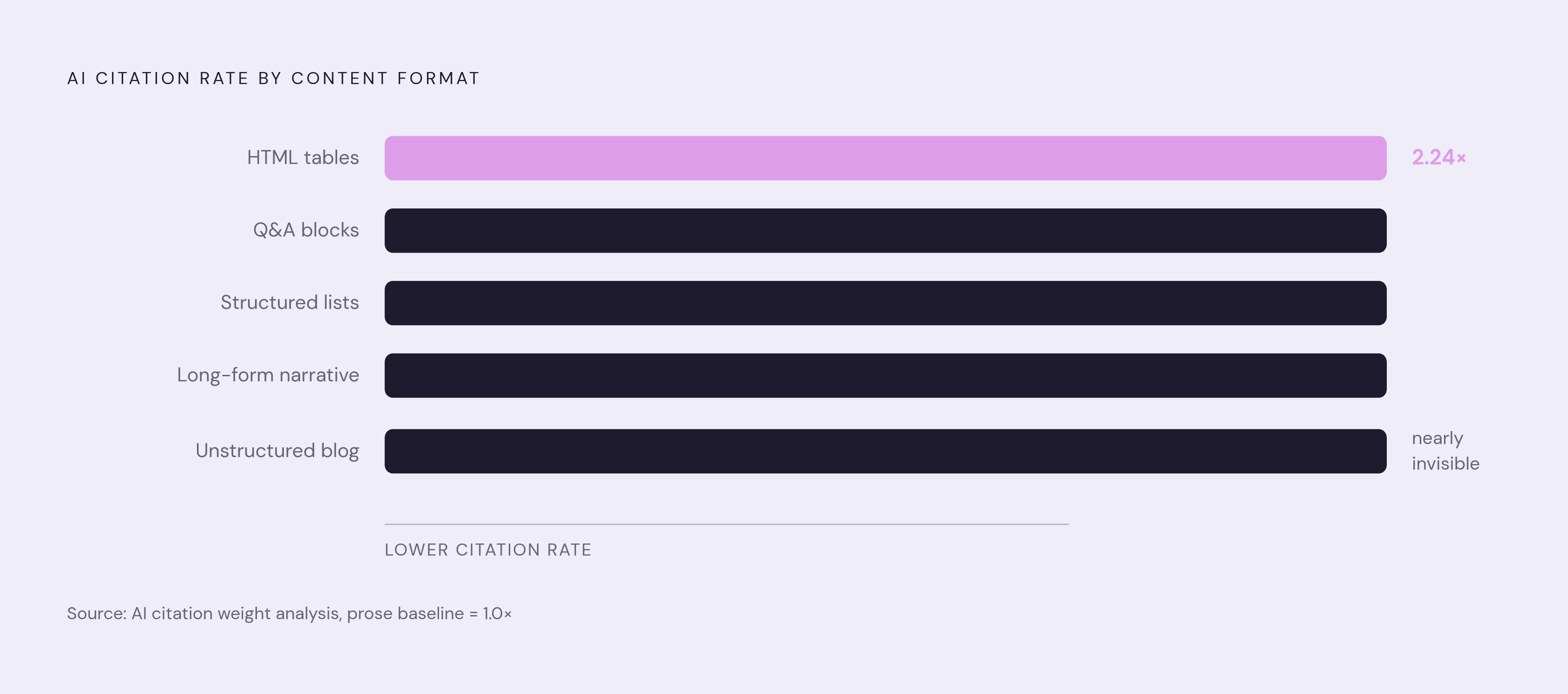
Once that's understood, the resulting hierarchy isn't surprising. A separate test of content extraction across AI queries found a consistent order: HTML tables were cited most, followed by Q&A blocks, then structured lists, then long-form narrative, with unstructured blog posts trailing behind, capturing only a small share of the citations that tables earn on the same ground. None of this means prose has no place. Tracking which formats a given piece of content uses and how often each gets cited across those platforms is one of the few ways to find out whether existing content is being extracted at all, or whether a format change would unlock a meaningfully higher rate of recommendation.
Matching formats to query types
None of this makes tables universally better or prose universally worse. Each format has a query type it was effectively built for, and applying the wrong one to the wrong question is its own kind of failure, separate from using no structure.
Tables do their best work on comparison queries, factual lookups, and attribute questions: anything shaped like "which option has property Y" or "how do A and B differ on this dimension." A two-dimensional grid maps directly onto how AI engines break a comparison question into sub-questions and then recombine the answers, so a table with clear rows for each attribute has effectively done that breakdown in advance. An LLM asked which industry has the highest number of billionaires performs noticeably worse when that information is written as prose than when it's laid out as a table, a gap Intel's research on tabular retrieval makes concrete, because the model has to reconstruct the row-and-column relationship from a paragraph instead of reading it straight off a grid.
Answer-first prose has its own territory: definitional, explanatory, and how-it-works questions, where the person asking needs reasoning laid out, not a single data point. The strongest version of this format is a self-contained paragraph that opens with a direct answer to the question implied by its heading and follows with two or three sentences of qualifying context, with anything beyond that moved into a separate paragraph so it doesn't dilute the passage. Passages built this way, dense enough to stand alone but short enough to be pulled as a single chunk, are cited substantially more often than longer passages, and by a wider margin over shorter ones.
FAQ blocks and Q&A formatting serve a third category: conversational, long-tail questions, the kind someone would type out in full sentence form. Unstructured prose still has a job, just not this one. It performs best as a narrative authority signal, in case studies, expert commentary, and original research, where the goal isn't to be the passage that gets cited directly but to supply the depth and credibility that supports a citation happening somewhere else on the same page.
The practical rule that falls out of all this is that "use tables" is an incomplete instruction on its own. The real question a content team has to answer is tables for what, prose for what, and FAQ formatting for what, matched against the actual question a buyer is asking. Getting that mapping right is a decision that has to be made page by page; building an actual page around it is the next problem.
Architecting a page so each format earns its own citation
A page that uses formats well is organized around the extraction unit, the individual passage a model might pull out and cite on its own. Pages built around specific structural patterns get cited 2 to 4 times more frequently across ChatGPT, Perplexity, Claude, Gemini, and Google AI Overviews, because each section on the page is self-sufficient: a model doesn't need to read what comes before or after it to make sense of the claim inside.
Several structural choices do most of that work. Descriptive H2 and H3 headings act as labels for the passage beneath them, not just as navigation aids, because the heading sets the context the model uses to judge whether that section answers the question it's working on. Paragraphs should each carry exactly one claim, because the chunking process that breaks a page into retrievable pieces can split a paragraph mid-thought if it's doing too much at once, and a claim divided across two separate chunks loses its coherence in either one.
Specificity in sentence construction matters just as much as heading structure. The same claim tied to a named product and an independent monitoring source becomes something a model can repeat accurately and attribute correctly. That same discipline, naming the entity every time a fact is stated rather than relying on "our" or "the platform," applies to every claim a brand wants an AI engine to get right.
Tables need their own internal discipline to keep the attention advantage they carry. Inconsistent or cryptic headers erode the attention advantage that made the table worth building. Every H2 section should open with an answer-first paragraph before any table or list appears beneath it, since that paragraph gives the table's numbers the context that makes them mean something, and the table then backs up the claim the paragraph just made with structured detail.
None of this works if the underlying markup gets in the way. Clean, semantic HTML matters because the crawlers and retrieval pipelines that process a page before a model ever sees it strip out anything that isn't proper markup, and a table built out of div tags rather than actual table elements may never register as a table at all once it's been through that pipeline. Matching format to query type takes visibility into how different structures actually perform across specific engines and question types, and that's the kind of insight cross-platform citation tracking exists to provide, helping teams build content that lines up with how their target engines actually extract it.
Format alone and whether a page gets retrieved
Everything above assumes a page has already made it into the pool of documents a model is choosing from. That assumption doesn't always hold, and the evidence against it deserves to be taken seriously rather than waved off.
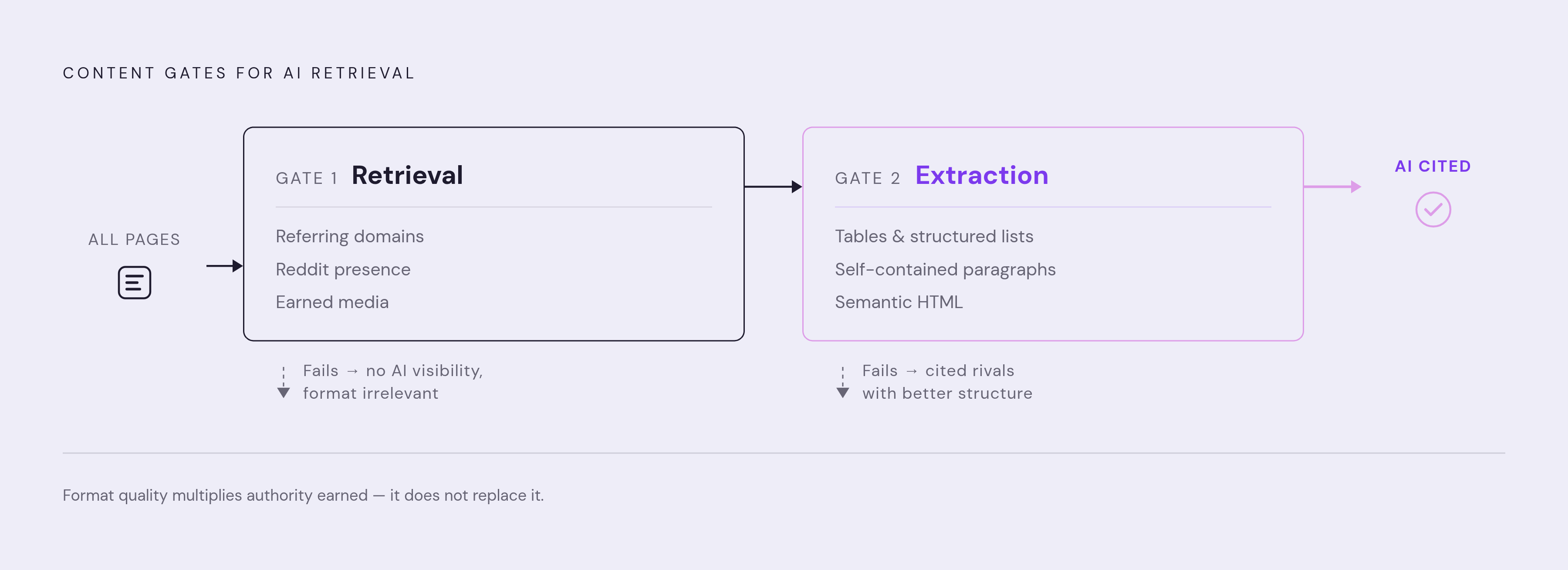
A study tracking startups across thousands of queries found that GEO, defined there as optimizing website content specifically for AI systems, showed no correlation with actual discovery rates. What did correlate with visibility on Perplexity was a set of traditional authority signals: referring domains, a presence in Reddit communities, and general web authority. That's a direct challenge to any argument that format changes alone will move the needle, and it holds up because it's measuring something format optimization doesn't touch: whether a page gets pulled into the retrieval set.
The platforms don't even source from the same places. ChatGPT sends the majority of its citations to earned media coverage. Perplexity sends its largest share to Reddit. Which authority channel actually matters for a given brand depends entirely on which engine that brand is trying to show up in, and no amount of table formatting changes where either engine goes looking for sources to begin with. A Columbia and MIT study of GEO heuristics in e-commerce reinforces the same point from another angle: most of the strategies they tested produced results that were negative or made no real difference. The strategies that did consistently work converged on three things: specificity of claims, clear source attribution, and content that could stand on its own without outside context, which are the exact structural properties the earlier sections of this piece have been describing.
Putting these findings together resolves the apparent conflict rather than deepening it. Retrieval and extraction are two separate stages, not two labels for the same job. A brand with no referring domains and no earned media coverage will not get retrieved in the first place, no matter how clean its tables are. A brand with strong authority but poorly structured content will get retrieved and then lose out to a better-formatted competitor at the extraction stage, once both are already in the running. Format optimization doesn't substitute for building authority. It multiplies the value of authority a brand already has, and the brands that gain the most from fixing their content structure are the ones that are already being retrieved and are losing citations once they get there.
How format decisions affect brand integrity and hallucination risk
Content that skips explicit entity naming and self-contained attribution doesn't just lose citations. It opens the door for an AI engine to generate and spread false claims about the brand it was supposed to represent correctly.
Brand hallucination happens when a generative AI system produces information about a brand that's factually wrong as part of a synthesized answer. The common versions of this include misquoting a pricing tier, claiming a certification the brand doesn't actually hold, confusing one brand's product with a competitor's, or repeating a feature set that's since been discontinued. These errors don't stay contained the way a bad article might. A wrong fact can spread across answers at scale before anyone at the brand notices it's happening, and because there's no retraction mechanism built into AI training data the way there is for a correction printed in a publication, the cost of fixing it grows the longer it circulates uncorrected.
The legal exposure here isn't hypothetical. The BC Civil Resolution Tribunal found Air Canada financially liable for statements its chatbot made in real time to a customer, establishing that a brand's own AI system can create direct legal liability, not just a reputational headache. The FTC's endorsement guidelines add another layer of scope here: they hold brands responsible for claims made in sponsored content, and there's no established exception for an AI having generated the claim rather than a person. If an answer engine attaches a false efficacy claim to a brand's name, that brand inherits the liability for it regardless of who or what wrote the sentence.
The fix runs through the same structural discipline the rest of this piece has been building toward. A sentence like "our platform achieves 99.99% uptime" can't be attributed to anything once it's pulled out as an isolated chunk in a RAG pipeline, since the retrieved text may be the only thing the model has seen from that domain. Getting the format right is a form of accuracy control, the same discipline that shapes whether a brand gets cited correctly.