Optimal Content Length and Chunk Size for LLM Retrieval
Recursive chunking at 512 tokens beats semantic methods on production accuracy.

Retrieval-augmented generation hit 51% adoption among enterprises in 2024, up from 31% the year before. That growth means chunking, the process of splitting documents into retrievable pieces, now determines how millions of production queries get answered every day. There's no single correct chunk size. The right answer depends on document type, retrieval method, and what actually counts as success: not whether a chunk gets retrieved, but whether the retrieved chunk lets the model produce a correct answer.
Chunks need to be small enough that a retrieval system can match them precisely to a query, but complete enough that once retrieved, they hand the model everything it needs to answer correctly. Miss on one side and chunks retrieve cleanly but arrive stripped of context. Miss on the other and irrelevant text dilutes the embedding, crowds the context window, and buries the signal the model actually needed. Recall (did the retriever find something relevant) and end-to-end accuracy (did the system answer correctly) are separate measurements, and a strategy can win on one while failing the other. Production systems have to optimize for the second.
What four independent benchmarks measured, and why their results look contradictory
Four benchmarks published results that, read side by side, seem to argue with each other. Four benchmarks published results that, read side by side, seem to argue with each other, but they don't actually contradict one another. Each one measured a different stage of the pipeline, and the apparent contradictions dissolve once you know which stage each number describes.
FloTorch's February 2026 benchmark, run in partnership with Vecta, tested seven chunking strategies against 50 academic papers totaling 905,746 tokens, holding the context budget fixed across every strategy tested. Crucially, it measured end-to-end answer accuracy: did the LLM's final output actually match the correct answer, not merely whether the retriever surfaced something related to the question.
NVIDIA's 2024 benchmark worked across five datasets, including FinanceBench for financial documents, and scored results using NV Answer Accuracy via the RAGAS framework. It compared token ranges from small to large, and split results out by factoid queries versus analytical ones, since those two query types behave differently.
Chroma Research took a narrower, more surgical approach: general text across multiple domains, scored on retrieval precision and recall metrics measuring how much of the actual relevant answer text a retriever surfaces. Chroma deliberately isolated retrieval from generation, so its numbers say nothing about what the LLM does once it has the chunk in hand.
Superlinked's VectorHub benchmark tested chunker-and-retriever pairings end to end against established QA datasets including HotpotQA (multi-hop reasoning) and QuAC (conversational QA). It scored on MRR and Recall@10 metrics.
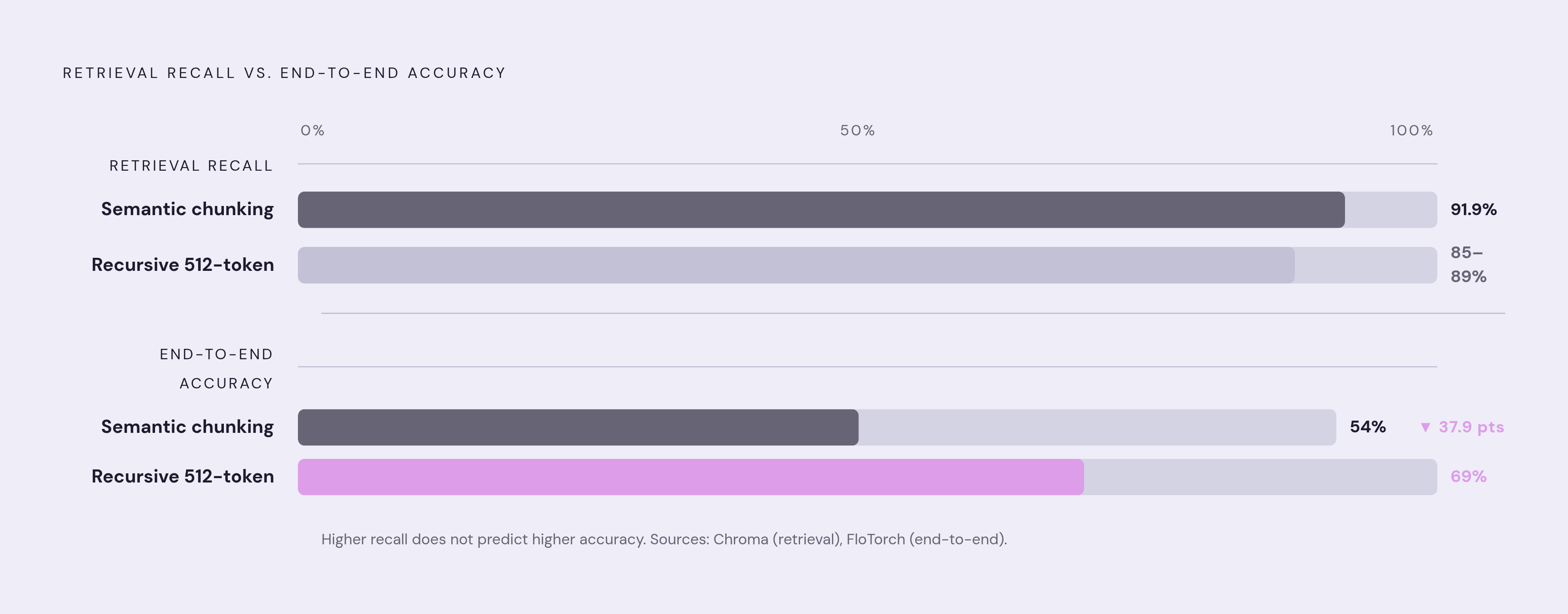
Semantic chunking scored 91.9% recall in Chroma's evaluation, yet only 54% end-to-end accuracy in FloTorch's test, two different failure points in the same pipeline. Semantic chunking scored 91.9% recall in Chroma's evaluation, yet only 54% end-to-end accuracy in FloTorch's test, reflecting two different failure points in the same pipeline. It's two different failure points in the same pipeline. Chroma measured whether the right text got surfaced. FloTorch measured whether the model, once handed that text, could produce a correct answer, and semantic chunking's fragments in FloTorch's test averaged just 43 tokens: small enough to embed cleanly and match a query well, but too thin to give the model the surrounding context an answer actually requires. The information needed to answer the question got severed at split time, before retrieval ever ran.
The lesson carries forward into every recommendation that follows: any benchmark that stops at retrieval recall will overstate how well semantic chunking performs in production. Teams choosing a default strategy should weight end-to-end accuracy studies far more heavily than recall-only numbers, because recall only tells you the retriever did its job. It says nothing about whether the rest of the system could finish the work.
Recursive splitting as the validated default, and what the numbers say about its range
Recursive character splitting at 512 tokens scored 69% accuracy in FloTorch's seven-strategy comparison, the highest of any method tested against those 50 academic papers, the strategy against which every alternative now has to justify its added complexity. Recursive character splitting at 512 tokens scored 69% accuracy in FloTorch's seven-strategy comparison, the highest of any method tested against those 50 academic papers, making it the strategy against which every alternative now has to justify its added complexity. It's the strategy against which every alternative now has to justify its added complexity.
The re-validated practical range, as of February 2026, is 256 to 512 tokens with 10 to 20% overlap, which works out to 50 to 100 tokens of overlap on a 512-token chunk. Microsoft's Azure architecture guidance recommends starting at 512 tokens with 25% overlap (128 tokens), and separately advises counting in BERT tokens rather than raw characters when doing fixed-size chunking, since character counts don't map cleanly onto how embedding models actually process text. Separately, Arize AI's findings point to 300 to 500 token chunks paired with K=4 retrieval as the sweet spot for balancing speed against answer quality.
None of this makes recursive splitting the best method for every document. It makes it the default worth deviating from only when a specific document structure earns the deviation.
When semantic chunking earns its computational cost
Semantic chunking's recall ceiling holds up across benchmarks rather than reflecting a quirk of one test. Chroma's data put LLMSemanticChunker at 0.919 recall and ClusterSemanticChunker at 0.913, both ahead of RecursiveCharacterTextSplitter's 85.4 to 89.5% range. In pure retrieval terms, semantic methods find more of the relevant text.
That advantage collapses the moment fragment size drops too low, and FloTorch's 54% end-to-end result against recursive splitting's 69% traces directly to those 43-token fragments, not to any flaw in semantic chunking as an idea. The fix is mechanical rather than conceptual: enforce a minimum token floor after the semantic split runs, so no fragment gets small enough to strip out the context an answer depends on. Skip that floor, and the recall advantage measured in isolation never survives contact with generation.
Where semantic chunking earns its cost outright is structured technical and clinical documentation, the kind of writing built around clear, logical topic boundaries. A clinical decision support study found adaptive chunking aligned to those topic boundaries hit 87% accuracy, against 13% for fixed-size baselines on the same material, with the gap confirmed at p = 0.001, in a domain where document structure does most of the work, and semantic chunking simply follows the seams the material already has. It's a domain where document structure does most of the work, and semantic chunking simply follows the seams the material already has. Narrative prose and mixed-format documents don't have those seams, so they don't produce anywhere near the same gain. Domain, more than any universal ranking of methods, decides the outcome.
Overlap, sparse retrieval, and the edge cases that change the defaults
Overlap exists to stop information from vanishing right at chunk boundaries, and the standard 10 to 20% range (50 to 100 tokens on a 512-token chunk) holds for dense retrieval methods. Sparse retrieval doesn't play by the same rule.
For SPLADE and similar sparse methods, testing with zero overlap first is the sounder starting point. Some evidence suggests overlap adds storage cost on sparse indexes without buying any real gain in retrieval performance, so the dense-retrieval default doesn't transfer automatically.
Paginated documents form their own separate case. NVIDIA's 2024 benchmark found page-level chunking hit 0.648 accuracy, the best score across the whole benchmark, but only for documents like financial PDFs that already come pre-segmented into pages. That result makes it the obvious choice for any document format where pagination already does the segmentation work for you.
Then there's the case where the chunker and the retriever interact in ways neither would predict alone. Superlinked's VectorHub testing found sentence-level chunking paired with ColBERT v2 produced the best MRR score of any combination tested on HotpotQA. No single method drove that result. The pairing did. It's a reminder that chunking strategy can't be chosen in isolation from the retrieval method sitting downstream of it.
Hierarchical and hybrid chunking for documents with nested or multi-format structure
Some documents don't have one right chunk size, because they don't have one kind of question asked against them. Hierarchical chunking handles that by building multiple layers at once: summary chunks that give a retriever something broad to match against high-level questions, and detail chunks that hold the granular facts a specific question needs. Query routing decides which layer gets pulled, sending analytical questions toward summaries and factoid questions toward detail chunks.
That complexity earns its keep on documents with genuinely nested structure, such as annual reports, technical manuals, and regulatory filings, where a single chunk size satisfies neither the reader asking a broad question nor the one asking a narrow one.
Hybrid chunking solves a different problem: documents that mix formats within a single file. PDFs with embedded tables, files mixing code blocks with prose, anything where structural metadata carries as much meaning as the surrounding text. Tables in particular need separate handling, since splitting a table row across a chunk boundary destroys the row's meaning rather than merely weakening the chunk.
LLM-based chunking is at the expensive end of the spectrum: every document gets run through a model that analyzes its structure before any splitting happens. That cost only makes sense for high-value, low-volume document sets, where the accuracy stakes are high enough to justify paying for inference on every single file.
How content freshness functions as a chunk-level retrieval signal
Freshness isn't only an SEO input anymore. It operates at the level of the individual chunk in AI retrieval systems, which weight recency directly when deciding what to surface. Half of all AI citations come from content published less than 13 weeks earlier. Eighty-three percent of cited content is under a year old, sixty percent falls within six months, and content older than three months takes on a penalty in citation likelihood that runs more than three times steeper than fresher material.
That has a direct architectural consequence. A page can be chunked well, structured cleanly, and still lose out in AI retrieval if the statistics, prices, or factual claims sitting inside those chunks carry stale dates. The freshness signal attaches to the content itself, chunk by chunk, not to the URL hosting it.
How chunking mechanics shape the way AI systems cite and recommend brands
Systems like Perplexity and Google AI Overviews weight relevance heavily toward a page's opening content. The first 200 words of any article need to answer the primary query directly, not spend that space building up to the answer. That's the content-level version of the same precision problem chunking solves at the document level: bury the answer, and the retrieval system either grabs a weaker chunk or skips the page.
The first 40 to 60 words of any answer carry outsized weight in AI extraction. Structure that delays the direct answer past that window forces a retrieval system into a bad choice it shouldn't have to make. Keeping a statistic or concrete data point roughly every 150 to 200 words gives AI systems citation-worthy anchors spread through the piece, rather than concentrated in one paragraph a retriever might not select.
And ownership of the content matters less than where it appears. Eighty-five percent of brand mentions in AI search come from third-party pages rather than brand-owned sites, and brands are far more likely to get cited through a third party than through their own domain. That means chunking and content architecture decisions on partner sites and outside publications carry weight equal to, or greater than, anything a brand controls on its own site.
A decision framework for choosing chunk size and strategy by document type and retrieval method
Document type is the first variable, and it narrows the choice fast. Narrative prose, blog posts, and editorial content call for recursive character splitting at 256 to 512 tokens with 10 to 20% overlap, the validated default. Paginated financial or legal PDFs call for page-level chunking, which posted 0.648 accuracy and the lowest variance of any method in NVIDIA's 2024 benchmark. Structured clinical or technical documentation with clear topic sections calls for adaptive or semantic chunking with a minimum token floor enforced, the approach that hit 87% accuracy in the MDPI Bioengineering study. Multi-format documents, PDFs with embedded tables, or files mixing code and prose call for hybrid chunking, with structured data regions handled separately from surrounding text. Question-based encoding is an emerging alternative for high-value scientific or research corpora, an approach explored in recent work out of IPN and CIC.
Retrieval method is the second variable, and it modifies rather than replaces the first. Dense vector retrieval keeps the standard overlap range. Sparse retrieval methods like SPLADE call for testing zero overlap before assuming the dense-retrieval defaults apply. And any chunker choice made in isolation from the retriever sitting downstream risks missing a pairing effect, the kind that pushed sentence-level chunking with ColBERT v2 to the top of Superlinked's MRR results on HotpotQA, a result neither method alone would have predicted.
No single number can be memorized to cover all of this. Every document set raises the same question: what kind of query will hit this content, what does the retriever downstream need, and does the chunk size chosen give the model enough to actually answer, not just enough to look relevant on the way in.