ChatGPT Search Source Selection Versus GPT-4o Browsing Behavior
ChatGPT Search and GPT-4o browsing select sources through fundamentally different mechanisms.

ChatGPT is not one system that behaves one way. Brands that treat "ChatGPT visibility" as a single target are, by definition, missing at least two-thirds of the problem.
Why ChatGPT is not a single retrieval system
Most content teams talk about "getting cited by ChatGPT" as if there's one gate to pass through. There isn't. The product encompasses base-mode generation, which pulls answers from training data with no live lookup at all, and live web retrieval, which actually goes out and fetches pages before answering. These aren't cosmetic variations on the same process. They produce structurally different outputs, and which sources show up in an answer depends entirely on which mode generated it.
The scale of this split isn't trivial. A study of real conversations pulled from LMArena found that roughly a quarter of GPT-4o responses, 24% in that sample, were generated with no online content fetched whatsoever. The rest relied on live retrieval. Same model name, same interface, but in a study of real LMArena conversations, roughly a quarter (24%) of GPT-4o responses were generated without fetching any online content at all, while the majority relied on live retrieval.
The distinction sharpens once you separate products. In ChatGPT Search, live retrieval is the default setting, not an occasional behavior. In general ChatGPT use, though, training-data answers stay common enough that they can't be treated as an edge case. Almost nobody talks about this split when they talk about brand visibility in AI, which is strange, because it's the whole ballgame. A team that optimizes content for one mode while ignoring the other has, at best, solved half the problem. At worst, it's solved the wrong problem.
How ChatGPT Search selects and cites sources
ChatGPT Search runs on a fine-tuned build of GPT-4o, trained further on synthetic data and wired into third-party search providers along with content supplied directly by OpenAI's partners. That's worth sitting with for a second: its citation behavior isn't some emergent property of crawling the open web. It's a direct consequence of the architecture OpenAI chose to build.
Here's what happens when a query comes in. ChatGPT Search breaks the question apart into precise, actionable search statements, turning a conversational sentence into something closer to a search-engine query. It reads intent and tacks on qualifiers like "tutorial" or "guide," so a page that states its purpose in the title and headers has a real structural edge over one that buries it three paragraphs in.
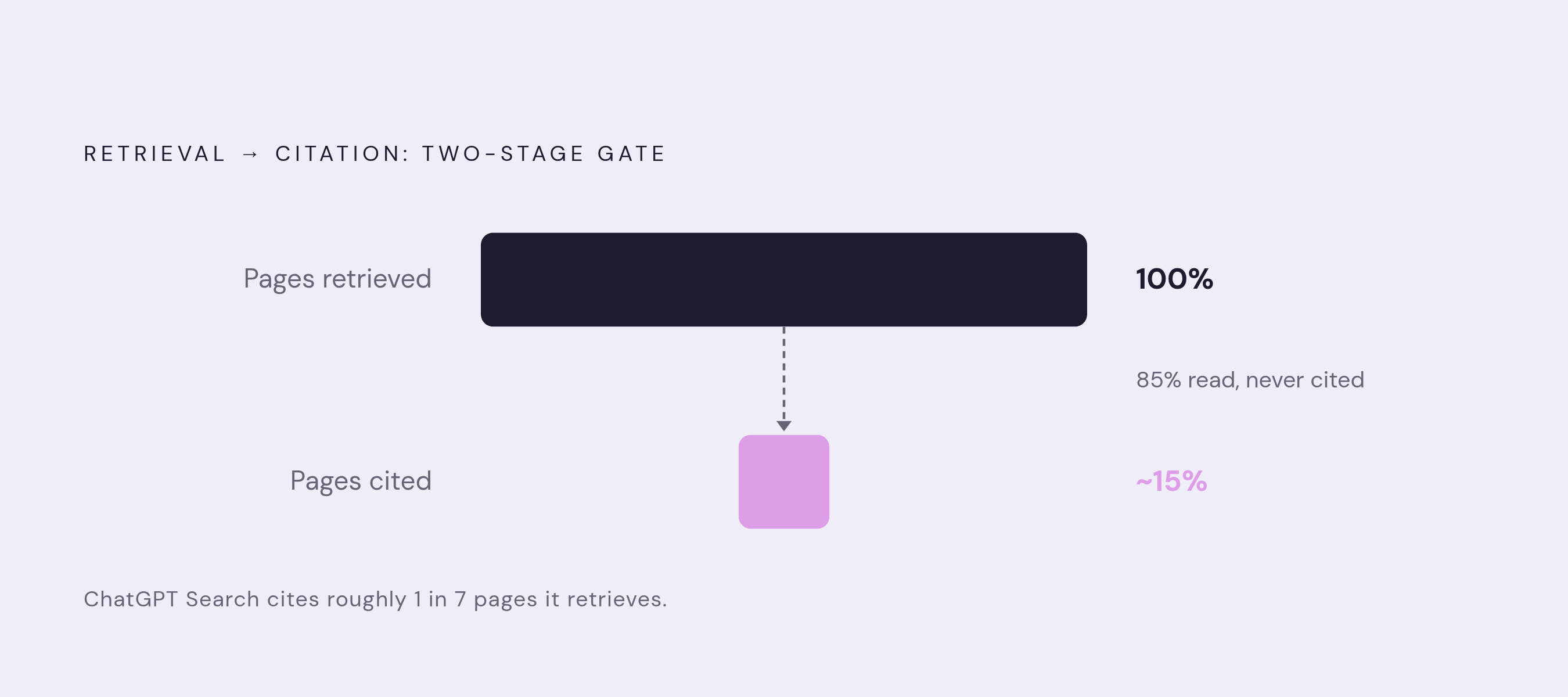
Retrieval and citation, though, are not the same event. Research cited in an April 2026 analysis from Kime.ai found that ChatGPT cites only around 15% of the pages it actually pulls during a search. A page has to clear two separate gates, not one: it has to get retrieved, and then it has to get chosen for citation, and those are governed by different logic.
Once a page clears both gates, there's no ranking system waiting on the other side. Citation is binary. A brand is either named in the answer or it isn't, with nothing resembling Google's ranked list of results. What matters after that point is where inside the answer the citation lands and how the surrounding sentence characterizes the brand.
Who actually wins this game, structurally speaking? Wikipedia, LinkedIn, Reddit, and a handful of authoritative editorial domains dominate the source pool ChatGPT draws from, according to the Kime.ai synthesis of research from late 2025 into early 2026. Brand-owned content is underrepresented relative to earned media: your own website carries less structural weight than a mention on a domain ChatGPT already trusts. The brands that get cited most consistently share three traits: FAQ schema on their pages, a real presence in publications ChatGPT already leans on, and answers that front-load the point instead of building up to it.
How GPT-4o browsing differs from ChatGPT Search in retrieval behavior
GPT-4o browsing and ChatGPT Search share a base model, but they are not the same product, and conflating them is where a lot of visibility strategy goes wrong. ChatGPT Search has been specifically fine-tuned for retrieval work. General GPT-4o with browsing turned on has not, at least not to the same degree.
The performance gap between these modes isn't subtle. The ScholarSearch benchmark, published in June 2025 out of Peking University, found that gpt-4o-search-preview scored markedly higher on accuracy than its non-browsing counterpart, and the mini version showed a similarly large gap against its own non-browsing sibling, too large to be a rounding error. That's not a rounding error. Browsing mode is a qualitatively different capability.
There's also a reliability difference. GPT-4o in general browsing mode doesn't always fetch live content, and whether it does depends on the query type, the user's settings, and the platform context surrounding the request. ChatGPT Search doesn't have that ambiguity. Live retrieval is simply the default there. A guide published by SkyScale in December 2024, and kept updated through May 2026, describes GPT-4o's browsing selection process in similar terms to search-mode: it converts a query into precise search statements and favors clear intent signals. But that behavior applies more consistently in the dedicated search product than it does in general browsing.
Then there's the rendering issue, in which pages fail to render correctly, which is entirely technical and easy to overlook. A Salt Agency study published in September 2025, run across a large sample of sites, found that Gemini is the only major AI platform among Gemini, ChatGPT, Claude, and Perplexity that renders JavaScript correctly. Claude and Perplexity stay on static HTML, and ChatGPT's behavior is inconsistent depending on the version in use.
Put together, optimizing for only one of these modes leaves a brand blind in the other. Because the two modes don't always surface the same content for the same question, a brand can land a citation in ChatGPT Search and vanish entirely from GPT-4o's base responses to the identical query, or the reverse. Neither mode is a stand-in for the other.
What base-mode generation does when it appears to cite sources
Base mode is where things get genuinely risky for brands, and it deserves its own reckoning. When ChatGPT answers without triggering any retrieval, whatever looks like a citation in that response isn't a citation at all. It's a statistically plausible guess built from patterns in training data. That's the mechanism behind fabrication rates in this mode, which swing widely, from under one-in-five responses to more than half, depending on the query and the model version in play.
This is not some rare failure mode tucked into a corner case. The same LMArena study that found roughly three-quarters of GPT-4o responses use live retrieval also found a real minority that don't, and that minority touches a meaningful share of actual user conversations. Every one of those conversations is a chance for a brand's facts to get invented rather than reported.
Think about what that means concretely. A hallucinated detail, wrong pricing, an outdated feature list, a founding story that never happened, credit given to the wrong person, can spread across AI-generated answers before anyone at the brand even notices it exists. And unlike a bad article that a publication can correct or retract, there's no retraction mechanism sitting inside a model's training data. Once the pattern is baked in, it stays baked in until the next training run, if it gets caught at all.
The brand-side damage is not hypothetical. Research cited in the S1 brief found that more than a third of brands report AI hallucinations actively harming their reputation. There's a genuine paradox here: newer reasoning models have cut down hallucinations substantially on simple tasks, but models like GPT-5 and Claude 4 can drift further off course on complex queries, precisely because they spend more computation "thinking through" an answer, which sometimes pulls them away from the source material rather than closer to it. OpenAI has said GPT-5 produces fewer factual errors than GPT-4o did, but that improvement isn't even across query types, and the gap between simple and complex tasks makes any blanket reassurance about accuracy misleading.
Why citation concentration and click behavior change the business case for AI visibility
None of this matters much if the traffic at stake is negligible. It isn't. The real case for caring about AI source selection has almost nothing to do with raw visit counts and everything to do with conversion quality and a genuine shift in where discovery happens.
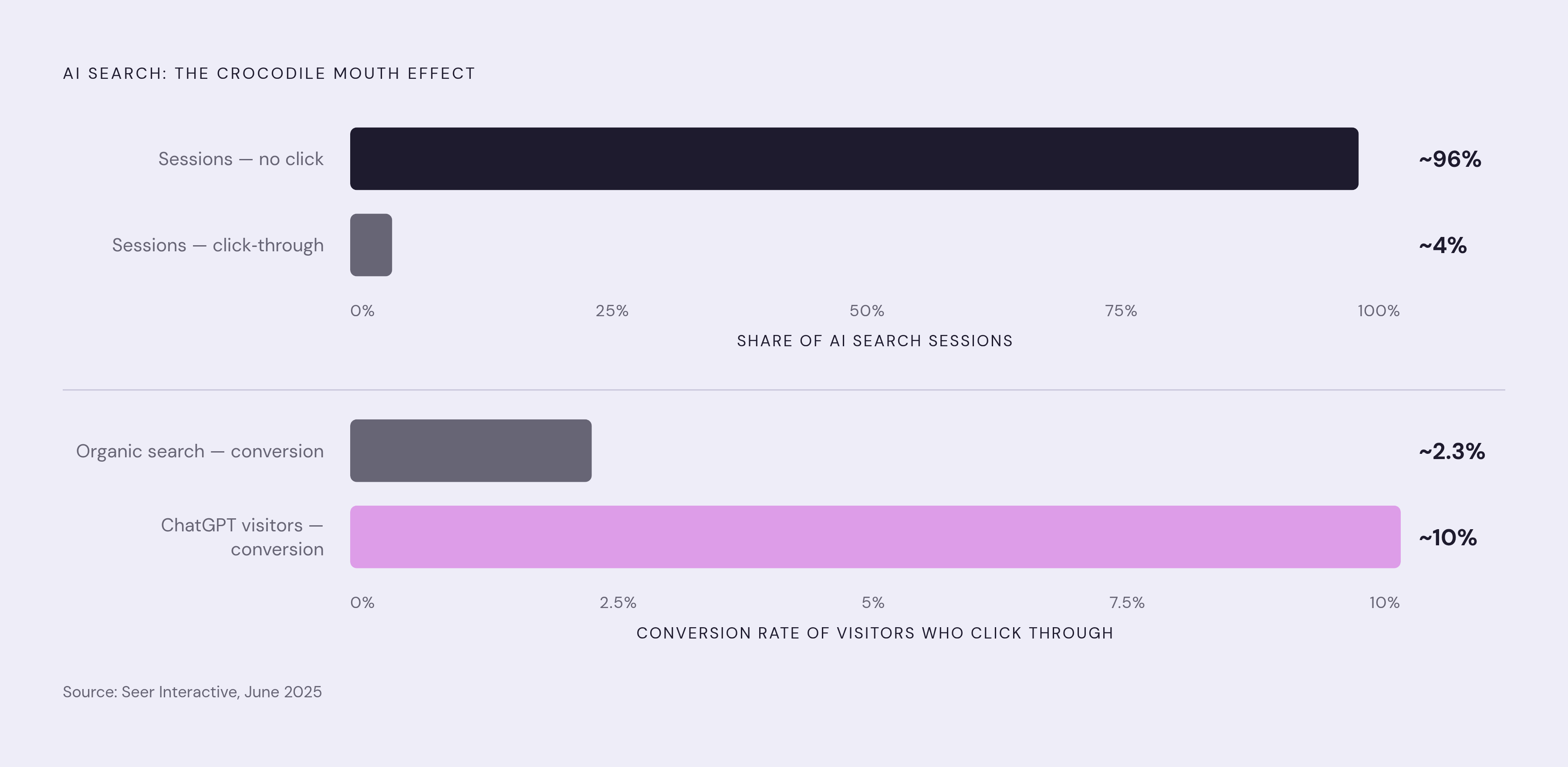
Consider what's been dubbed the "Crocodile Mouth Effect": a widening gap between how many times a brand appears in an AI answer and how often anyone actually clicks through to the source. As of 2026, the overwhelming majority of AI search sessions end without a click at all. If a brand isn't cited directly inside the answer itself, it's effectively invisible in that session, no matter how well it ranks on a traditional search results page.
This is happening against a backdrop of real behavioral change. Gartner predicted back in 2024 that traditional search engine volume would decline substantially by 2026. Per the S1 brief, that prediction had become reality by mid-2026, with a meaningful share of consumers now starting their searches inside AI tools instead of typing into a search bar.
This should reframe how marketers think about this traffic. It's tempting to assume AI-referred visitors are low-intent browsers just poking around. The data says the opposite. Seer Interactive figures cited in the S1 brief, from June 2025, found that visitors arriving from ChatGPT convert at rates far above standard organic search benchmarks. That makes AI citation a higher-value acquisition channel than its traffic volume alone would suggest, which is exactly the kind of detail that gets lost when a marketing team is only counting sessions.
And the measurement systems most companies already have in place are working against them here. Traditional analytics tools routinely misclassify AI-referred activity as direct traffic, or miss it altogether. That suppresses the apparent return on any investment in AI visibility, which makes the internal budget conversation harder to win even as the real-world impact keeps growing.
What content structure signals citability across both retrieval modes
Given how differently ChatGPT Search and GPT-4o browsing behave, there is common ground to build on. There is, and it overlaps significantly, though not completely. Brands trying to show up in both modes need to satisfy a shared core of structural signals first, then layer mode-specific tactics on top.
Front-loading sits at the top of that list, by a wide margin. The first 200 words of any page should answer the reader's main question directly and completely, not build toward it. This isn't stylistic advice. Citations concentrate heavily in a page's opening section, so where the answer sits physically on the page matters almost as much as whether the answer is any good.
Heading structure matters too, and in a specific way. Framing H1s and H2s as actual questions, the kind a person would type or say out loud, carries an outsized effect on citation odds, especially for smaller or less-established domains that don't have brand authority to lean on. That structure lines up with how ChatGPT decomposes a query into sub-questions before it goes looking for answers.
FAQ schema appears repeatedly across the brands ChatGPT cites most often, according to the Kime.ai analysis. It does something plain prose can't: it makes the intent and structure of the content readable by machines, not just by people scanning the page.
Earned media matters more than most brands want to admit. Presence in publications ChatGPT already trusts outweighs the sheer volume of content sitting on a brand's own domain. Wikipedia, LinkedIn, Reddit, and a set of authoritative editorial outlets dominate the actual source pool ChatGPT draws citations from. A brand can have a beautifully structured website and still lose the citation competition if it has no footprint on the third-party sources the model already leans on.
The academic research backs this up directly. The GEO paper formalized at KDD 2024, with authors from Princeton, Georgia Tech, the Allen Institute for AI, and IIT Delhi, found that adding quotations from credible sources, incorporating statistics, and including citations in content each raised a source's share of AI answers, with quotations from credible sources producing the largest lift. That finding matters because it points toward something structural changes alone can't fix. GEO, as a discipline, leans strategic more than technical, per the framing in the S1 brief, weighted heavily toward positioning and ecosystem presence rather than markup and page speed. Structural fixes help. They're not enough on their own without a real presence elsewhere.
How to measure AI source selection performance across retrieval modes separately
Given everything above, tracking "AI visibility" as one blended number is close to useless. Aggregating metrics across models and retrieval modes hides the exact differences that should be driving strategy. A brand can be fully visible in ChatGPT Search and completely absent from GPT-4o's base responses for the identical query, and the reasons behind that gap, along with the fixes, are not the same.
LLM share of voice is the percentage of brand mentions a company receives across AI-generated responses relative to all brand mentions tracked for its category, and its formula requires model-specific tracking to be meaningful: divide brand mentions by total tracked brand mentions across a defined prompt set, then multiply by 100, for each platform separately. Do it once across a blended dataset and the number means almost nothing.
Platform-level differences make that separation non-negotiable rather than a nice-to-have. The Salt Agency study from September 2025 found Gemini is the only major platform that renders JavaScript correctly, while Claude and Perplexity fetch raw HTML instead and ChatGPT's behavior shifts by version. A brand running a JavaScript-heavy site might look fully formed to Gemini and show up partially, or not at all, to ChatGPT under certain conditions, for reasons that have nothing to do with content quality.
None of this holds still, either. Roughly 30% of brands visible in one AI response appear again in the very next consecutive response for the same query, per the S1 brief. That volatility rules out the one-time audit as a serious measurement approach. This needs ongoing tracking.
The infrastructure to do this is catching up fast. Somantra announced general availability of its AEO Metrics Suite on September 29, 2026, built around three proprietary scores, Brand Mindshare, Brand Consideration, and Brand Engagement, running on infrastructure that tracks millions of AI search conversations per brand category. The goal there isn't just measuring whether a brand shows up. It's measuring whether it gets chosen. HubSpot moved in a similar direction, acquiring the AEO platform XFunnel in 2025 and launching HubSpot AEO at its 2026 Spring Spotlight, tracking visibility scores, share of voice, and citations across ChatGPT, Gemini, and Perplexity. That's a real signal that this kind of measurement is becoming standard practice at larger marketing organizations.
Closing the analytics gap takes more than better dashboards, though. Traditional tools still classify a lot of AI-referred activity as direct traffic, which undercounts the real impact and makes the ROI case harder to defend internally. Fixing that means combining AI share of voice data with web analytics segmented specifically by AI referral source, alongside CRM conversion data that shows what that traffic actually does once it lands. Platforms built to track citations, spot content gaps, and measure share of voice across eight or more models at once, spanning ChatGPT, Perplexity, Gemini, Claude, Copilot, and Grok, exist precisely because no single-model view tells the whole story. Given how differently each of these systems retrieves, filters, and cites, treating them as one audience was never going to work.


