Heading Hierarchy Patterns for Generative Search Indexing
Proper heading structure now determines AI citations more than traditional search rankings.

Generative AI engines don't rank pages anymore. They extract passages. That shift, from ranking a whole document to pulling and scoring discrete chunks of it, has turned heading hierarchy into one of the few structural levers a content team can pull with any confidence about the outcome. Ranking well on Google used to mean something close to guaranteed visibility everywhere else. That correlation is breaking down, fast, and heading structure is one of the clearest reasons why.
The competition has changed shape along with it. A page doesn't need the top spot anymore. It needs a slot in a much smaller set of sources an AI engine decides to cite for a given answer, and heading tags tell a model what a section is about before it reads a single sentence of body copy. A deeper cause is at work: heading tags tell a model what a section is about before it reads a single sentence of body copy, so getting the hierarchy wrong causes the passage to be skipped, no matter how good the writing is. That's the trade nobody warned content teams about: you can write the best paragraph on the internet and still lose the citation to a worse paragraph that was labeled correctly.
How AI engines read a document
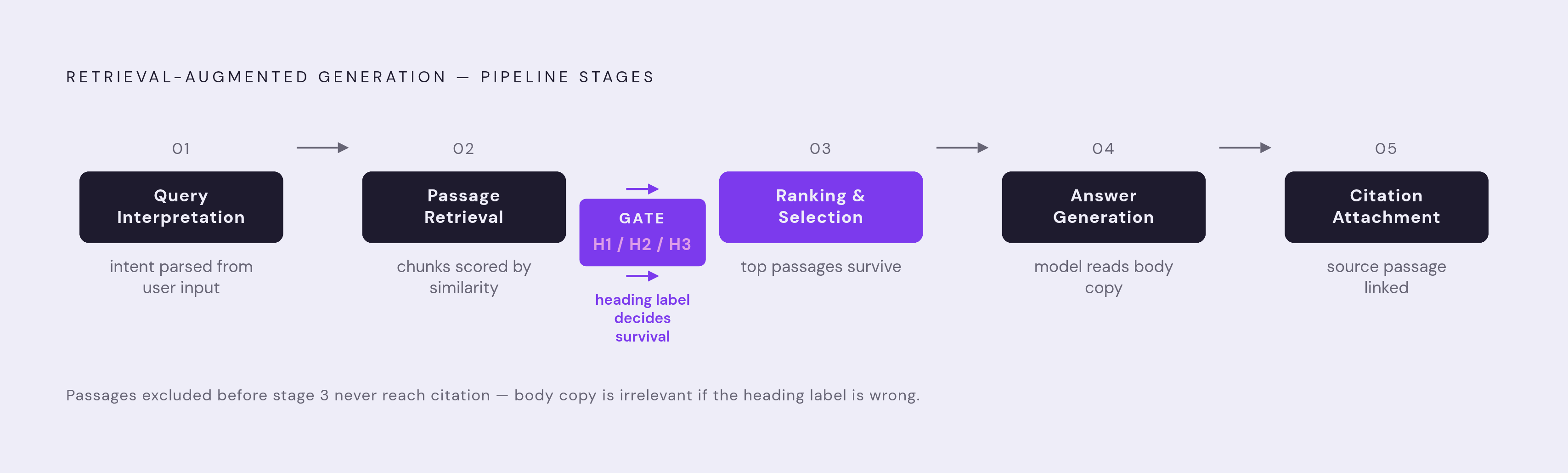
Retrieval-augmented generation runs in five stages. A query gets interpreted, candidate passages get retrieved, those passages get ranked and selected, an answer gets generated, and a citation gets attached. Each stage depends on the one before it, and the whole pipeline runs on chunks of text pulled out of context, not full pages read start to finish.
That's the part content teams tend to miss. A model doesn't read a page top to bottom the way a person does. It pulls a passage out of its surroundings and judges it more or less on its own. A section that leans on a paragraph two screens above it for meaning risks getting misread, or skipped entirely, because the context that would have clarified it never made the trip into the chunk.
Citation, the fifth stage, has less to do with how well a page reads as a whole and more to do with how cleanly a passage was labeled and pulled out during retrieval. Treating an AI citation strategy as an extension of an SEO ranking strategy is the wrong call, and the two are no longer the same problem. A page can sit at position one on Google and never once get pulled into an AI answer, because a top-10 ranking and a citation depend on different things entirely, the latter comes down to whether a passage can be lifted cleanly out of its surroundings and still make sense.
The mechanics of heading hierarchy that affect AI extraction
Each heading level does a different job in this pipeline, and conflating them is where most structural mistakes start.
The H1 sets the primary relevance signal for the whole document, both for traditional search and for AI extraction, particularly when an engine generates a section summary before deciding whether to dig further. A page gets one H1, and it should describe the single primary query the document is built to answer. Trying to make it double as a marketing tagline undercuts the signal it's supposed to send, and that's a more common mistake than it should be. Brand taglines belong in a subheading or a meta description, not in the one tag a model treats as the whole document's thesis statement.
The H2 is the real workhorse, and it's the level teams underinvest in most. Each H2 marks the boundary of a new chunk, and AI systems use that label to decide what the block underneath it is about before reading any of the sentences inside it. Most of the citation decision gets made right here, at the H2 line, before the model has processed a single supporting sentence. Teams that spend hours polishing body copy and five minutes on the H2 above it have the effort backwards.
H3s label the sub-chunks inside a passage: individual FAQ items, individual steps in a sequence, individual entries in a comparison. Each one is a candidate for extraction and citation on its own, separate from the rest of the section around it.
Getting the sequence wrong breaks the nesting logic a model relies on to figure out how sections relate to each other. H1 to H2 to H3, no skipped levels, no H2 followed directly by an H4. Skipping a level doesn't just look sloppy to a person scanning the page. It breaks the nesting logic a model relies on to figure out how one chunk relates to the ones around it, and a broken nesting structure reads to the model like an ambiguous chunk boundary, which is exactly the condition that gets a passage passed over. Teams that skip from H2 to H4 to save space on a page are trading a citation for a slightly shorter table of contents. That's a bad trade, and it's one plenty of content teams still make without realizing what it costs them.
Heading hierarchy patterns that AI-cited content uses most reliably
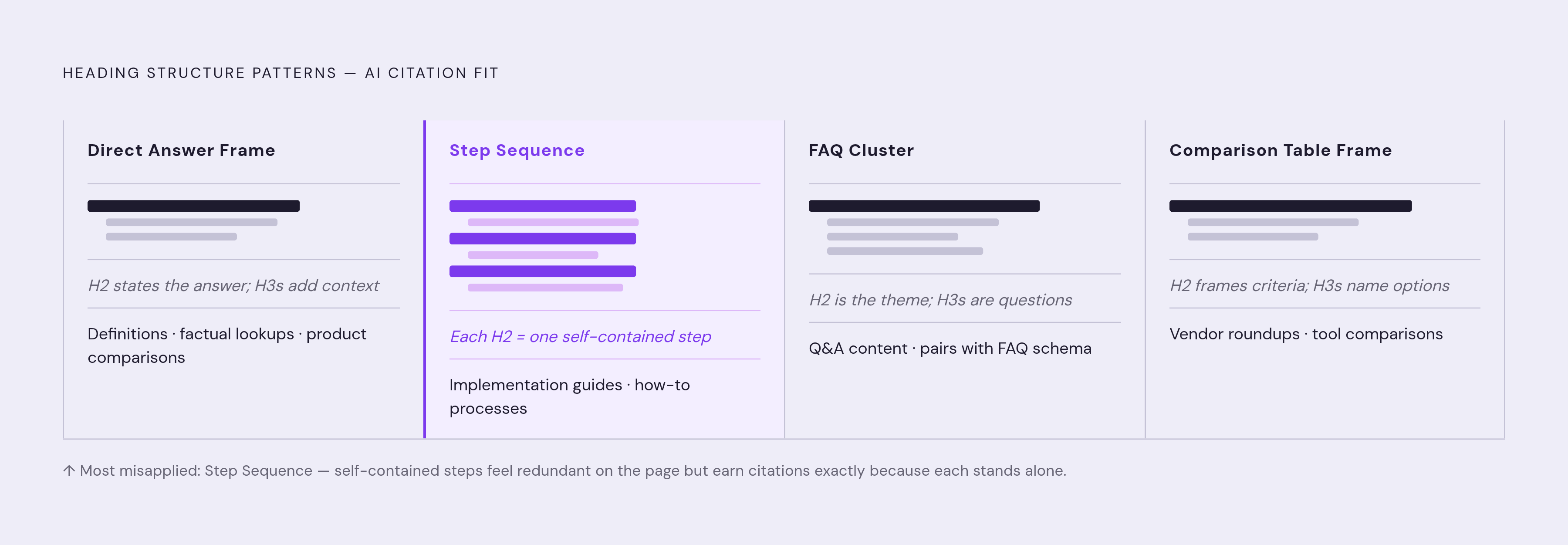
Four patterns recur in content that gets cited, and each one fits a different kind of query. Picking the wrong one for the content type makes the structure work against the writing instead of for it.
The Direct Answer Frame puts the question, or a question-shaped topic, in the H2, answers it in the first sentence or two underneath, and pushes qualifications and supporting detail down into H3s. A model looking for the passage that most directly answers the implied question in the heading isn't going to dig through three paragraphs of preamble to find it. Definitions, factual lookups, and product comparisons all fit this shape well.
The Step Sequence names the process in the H2 and gives each step its own H3, written so that step three makes sense without anyone having read steps one and two first. An engine can cite step three of an implementation guide on its own, without pulling in the rest of the document, only if step three doesn't secretly depend on something explained two steps earlier. This is the pattern most writers get wrong, because writing a step that stands alone feels redundant on the page even though standing alone is what gets it cited.
The FAQ Cluster puts a dedicated FAQ section under its own H2 and gives each question its own H3 with a short, standalone answer directly below it. This pairs naturally with FAQ schema markup, and the two reinforce each other: the heading tells a model what the question is in plain language, the schema confirms it in a structured format.
The Comparison Table Frame sets the scope of the comparison in the H2 and gives each option its own H3, with the body text under each one written to stand alone. A model should be able to cite the section on Option A without pulling in anything written about Option B. Vendor roundups and tool comparisons need this pattern most, precisely because readers, and models, often only want one side of the comparison at a time.
How heading structure interacts with schema markup to amplify AI citation signals
Headings speak natural language. Schema markup speaks machine-readable labels. Used together, they give an AI engine two separate ways to confirm what a section is about, which lowers the odds of a misread. Skipping the schema leaves the heading to do the job alone, with no second signal to back it up if the wording is even slightly ambiguous.
Google and Microsoft have both confirmed that structured data feeds their generative AI features, closing a couple of years of debate over whether schema still mattered once AI-generated answers entered the picture. It does, and the two systems aren't in competition. A well-nested heading tells a model what a section covers in plain language. Schema tells it the same thing in a format built for machine parsing. When both point to the same answer, the model's confidence in that passage goes up, and confidence is what separates a cited passage from one that gets quietly passed over.
Treating schema as an optional add-on, something to bolt on after launch if there's time, gets the priority backwards. FAQ schema on an FAQ Cluster section, a step-by-step markup type on a Step Sequence, Product schema on a comparison entry: these aren't decorative. They're the second confirmation a model uses when the heading alone leaves room for doubt, and pricing pages, spec sheets, and comparison tables are exactly the content types where that doubt is most expensive.
The gap between SEO ranking and AI citation
Plenty of pages sit comfortably on page one of Google that AI engines ignore completely. That gap is not a fluke, and it's not a sign that the page's content is weak. It's a sign that nothing about the page's structure was built for chunk extraction, and heading hierarchy is the direct fix for that specific failure. It won't fix a weak page. It fixes a strong page that happens to be invisible to a model reading in fragments, and those are two different diagnoses that call for two different fixes.
The second edge of the gap sits outside a brand's own domain. Brand mentions in AI answers appear disproportionately on third-party pages, not the brand's own site: comparison sites, review roundups, trade publications, industry blogs. A brand is far more likely to get cited through someone else's well-structured page than through its own. That fact changes what a PR function is actually responsible for. Briefing outside publishers and partner sites on heading conventions used to be a courtesy. It's now part of the citation strategy, and treating it as someone else's job is how brands end up invisible on their own best coverage, cited nowhere despite being the actual subject of the piece.
The fix for each edge of the gap is different, and conflating them wastes effort. A brand's own pages need heading and schema work. A brand's earned coverage needs the publisher to do the same work, on a page the brand doesn't control.
Heading hierarchy as a hallucination-prevention tool for brand-specific content
Hallucination risk isn't evenly distributed across query types, and brand facts fall into one of the riskier categories. Pricing, product specs, and executive details get fabricated or misattributed at rates high enough that no brand can afford to treat the risk as marginal, and B2B buyers doing vendor research increasingly hit AI-generated answers before they hit a brand's own site.
That risk lands on real decision-makers, and it lands early in the buying process, before a sales rep or a corrected web page ever gets a chance to intervene. A hallucinated price or a fabricated product spec reaches the buyer first.
Heading structure narrows that risk in a specific, mechanical way. A heading like "What [Brand] charges for enterprise plans" gives the extraction layer a tight, unambiguous scope. The model finds a specific question answered directly underneath it, and it's less likely to invent a round number when the source passage is labeled that precisely. A vague heading, or a fact buried in a generic "Overview" section, leaves the model to infer context from whatever surrounds it, and inference is where hallucination gets room to happen. A self-contained block, heading plus direct answer plus supporting data in one place, is also harder to strip of its source attribution than a fact sitting three sentences into a long paragraph.
Pricing, product specs, leadership details, and company history each need their own explicit H2 or H3. Burying them inside a catch-all "About" section under a generic heading is exactly the setup that produces a hallucinated fact with no fingerprint pointing back to where it went wrong, and no way for the brand to trace where the model got it.
Measuring whether heading hierarchy changes are improving AI citation
Structural changes without a measurement plan are a guess dressed up as a strategy. Citation rate, tracked by page and by section, is the first thing worth watching, and it has to be broken out by engine: a win on ChatGPT says nothing about performance on Gemini or Perplexity, and blending the three into one number erases the exact detail a content team needs to act on.
AI Share of Voice, brand mentions divided by total AI responses across a target set of queries, is the second benchmark, and it needs the same per-engine discipline. A brand running a seemingly healthy aggregate share can be strong on one engine and close to zero on another. The blended number hides that split completely. Chasing the aggregate is chasing a number that doesn't correspond to any decision a brand can actually make, since the fix for a Gemini gap and the fix for a Perplexity gap aren't the same fix.
None of the tracking platforms measure "share of voice" the same way. One counts brand mentions inside the answer text itself. Another counts domain-level citations instead. Pick one definition before benchmarking anything. Hold it constant across every measurement period that follows. Comparing numbers built on different methodologies doesn't produce insight. It produces a trend line that looks like signal and reads like noise the moment anyone checks the underlying math.
Sources
- Google's Guide to Optimizing for Generative AI Features on Google Search | Google Search Central | Documentation | Google for Developers
- llmpulse.ai
- AI Hallucinations in Business: Causes and Prevention | IntuitionLabs
- H1, H2 and H3 Tags 2026 Guide: Best Practices - Incremys
- SEO Header Tags: 2026 Guide to Better Rankings
- siteimprove.com
- seedli.ai
- explaingeo.com