Google Gemini AI Overviews Ranking Signals for Non-Google-Owned Content
Google's AI now cites pages ranked below five more than top results.

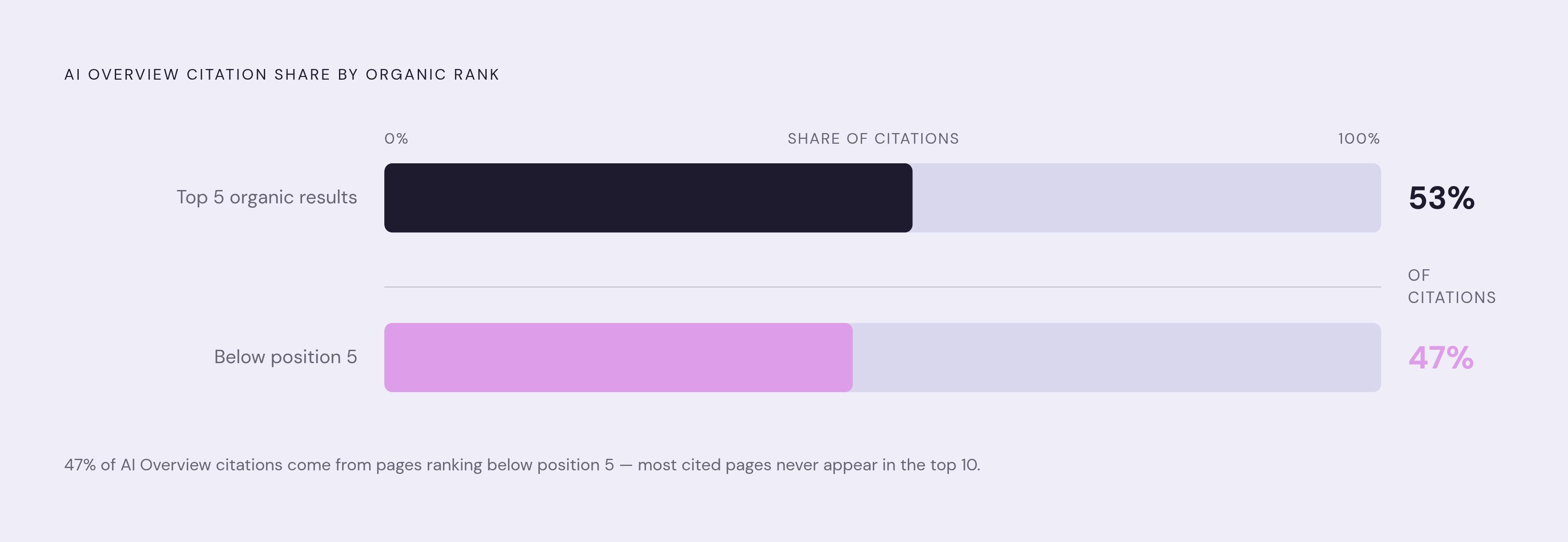
A page holding position one on Google can still get skipped entirely by AI Overviews, while a page buried below position five earns a prominent citation. Wellows' 2026 ranking factor analysis found that 47% of all AI Overview citations come from pages ranking below position five, which undercuts the long-held assumption that organic rank predicts AI inclusion. A large-scale study found the same pattern from a different angle: most pages cited inside AI Overviews don't even appear in the top ten organic results.
That gap has a direct consequence for anyone building a content strategy around traditional ranking alone. A brand can execute flawless technical SEO, hold strong positions across its core keywords, and remain structurally invisible inside AI Overviews. This isn't a minor discrepancy to note in a footnote. AI Overviews now reach a scale that makes this gap consequential rather than marginal, and Green Flag Digital's May 2026 analysis reports that Sundar Pichai confirmed at Google I/O in May 2026 that AI Overviews had crossed a major user milestone; being cited inside an AI Overview earns meaningfully more organic and paid clicks than not being cited, making citation a performance lever rather than just a visibility metric. Citation has become its own discipline, governed by its own signals, and treating it as a byproduct of good SEO is a strategic error with a growing cost attached to it.
How Gemini selects content: the passage-extraction mechanic
Gemini does not choose a winning page and cite it wholesale. It extracts passages. The actual unit competing for citation is a self-contained block of text, not a document. The mechanism behind this is called query fan-out: Gemini breaks a single search into multiple sub-queries, each one retrieved and ranked independently, and the final synthesized answer draws passages from across that whole set of results. A user's question about, say, the best time to refinance a mortgage might fan out into sub-queries on current rates, break-even timelines, and credit score thresholds, each pulling from a different source.
That mechanic reshapes what "competitive" content looks like. A sprawling 3,000-word article without clearly delineated answer boundaries loses out to a shorter passage that nails one sub-question directly. One analysis calls these smaller wins "micro-wins": a page doesn't need to rank first for the primary query if its individual passages each answer one piece of the fanned-out puzzle well enough to get pulled in. Length matters here in a specific way. Wellows' research points to an optimal word-count range for extracted passages, one that favors concision and self-containment over both terse snippets and sprawling paragraphs.
The diagnostic that follows from this mechanic is straightforward enough to apply immediately: can a passage stand on its own, answering a specific question with no surrounding context required? Khorev's guide calls this the island test, and it applies at the level of the section opener and even the individual paragraph. One analysis describes this as creating "micro-wins": individual passages that each serve one cascading sub-query can collectively earn citation even when the page doesn't rank first for the primary query. Content built this way answers the question immediately, defines its terms inline, and only then elaborates.
None of this happens in isolation from Google's older infrastructure. Gemini's passage selection draws on the Knowledge Graph, the Shopping Graph, and Google's core ranking systems, all feeding into the same synthesis process. The guide states that AI Overviews still rely on Google's fresh and helpful content systems, review signals, and PageRank, layered underneath Gemini's language model. Traditional SEO signals haven't gone away: they function as the floor Gemini stands on, and the criteria that decide who gets cited apply once that floor is in place. That distinction sets up the next layer of the problem: before a passage can compete on structure or completeness, the entity behind it has to exist in a form Gemini can verify.
Entity recognition and Knowledge Graph presence as the prerequisite layer
Before Gemini ever evaluates a passage for extraction, it evaluates whether the source behind that passage is a coherent, verifiable entity. Knowledge Graph inclusion works as a trust prerequisite, and Gemini is structurally more inclined to cite brands it can confirm as real, stable entities, with no content optimization strong enough to substitute for that absence. Digivate frames this clearly: the Knowledge Graph supplies Gemini with verified entity relationships and attributes that anchor its recommendations in confirmed data, which gives entity recognition a structural weight that content signals on their own cannot replicate.
Entity strength accumulates the way credibility usually does, slowly and from multiple directions. Consistent business details across directories, brand mentions scattered across third-party sites, forum threads, reviews, and coverage in industry publications tell Gemini that this entity is stable and trustworthy. CI Web Group's June 2026 guide breaks the specific signals down further: a consistent name, address, and phone number across the web, Organization and LocalBusiness schema, citations from authoritative sources such as news outlets and industry associations, and co-citations alongside related entities.
For local and small-to-medium businesses, the Google Business Profile is the surface that matters most for entity signal. CI Web Group notes that for local queries, Gemini pulls directly from GBP data, business information, category tags, photos, reviews containing keyword-relevant language, and Q&A responses, making GBP optimization the single most important local Gemini factor available to a business. The Knowledge Graph and GBP aren't running on separate tracks here. A fully built-out profile with consistent name, address, and phone data and structured markup feeds directly into the entity recognition that anchors Knowledge Graph presence.
For them, entity strength comes from analyst coverage, press mentions, industry association citations, and the kind of third-party validation that accumulates through sustained public relations work rather than through a Google Business Profile listing. The mechanism is the same even when the surface changes: Gemini needs external confirmation that an entity exists and holds a stable identity before it will treat that entity's content as citation-worthy.
Skipping this layer carries a specific risk that content teams underestimate constantly. A brand can publish content that passes every semantic completeness test, structured perfectly, answering every sub-query cleanly, and still lose the citation to a weaker page from an entity Gemini already trusts. Entity signals establish that a brand exists and can be relied upon. E-E-A-T signals establish something narrower and more specific: that a given piece of content is authoritative on the topic it covers. Both layers are required, and neither substitutes for the other.
E-E-A-T signals and third-party citation depth as the authority filter
E-E-A-T doesn't function as a soft quality signal that nudges a page up a few positions. It works as a hard filter deciding whether Gemini will consider a source at all. Wellows' analysis found that 96% of AI Overview citations come from sources carrying strong E-E-A-T signals, and that entity density and author credibility get evaluated together rather than as separate scoring inputs. That figure leaves very little room for content that skips this layer, regardless of how well it's written.
Author credentials matter here in a way that goes beyond a byline. Institutional affiliations, peer-review indicators, and named expertise all feed into E-E-A-T scoring, alongside the domain's broader authority rather than in place of it. Inline author bios with verifiable credentials, named subject-matter experts, and links out to authoritative external sources have shifted from stylistic flourishes to structural requirements that content either has or lacks.
Third-party citation depth extends this same authority question outward, past the page itself. It measures how much authoritative external sources reference and validate a brand's claims independently. Digivate treats earning citations in authoritative outlets as one of five core requirements for AI Overview ranking, not a bonus that helps at the margins but a necessary condition for citation to happen at all. Gemini appears to cross-check factual claims in real time against authoritative databases as part of this process, and content that references peer-reviewed research, recent data, and Tier-1 publications clears that verification layer with a meaningfully higher probability of selection.
That verification behavior carries a strategic implication that reframes how marketing teams should allocate their effort. Digital PR, analyst relations, and coordinated outreach to industry publications now function as GEO and AEO tactics in their own right, alongside content optimization. These activities build exactly the kind of third-party citation depth that Gemini's verification process rewards, and a content team working in isolation from a PR or communications function is leaving a structural signal unaddressed.
Domain Authority as traditionally measured has weakened as a proxy for AI Overview citation likelihood, since Gemini evaluates topical authority and trust signals rather than link volume alone. Wellows reports that the correlation between Domain Authority and AI Overview citation has dropped sharply, a signal that topical depth and E-E-A-T now outperform broad link accumulation for this specific goal. None of this makes traditional link building worthless. It does mean that a link profile built purely for volume, without corresponding topical depth or verifiable authorship, buys less in the AI Overview environment than it once did in classic organic ranking.
Semantic completeness and content architecture: how to structure content that passes the extraction test
Semantic completeness, the capacity of a single passage to fully answer a query without requiring the reader or the model to look elsewhere, carries the strongest individual correlation to AI Overview citation of any content signal measured. Wellows ranks it first among seven core AI Overview ranking signals, ahead of every other factor tested. That ranking gives content teams a clear priority order when time and resources are limited: structure the passage before worrying about anything else.
In practice, semantic completeness translates into a handful of concrete architectural choices. Each section opens with a direct answer before any elaboration follows, and each passage reads coherently in isolation, without losing meaning when separated from its surrounding paragraphs. Technical terms get defined inline, in the same sentence or the one immediately following, rather than deferred to a glossary the extraction process will never reach. A paragraph explaining amortization, for instance, defines the term where it first appears rather than assuming the reader already knows it or sending them to a linked resource.
Passage-level completeness solves half the problem. The other half is topical, and it operates at the level of the site rather than the single article. Building interlinked clusters of content that cover a topic from multiple angles signals to Gemini that a source holds authority across an entire subject area, not just for the one query a single article happens to target. A financial services site publishing one strong article on refinancing rates competes on a narrower footing than one that also covers break-even calculations, credit score thresholds, and closing cost variations, all cross-linked into a coherent cluster.
That cluster-level thinking also needs to stretch across content formats as well as topics. FAQ sections, standalone definition pages, comparison content, and forum-style or community discussion formats all show up among the content types AI engines draw from. Gap analysis has to account for these formats alongside the traditional article and blog post. A content team auditing its coverage of a topic by counting blog posts alone is measuring the wrong inventory.
Schema markup provides the machine-readable layer that translates well-organized content into a form Gemini's extraction process can read. FAQ, HowTo, and Article JSON-LD schema stand out as the priority markup types for AI Overview citation in Digivate's practical framework. ImageObject and VideoObject schema become essential once multimodal content enters the picture, since Gemini has to classify non-text content with the same confidence it applies to text. Schema doesn't function as a shortcut around weak content. It amplifies a passage that already satisfies the completeness test, and it does nothing for a passage that doesn't.
Multimodal content as the signal with the highest observed citation lift
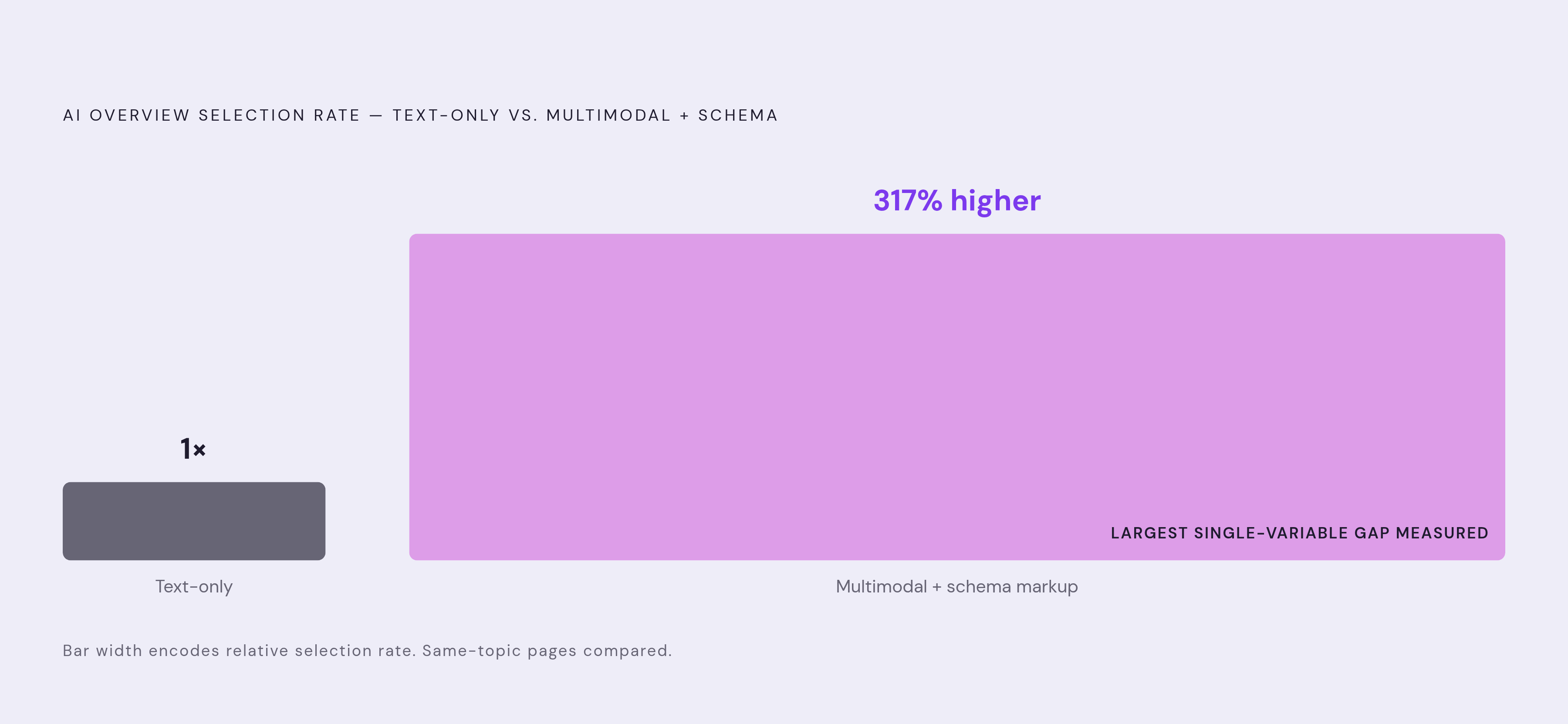
Among every signal measured across the current research, multimodal integration shows the largest observed gap between winning and losing pages. Pages combining text, images, video, and structured schema markup achieve selection rates dramatically higher than text-only equivalents, and for most content teams, adding this layer is the single highest-leverage upgrade available right now. One analysis puts a number on that gap: pages with full multimodal integration plus schema markup show a 317% higher selection rate compared to text-only pages covering the same ground. Few other single changes in this framework move the needle by that margin.
Wellows' research frames multimodal integration as the highest-correlation new factor to emerge in 2025, and the framing carries a warning alongside the opportunity. Text-only content now faces a structural disadvantage that is unlikely to shrink on its own. E-E-A-T functions as a mandatory filter rather than a ranking boost: the sources Gemini cites skew overwhelmingly toward content from verified authoritative sources, so weak E-E-A-T signals are effectively disqualifying.
Query fan-out produces that gap: it splits a query into sub-queries, and pages answering more of them across formats are more likely to be extracted. Gemini's multimodal architecture processes images, video transcripts, and PDFs alongside written text, so a page offering information across multiple formats answers a larger share of the sub-queries generated during fan-out. That broader coverage raises the probability that at least one passage from the page gets extracted into the final answer. A comparison guide that pairs written specifications with an embedded video walkthrough and a labeled diagram covers ground that a text-only competitor simply cannot match, no matter how well that competitor's prose is written.
Text remains the foundation, and none of the structural and authority signals covered earlier stop mattering once video and imagery enter the mix. Multimodal content sits on top of semantic completeness and entity strength, rather than replacing either one. A page that adds video and schema without first solving for passage-level completeness is layering a high-impact signal onto a weak foundation, and the lift that signal promises depends on that foundation holding.
Sources
- How to Rank in Google Gemini — Complete SEO Guide for 2026 | CI Web Group
- Google AI Overview: New Ranking Signals That Matter in 2026
- How to Rank in Google AI Overviews in 2026: What Gemini Really Looks For | Digivate
- Google AI Overviews vs. AI Mode vs. Gemini: The Differences That Actually Matter for Your Visibility - Green Flag Digital
- Google AI Overviews Ranking Factors: 2026 Guide to Winning Citations


