Internal Linking Structures That Reinforce AI Entity Signals
Internal links now signal topical authority to AI systems, not just crawler crawlability.

Internal linking used to be a plumbing decision: get the crawler to every page, spread some PageRank around, move on. That job hasn't disappeared, but it's no longer the main one, and treating it as the main one is the mistake most sites are still making. Internal links now function as one of the only on-page signals that tells an AI retrieval system what a brand actually owns, topically, and whether that brand can be trusted enough to cite in an answer. Anyone still building internal links purely as a crawler discovery mechanism is optimizing for a bottleneck that closed years ago. The real bottleneck is entity clarity: can a system reading a fragment of a page tell, without guessing, what that fragment is about and how it connects to everything else on the site.
The old model assumed a document got evaluated whole, with internal links existing mainly to help Google find it and rank it. That framing isn't wrong, exactly, it's just built for a search engine that no longer exists in its old form. Generative search engines decide, passage by passage, what to lift out, summarize, and hand back to a user as a cited answer. Internal link structure is one of the clearest signals available for making that decision correctly, and most site architectures were never built with that decision in mind.
Where links land in how AI retrieval systems read a page
By 2026, AI Overviews, ChatGPT, Perplexity, and Gemini had all moved past whole-document reading. They work at the section level, pulling self-contained passages from a page and stitching them together with passages pulled from other sources to build one answer. A page doesn't earn a citation as a complete document anymore. It earns citations one passage at a time, based only on the strength of that individual passage.
That mechanical shift changes what a link is for. A query gets broken into several sub-questions first, sometimes called query fan-out, and each sub-question hits an index of passages, not pages. Those passages get scored on how clearly they name their entities, how dense they are with verifiable facts, how fresh they read, and how authoritative the source appears. Passages vague about which entity they're describing get filtered out before they ever reach the model. Only a small number survive to the final step, where they show up as citations, and those are the ones that get the click.
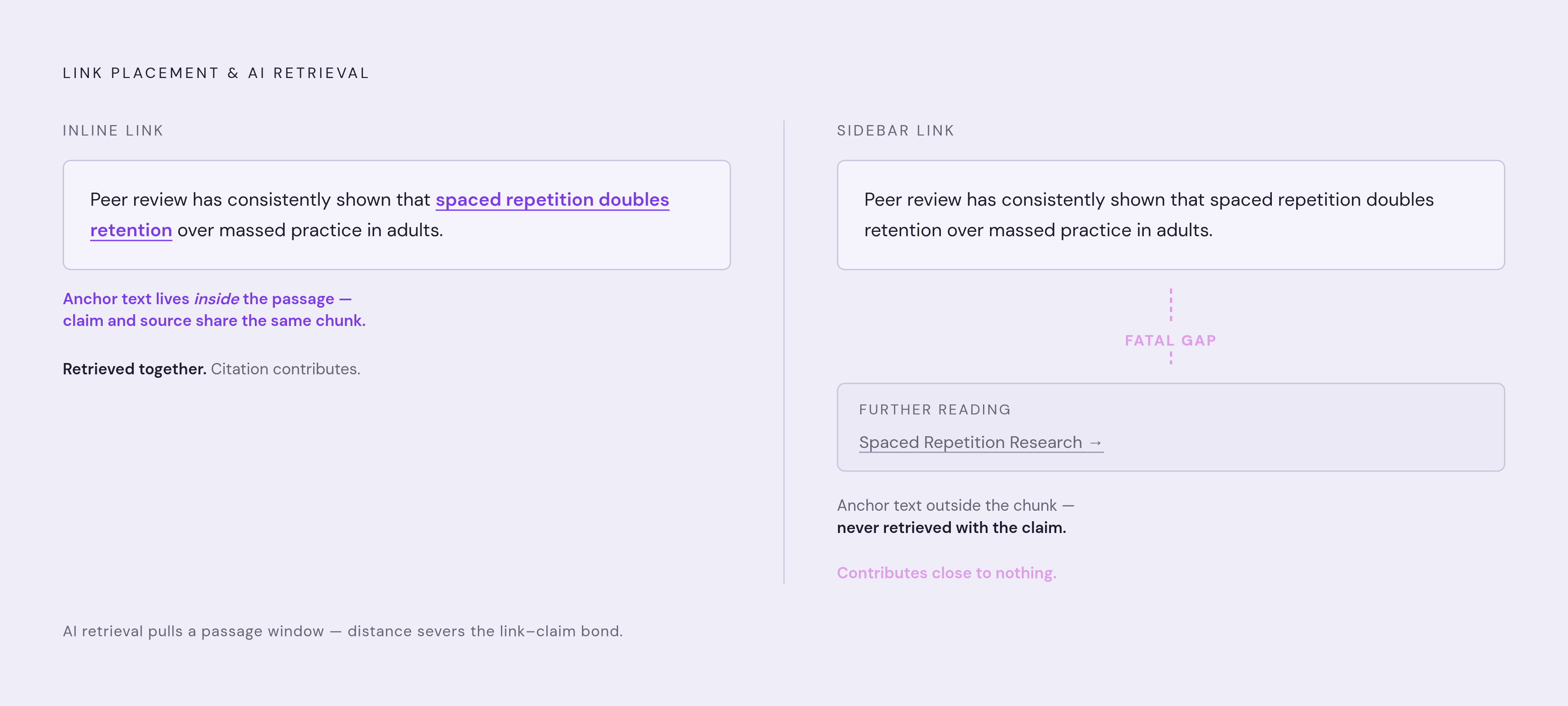
Where a link sits inside that flow decides what it's worth. A link buried in a sidebar, footer, or "Further Reading" box sits outside the prose that actually gets pulled as a passage. Its anchor text never enters the text the model reads, so it contributes close to nothing toward earning the linked page a citation. A link placed inside a sentence, by contrast, has its anchor text read as part of that passage, telling the retrieval engine something concrete about what the linked page covers. Links belong next to the claim they support, in the same passage, not off to the side in a "related content" module. Separate the two and the model retrieves the claim without ever seeing the proof behind it, which is exactly the kind of ungrounded statement these systems are built to avoid citing.
The pillar-cluster structure as the primary framework for communicating topical ownership
A pillar page targets a broad topic and links out to a set of cluster pages, each covering a specific subtopic underneath it. Each cluster page links back to the pillar in turn, so the relationship runs in both directions by design, not by accident. Sites that skip the reverse link and treat clustering as a one-way export of authority are building half the structure and wondering why the pillar never gets cited.
Done right, this is the closest thing a brand can build to its own small knowledge graph, sitting inside the site's existing link structure, no separate tooling required. When several pages all link to the same destination using anchor text that's descriptive and keyword-relevant, AI models read that pattern as evidence the destination page is the authoritative source on the subject, based on observed model behavior. The same mechanism behind the Reasonable Surfer patent, covered below, produces this effect, operating at the scale of a whole cluster instead of a single link.
LinkBoss's 2026 nine-practice standard formalizes this as hub-and-spoke mechanics: the hub links to every spoke, and every spoke links back to the hub. The standard treats this as the most efficient way to concentrate authority on one page while still signaling topical coherence to the indexer. Sites applying all nine practices consistently see crawl coverage improve within 30 days, with topical-authority ranking gains following at 60 to 90 days https://linkboss.io/blog/internal-linking-best-practices/. A structured internal linking strategy has separately been shown to lift rankings by as much as 40% and organic traffic by roughly 30% https://www.awilix.ai/blog/uncategorized/internal-linking-strategy-2026/. Those numbers cost nothing in ad spend. They cost editorial discipline, and most teams still treat that as the cheap option they can skip.
Anchor text as entity declaration: what descriptive linking communicates to AI models
Google's patent US 7,716,225, the Reasonable Surfer Model, describes an indexer that reads internal anchor text to assign topical context to the page being linked to, and the mechanism is still in use as of 2026. It's an old patent, but it matters more now, because passage-level retrieval depends even more heavily on knowing what a linked page is actually about.
Generic anchor text, "click here," "read more," "this article," carries almost no topical weight under that model and gives the retrieval system nothing to work with. Descriptive anchors that name the destination page's primary entity and its relevant keyword are documented best practice in Google Search Central's "Write good link text" guidance, a direct instruction about how the anchor gets parsed and weighted. That's not a style preference. It's a direct instruction about how the anchor gets parsed and weighted, and sites that keep defaulting to "learn more" are leaving that weighting on the table for free.
Length cuts both ways here. An anchor stretched across too many words dilutes the signal across competing terms, while one trimmed too short underspecifies what the page covers and leaves the model to guess.
Schema markup and entity anchoring as the structural layer beneath the links
Anchor text alone can't carry all the entity weight a retrieval system needs. Generative AI models lean heavily on JSON-LD schema to anchor what an entity actually is. If that structured layer is skipped, the model has to infer the relationships internal linking implies instead of reading them directly off the page; errors occur in that inference step.
For content pages, BlogPosting or Article schema, carrying mainEntityOfPage and author properties, ties each individual passage back to the entity that produced it.
Leadership pages need particular attention here, and this is where sites get sloppy fastest. Tying executives to the organization through alumniOf or worksFor properties heads off a specific, documented failure mode: a model attributing the wrong founder or the wrong leadership team to a brand. That sounds like a footnote-level structured-data detail until a founder's name gets attributed wrong in an AI answer, and there's no clean way to walk that back once it's baked into a model's training data or retrieval cache. The minimum viable Organization schema implementation is official name, url, logo, and a sameAs array pointing to verified LinkedIn, Crunchbase, and other authoritative external profiles. That array is how the on-site entity connects to the public knowledge graph, and skipping it is the single most common gap in otherwise well-built schema.
Passage placement, content architecture, and the extractability test
Every part of this architecture eventually has to survive one test: extractability. Can the passage stand on its own once it's lifted clean out of the page it came from? AI systems pull the sections that pass that test and leave the rest on the page, uncited.
The research behind this is about as concrete as the field gets right now. Researchers from Princeton, IIT Delhi, Georgia Tech, and the Allen Institute for AI found that adding citations, statistics, and direct quotations to content can lift AI citation visibility by up to 40% across a wide range of queries https://www.frase.io/blog/entity-optimization-for-geo. That's the strongest quantitative case currently available for rewriting how passages get built, and it points in one direction: content that names its sources and states its numbers beats content that leans on vague, confident-sounding assertion, every time.
At the passage level, "entity-rich" means naming, without ambiguity, the entities the user's question is actually about. A shorter passage cleanly grounded in named entities beats a longer, keyword-stuffed page that never quite says what it's about in plain terms. That's a tight constraint to write inside of, and it means saying the important thing first, before any of the scene-setting a blog post might otherwise open with. In the section on passage placement, content architecture, and the extractability test, the research brief's GEO checklist recommends a page-level implementation of 40–60 word answer blocks near the top of each page, short enough to quote, factual enough to cite.
Maintaining the link graph over time: reverse linking, content freshness, and entity drift
Link graphs decay if nobody tends them. As new cluster pages go live, older pillar pages tend to accumulate spokes that never get linked back, so the entity relationship exists in the content itself but stays invisible to the link graph a retrieval system is actually reading.
The fix has a name in the research brief: reverse linking, the ongoing practice of going back into older pillar pages and adding links to the newer spokes. It keeps the hub current and signals to retrieval systems that the pillar page is still actively maintained rather than left to fossilize. It's unglamorous work, closer to gardening than strategy, but it's one of the few maintenance tasks with a directly traceable effect on citation eligibility.
Freshness now directly affects how often a brand gets cited, since AI citation behavior can shift a brand's citation frequency from one moment to the next. Roughly 30% of brands that show up in one AI response show up again in the very next response to the same query. Read that number the right way: it means even a well-linked, freshly maintained page doesn't guarantee a citation, because these systems carry real non-determinism in how they sample and assemble answers. A stale page, or one with an inconsistent link structure, comes close to guaranteed deprioritization over time, though. Non-determinism argues against overconfidence, not against doing the work, and teams that use it as an excuse to skip maintenance are misreading what the number means.
Name consistency compounds the problem in a way most teams don't notice until it's already cost them citations. When a company's name appears with different variations across its own pages and its external profiles, the AI model's entity graph fragments across those variations. It looks like a cosmetic detail right up until it turns out to be the reason a brand's citations split across three half-recognized identities instead of consolidating around one.
Measuring whether the link architecture is improving AI citation share
None of this is worth doing without a way to measure it, and the metric that matters is AI Share of Voice. The formula is plain: count how many times a brand gets mentioned across a set of target queries, divide by the total number of AI responses generated for those queries, multiply by 100. That percentage tells a brand how often it shows up when showing up actually matters, and it's the number that should be driving the linking decisions above, not traffic or rank position.
Traditional rankings don't capture any of this anymore, and the gap between the two isn't a rounding error. A site can hold strong traditional rankings while steadily losing ground in AI citation share, because the two outcomes diverged the moment retrieval systems started favoring passage-level authority over the page-level signals ranking algorithms were built around.
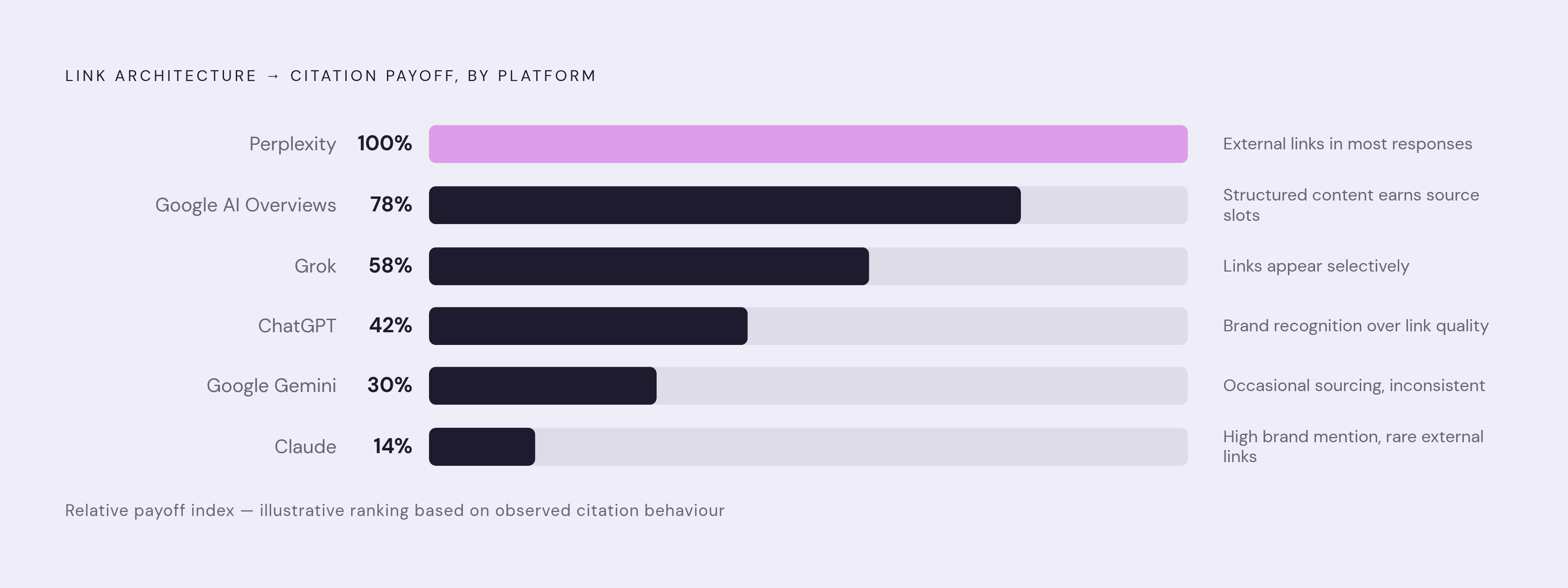
Measuring AI SoV properly means sampling at scale, not running a query once and calling it a result. The same prompt run multiple times returns different responses, so a single result tells a brand almost nothing, and the signal is visible only in frequency across many runs. Track six platforms: ChatGPT, Google Gemini, Perplexity, Claude, Grok, and Google AI Overviews. Each behaves differently enough that skipping any one leaves a real blind spot. Perplexity includes external links in the majority of its responses, which makes it the platform that most directly rewards good link architecture. Claude mentions brands at a high rate but tends not to include external links at all, so link structure does less visible work there even as it still shapes what gets mentioned through other factors. ChatGPT leans toward brands that already carry strong name recognition, a bias that shapes which brands get mentioned before any content quality is considered.
The payoff for getting this right isn't abstract. AI-sourced visitors convert at roughly 4.4 times the rate of traditional organic traffic https://www.frase.io/blog/entity-optimization-for-geo. The citations this whole architecture exists to earn aren't a visibility exercise for its own sake, they arrive already primed to act, and that's the actual return on the work of building the link graph in the first place.