LLM Training Data Cutoffs Versus Live Retrieval and What Each Means for Brand Content
Brands need separate strategies for each LLM pipeline to stay accurately represented.

Ask ChatGPT about a brand's latest product launch: the answer that comes back can describe the version that existed a year ago, down to a discontinued pricing tier. That failure gets labeled "the AI doesn't know about it yet," as if the fix were one thing, but it isn't. Training cutoffs and live retrieval are two separate pipelines inside the same product, and each rewards a different kind of content work. A brand that solves for one while ignoring the other stays half-exposed no matter how much it publishes.
Training cutoffs and live retrieval are two distinct mechanisms
A training cutoff is the date after which a model's training data includes nothing new. Anything published after that date does not exist for the base model, unless the platform wraps it in a retrieval layer or the provider ships an updated model. A training cutoff is a hard stop baked into the model's weights during a training run that takes months and costs enormously to repeat, rather than a rolling window that drifts forward as time passes. No clever prompt gets around it, no fine-tune erases it, and no larger model size pushes the date forward. The only way past a training cutoff is to bolt something else onto the model: retrieval-augmented generation, tool use, or native browsing.
Live retrieval is that something else. It is a layer, separate from the base model, that pulls current documents into the prompt at the moment a user asks a question, handing the model temporary context it never learned during training. The distinction matters because retrieved knowledge behaves nothing like trained knowledge. What a model learns during training becomes part of its weights, stable and consistent across sessions. What a model retrieves at query time is context, present in one answer and gone in the next if the retrieval step fails, times out, or simply pulls a different source the second time around. Two answers to the same question, generated minutes apart, can draw on entirely different knowledge, and both can read with identical confidence and polish.
That difference creates a specific problem for brands trying to figure out how they're represented. The buyer reading it has no way to know whether the answer came from a stable, trained fact or a shaky, one-time retrieval. Understanding the structural difference between the two is essential, because each demands its own content optimization approach. That's a principle that AI search optimization platforms operationalize directly: Athenahq, for instance, tracks brand visibility separately across both retrieval mechanisms, so a content strategy can be built around which pipeline will actually surface a brand's message in a given LLM rather than guessing.
Training data gaps across major models
The distance between the freshest and stalest cutoff running in production today is measured in years, not weeks. That spread means the risk of being described inaccurately by an AI system isn't spread evenly across the landscape. It concentrates in specific platforms, specific API integrations, and specific product surfaces that a brand may not even realize are still live.
As of September 2026, the frontier models sit remarkably close to the present. Any brand whose current web presence is reaching one of these models through retrieval or training is dealing with a system that has a reasonably current picture of the world.
What's still running underneath those headline releases causes the trouble. GPT-4o remains alive inside countless API integrations, and it carries a cutoff of June 2024. A brand that changed its product line, adjusted pricing, or repositioned itself after late 2023 risks being described in fundamentally outdated terms by any product still built on that model, and a striking number of production tools still are, because switching underlying models is a nontrivial engineering decision that many teams delay.
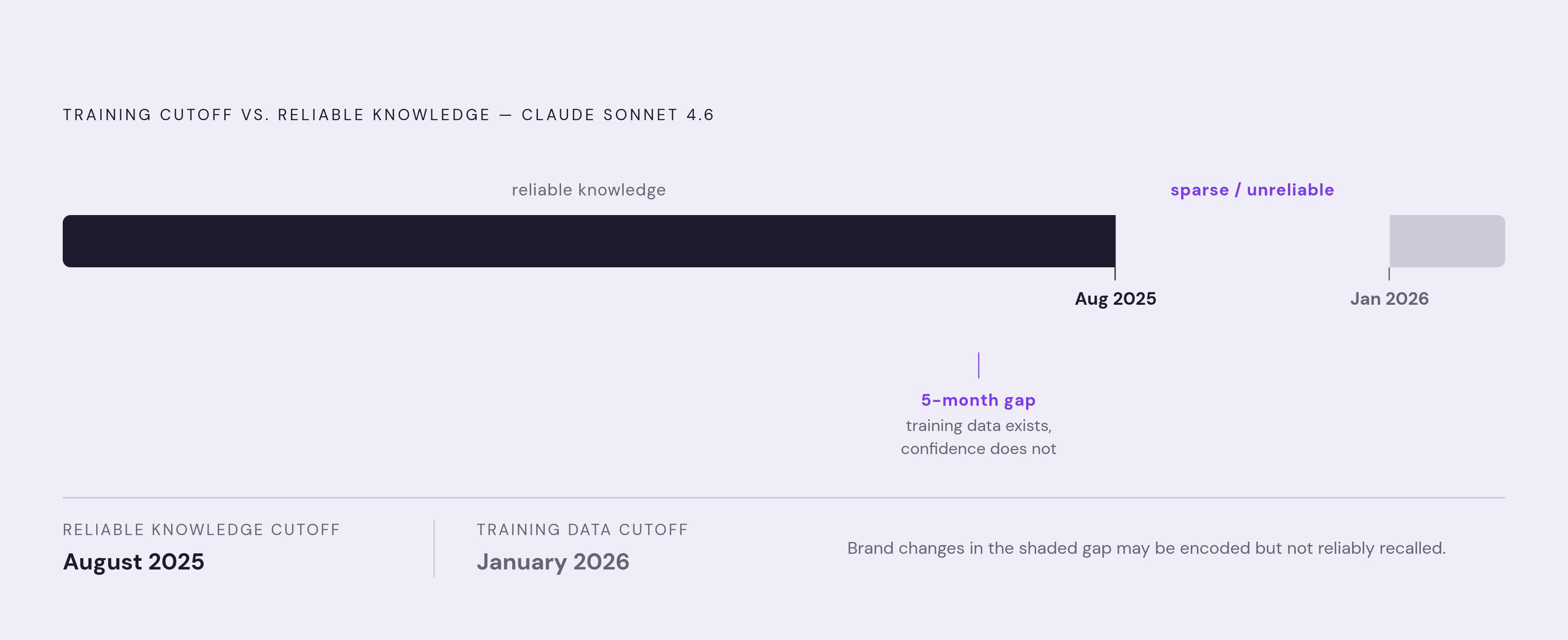
The cutoff date itself can also mislead. Anthropic separates training data cutoff from reliable knowledge cutoff as two distinct fields: Claude Sonnet 4.6 has training data running through January 2026, but Anthropic states reliable knowledge only extends through August 2025. The gap between those two dates is exactly where a brand's most consequential changes can fall, encoded in the training data but too sparsely represented for the model to state with confidence. Google makes a related admission about Gemini 3.7 Flash. And training data collection itself lags behind real-world events: processing takes weeks to months, so a model trained through February 2026 is likely to have thin, patchy coverage of anything that happened between December 2025 and February 2026, right before its own cutoff.
Open-weight models introduce a different kind of exposure. For any brand embedded in a product running a local or fine-tuned version of that model, there's no retrieval layer standing between the user and the base model's knowledge. Whatever the model learned during training is the only answer that product will ever give.
A single AI-facing content strategy, applied uniformly, misreads the situation. The same question, asked on two different platforms, can draw from a May 2026 knowledge base on one and something closer to a 2023 knowledge base on the other. Brands that launched products, changed pricing, or repositioned after October 2023 carry real misrepresentation risk on any surface still running GPT-4o, and that risk is only visible in a dashboard built to look for it platform by platform. That fragmentation is precisely why cross-platform tracking has become a necessary function rather than a nice-to-have. Monitoring how a brand appears across eight or more major LLMs simultaneously, the way Athenahq does, reveals which specific platforms are serving stale information and where the gap between cutoff dates is creating a misrepresentation problem that a single spot-check would miss.
How retrieval works across platforms
Retrieval behavior is not a single standardized feature that works the same way everywhere it exists. It varies sharply by platform, and that variation means a brand cannot assume that updated web content is actually reaching any given model's answer. The retrieval layer is itself a surface that needs attention from a brand, since it does not quietly handle freshness on its own.
Gemini models have native Google Search integration available, but it's opt-in rather than continuously active. Four platforms, four different defaults, and a brand's visibility depends on knowing which default applies where its audience is actually asking questions.
There's real evidence that retrieval closes the cutoff gap when it fires correctly. In one documented case, both Gemini and another leading model correctly described a January 2026 semiconductor breakthrough despite the fact that both models' training cutoffs preceded that event. That result shows retrieval working exactly as designed: current information crossing the bridge from the live internet into an answer the base model couldn't have produced on its own.
But working in principle is not the same as reliably representing a given brand. Even when retrieval fires, the outcome depends entirely on what gets found and how the model weighs it. A model might retrieve one recent article, one product page, and one third-party mention, and if any of those three sources is incomplete, outdated, or simply inconsistent with the others, the resulting answer can sound just as polished while still getting the brand's story wrong. Retrieval is the bridge between frozen training data and the live internet, but what actually crosses that bridge depends on which pages are crawlable, which ones carry enough authority to be trusted, and which ones are structured clearly enough for the model to pull the right fact from the right place.
There's also a basic, avoidable error that compounds the problem: blocking the wrong bots. Blocking crawlers like GPTBot or ClaudeBot, which feed training pipelines, does nothing to remove a brand from today's AI answers. Many brands have this backward, assuming that blocking a training crawler protects them from an outdated representation when it does the opposite: it leaves today's answer untouched while cutting the brand off from correcting tomorrow's. For nuanced opinions, contextual judgment, and synthesized answers that blend multiple facts into a single narrative, training data still carries more weight than whatever gets retrieved in the moment. And on platforms where retrieval doesn't fire, or on locally run models with no web access at all, training data is the only path there is. Because retrieval behavior varies so much across platforms, brands need to check not just whether retrieval is switched on, but whether the sources it pulls are accurate, current, and actually making it into the final answer, a question that requires monitoring citation presence and source quality on each platform's retrieval layer separately, which is the approach dedicated AEO platforms have built toward for cross-LLM tracking.
What a brand described from stale training data looks like to a buyer
When training data is the primary source behind an answer and it predates a brand's meaningful changes, the model doesn't go quiet about it. It states a confident description of a version of the brand that no longer exists, and the buyer reading that answer has no signal telling them it's wrong.
Several failure patterns recur. Outdated product descriptions present discontinued tiers, retired features, or missing capabilities as though they're current, and a buyer shortlisting vendors on the strength of an AI-generated summary may eliminate a brand it would otherwise have chosen. And missed launches are simply invisible in any context without retrieval. A product or capability that emerged after the cutoff doesn't get described poorly, it doesn't get described at all, making a genuinely capable brand look smaller than it is.
Hallucination makes all of this worse. When the training signal for a specific fact is thin, which happens most often for events close to or after a model's cutoff, the model doesn't default to admitting it doesn't know. It produces a fabrication that sounds exactly as confident as a well-supported fact, and nothing in the output marks the difference.
The legal and commercial stakes here are already established, not hypothetical. A customer used Air Canada's AI chatbot and received incorrect information about bereavement fares, specifically that a retroactive refund could be claimed. Air Canada paid compensation. On the commercial side, a global fashion retailer suffered AI-hallucinated product descriptions drawn from outdated supplier data, and after three months of targeted correction, detected hallucinations dropped by a large margin, while product returns linked to the incorrect descriptions fell significantly. Both cases point to the same underlying mechanism: neither training data nor retrieval produced an accurate answer, and the gap between what the model said and what was true turned into a measurable cost, legal in one case and operational in the other.
Building durable brand memory before the next training cutoff closes
Content that's meant to end up correctly encoded in a model's weights has to be built for longevity, authority, and broad citation well before the relevant cutoff date arrives. Updating reactively afterward does nothing, because once the training window for a given model closes, no amount of fresh publishing changes what that model already knows. This is a different discipline from retrieval optimization, and it runs on a different clock.
Training data functions as an archive, fixed at the moment of the training run. What ends up encoded in a model's weights is whatever existed, was findable, and was cited by authoritative sources in the months and years leading up to the training run, not whatever a brand published last week. Coverage in trusted publications, review sites, and industry hubs raises the odds that a brand's information makes it into future training data, because third-party validation carries more weight in a training pipeline's assessment of authority than a brand's own pages do. A brand that shows up across many credible, independent contexts in the run-up to a cutoff is simply more likely to be described accurately, and favorably, when a model has to synthesize an answer from training data alone, with no retrieval available to correct the record.
Certain structural choices make content easier for both training and retrieval pipelines to use correctly. Pages with clear timestamps and definitive summary sections help a training pipeline distinguish what's current from what's been superseded. Tables, FAQs, and comparison matrices extract cleanly for both retrieval and training, and that kind of citation-worthy structure raises the probability that a brand gets represented accurately rather than paraphrased into something close but wrong. Placement on the page matters too: a large share of LLM citations draw from the first section of a page's content, so the facts that matter most about a brand, current pricing, current product names, current positioning, shouldn't sit buried three sections down where a crawler or a reader might never reach them.
The distinction Anthropic draws between training data cutoff and reliable knowledge cutoff carries a direct planning implication. It simply hasn't had time to accumulate the citations and cross-references that build a model's confidence in a given fact. The practical conclusion follows directly: brand-defining content needs to be treated as a long-term compounding asset rather than a last-minute correction filed right before a known cutoff. The earlier it's published and the more it gets cited by independent sources, the more stably a future model will represent it.
Blocking training bots like GPTBot or ClaudeBot removes a brand from the next generation of training data, and most brands have no legal or proprietary reason to do this. The brands most damaged by stale cutoffs are frequently the same ones that blocked training crawlers at some point, often for unrelated reasons, and are now left wondering why the newest model on the market still doesn't know who they are.


